


For most finance teams at small to mid-size companies, Zenith-books is the strongest starting point: it automates invoice capture from email, matches transactions, syncs bank data live to Google Sheets, and can run a working pilot in days rather than months. If you need enterprise-grade dispute orchestration, HighRadius or Billtrust belong on your shortlist. For lightweight invoicing without a dedicated AR layer, QuickBooks Online or Zoho Books cover the basics.
- Zenith-books — best for fast pilots, Google Sheets/Drive workflows, and teams that want zero manual data entry from day one
- Enterprise AR platforms (HighRadius, Billtrust, BlackLine) — best for large organizations with complex ERP integrations and high dispute volumes
- SMB billing platforms (QuickBooks Online, FreshBooks, Zoho Books) — best for small businesses that need invoicing and basic aging reports without a full AR suite
A well-run 30–60–90 pilot that tracks DSO movement and invoice auto-match rate is the fastest way to validate ROI before committing to any platform.
Table of Contents
- Best accounts receivable software: side-by-side comparison
- What each solution actually does in practice
- How to choose accounts receivable software: a buyer’s checklist
- Key Takeaways
- Zenith-books cuts your AR setup time from months to days
Best accounts receivable software: side-by-side comparison
The table below maps each solution category and named vendor to the dimensions that matter most during procurement. Vendor-specific cells reflect public product claims; category-level cells reflect typical market positioning.
| Solution | Best for | Core features | Integrations | Pricing shape | Implementation | Security |
|---|---|---|---|---|---|---|
| Zenith-books | SMB/mid-market; fast pilots; Google Workspace users | Invoice OCR, email/bank sync, transaction matching, Google Drive/Sheets sync, QR payment generation | Gmail, Google Drive/Sheets, bank feeds, eSlog export | Free tier + pay-as-you-go; tiered monthly/annual plans | Days to weeks | SOC 2-aligned; encrypted data |
| HighRadius | Large enterprise; high invoice volume; ERP-heavy | AI cash application, dispute management, credit risk scoring, collections orchestration | SAP, Oracle, Workday, major ERPs | Custom enterprise pricing | Weeks to months | SOC 2 Type II |
| Billtrust | Mid-market to enterprise; B2B payments focus | Invoice delivery, payment portal, cash application, credit management | NetSuite, SAP, QuickBooks, Salesforce | Custom pricing; demo required | 4–12 weeks | SOC 2 Type II |
| Quadient AR (YayPay) | Mid-market; collections automation | Predictive collections, AR aging, payment portal, workflow automation | NetSuite, QuickBooks, Xero, Sage | Subscription; pricing on request | 2–6 weeks | SOC 2 |
| VersaPay | B2B AR; collaborative collections | Customer self-service portal, dispute management, cash application | NetSuite, SAP | Custom pricing | 4–8 weeks | SOC 2 Type II |
| BlackLine | Enterprise close automation | AR reconciliation, journal entry automation, intercompany | SAP, Oracle, Workday | Enterprise licensing | Months | SOC 2 Type II |
| Tesorio | Mid-market; cash flow forecasting | Collections automation, cash forecasting, AR analytics | NetSuite, Salesforce, QuickBooks | Subscription; pricing on request | 2–6 weeks | SOC 2 |
| Growfin | Mid-market; collaborative AR | Collections workflows, dispute tracking, AR analytics | NetSuite, QuickBooks, Salesforce, HubSpot | Subscription; pricing on request | 2–4 weeks | SOC 2 |
| Invoiced | SMB to mid-market | Billing automation, payment portal, collections, AR analytics | QuickBooks, NetSuite, Xero, Stripe | From a custom pricing quote | 1–4 weeks | SOC 2 |
| Gaviti | SMB to mid-market; collections focus | Collections automation, dunning, AR aging, payment portal | QuickBooks, NetSuite, Xero, SAP | Subscription; pricing on request | 1–3 weeks | SOC 2 |
| Upflow | SMB to mid-market | Collections automation, AR analytics, payment portal | QuickBooks, Xero, Stripe, HubSpot | From a custom pricing quote | 1–2 weeks | SOC 2 |
| Centime | SMB; cash flow + AR/AP | AR automation, AP automation, cash forecasting, banking | QuickBooks, NetSuite | Subscription tiers | 1–3 weeks | SOC 2 |
| Corcentric | Enterprise; order-to-cash | Invoice management, collections, dispute resolution, payments | SAP, Oracle, Dynamics | Custom enterprise pricing | Months | SOC 2 Type II |
| Fazeshift | Mid-market; AI-native AR | AI collections, dispute management, cash application | NetSuite, QuickBooks, Salesforce | Subscription; pricing on request | 2–4 weeks | SOC 2 |
| Hiver | SMB; email-based AR follow-up | Shared inbox, email automation, AR follow-up workflows | Gmail, Slack, Zapier | — | Days | — |
| ChaserHQ | SMB; automated chasing | Invoice chasing automation, payment portal, AR analytics | QuickBooks, Xero, Sage | — | Days to 1 week | SOC 2 |
| Payt Software | SMB to mid-market; EU-focused | Automated dunning, payment portal, AR analytics | Exact, AFAS, SAP, QuickBooks | Subscription; pricing on request | 1–2 weeks | SOC 2 Type II |
| Onguard | Mid-market to enterprise | Credit management, collections, dispute management | SAP, Oracle, Dynamics | Custom pricing | 4–8 weeks | SOC 2 Type II |
| Notify.nl | SMB; automated reminders | Invoice reminders, payment portal, AR analytics | QuickBooks, Xero, Exact | Subscription; pricing on request | Days | — |
| Debitan | SMB; automated collections | Dunning automation, payment portal | QuickBooks, Xero | Subscription; pricing on request | Days to 1 week | — |
| Graviti | SMB; payment-first invoicing | Invoicing, payment acceptance, basic AR | QuickBooks, Stripe | Subscription; pricing on request | Days | — |
| Credit-IQ | SMB; credit risk | Credit scoring, AR aging, collections | QuickBooks, Xero | Subscription; pricing on request | Days to 1 week | — |
| Growfin | Mid-market | Collections, dispute tracking, analytics | NetSuite, Salesforce, QuickBooks | Subscription | 2–4 weeks | SOC 2 |
| TreviPay | Enterprise; B2B trade credit | Trade credit, invoicing, collections, payment terms management | ERP integrations; custom | Custom enterprise pricing | Months | SOC 2 |
| Capital One Trade Credit | Enterprise; trade credit programs | Trade credit lines, invoicing, payment terms | Custom | Custom | Months | Bank-grade |
| BILL | SMB to mid-market | AP/AR automation, payment processing, invoice management | QuickBooks, Xero, NetSuite, Sage | — | Days to 1 week | SOC 2 Type II |
| QuickBooks Online | Small business | Invoicing, payment acceptance, AR aging, reminders | Multiple app integrations | From ~$30/month | Hours to days | SOC 2 |
| Zoho Books | Small business; Zoho ecosystem | Invoicing, payment portals, AR aging, reminders | Zoho suite, Stripe, PayPal | — | Hours to days | SOC 2 |
| FreshBooks | Freelancers; small service businesses | Invoicing, time tracking, payment acceptance, basic AR | Stripe, PayPal, Gusto, Zapier | — | Hours | — |
| NetSuite (Oracle NetSuite) | Mid-market to enterprise | Full ERP with AR module: billing, collections, cash application, reconciliation | Native ERP integration; extensive connectors | Custom licensing | Months | SOC 2 Type II |
| Bill.com | SMB to mid-market | AP/AR, payment processing, invoice management | QuickBooks, Xero, NetSuite, Sage | — | Days | SOC 2 Type II |
A note on pricing: figures marked “pricing on request” reflect vendors that do not publish list prices. Entry-level figures for SMB platforms are approximate and subject to plan changes; verify current pricing directly with each vendor before shortlisting.
What each solution actually does in practice
Zenith-books
Zenith-books automates the full intake-to-reconciliation loop: it pulls invoices from email using OCR, categorizes and names them, files them to Google Drive, matches transactions against bank feeds, and syncs live cash data to Google Sheets. QR payment codes can be embedded directly in outgoing invoices to accelerate settlement. The result is zero manual data entry across the invoice lifecycle, which is the friction point most small finance teams hit first.
- Key features: AI invoice extraction from email, bank-to-Sheets live sync, transaction matching and reconciliation, QR payment generation, eSlog accounting export
- Best for: Finance teams at small to mid-size companies that run on Google Workspace and want a pilot running in days
- Trial/pricing: Free tier available; tiered monthly and annual plans with pay-as-you-go options based on invoice volume and bank accounts
- Implementation: Days to two weeks for a full pilot
Pro Tip: Before your Zenith-books pilot, audit how many invoices arrive by email each month. That single number determines which plan tier fits and gives you a clean baseline for measuring auto-match rate improvement.
Enterprise AR platforms

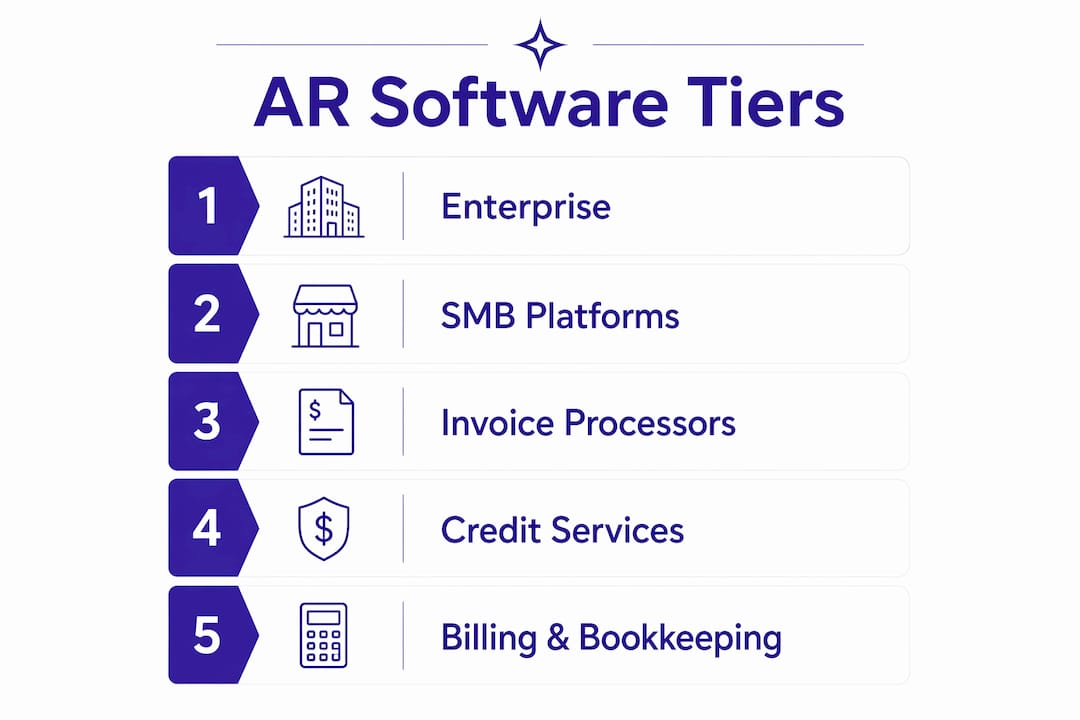
HighRadius, Billtrust, BlackLine, Corcentric, and VersaPay sit in this tier. They are built for organizations processing thousands of invoices monthly with complex dispute workflows, multi-entity reconciliation, and deep ERP dependencies. HighRadius leads on AI cash application and credit risk scoring. Billtrust is strongest for B2B payment delivery and portal-based collections. BlackLine focuses on the financial close side: AR reconciliation, journal automation, and intercompany. VersaPay differentiates with a collaborative customer portal that lets buyers dispute and pay in one place.
Implementation for this tier typically spans multiple weeks to months for mid-market and large enterprise deployments. All major vendors in this category carry SOC 2 Type II certification. Pricing is custom and requires a vendor demo.
SMB billing and bookkeeping platforms
QuickBooks Online covers the core AR tasks most small businesses need: invoicing, online payment acceptance, AR aging reports, and automated reminders. Zoho Books adds a tighter ecosystem play if you already use Zoho CRM or Zoho Inventory. FreshBooks is the lightest option, built for freelancers and service businesses that bill by the hour. BILL (formerly Bill.com) adds AP alongside AR and is a natural fit for teams that want one platform for both payables and receivables.

None of these platforms offer AI-driven reconciliation or advanced dispute management. Growing firms that hit collection friction or need cash forecasting typically move to a dedicated AR layer on top of, or instead of, their accounting platform.
Payment-focused invoice processors
Graviti, Credit-IQ, and Debitan sit in this tier alongside the payment modules inside BILL and QuickBooks. The defining feature is native payment acceptance: cards, ACH, and digital wallets embedded in the invoice itself. Payment method variety materially affects how fast customers pay, which is why this dimension belongs in every vendor evaluation. Platforms in this category tend to have lighter collections and reconciliation features; they are best paired with a dedicated AR tool when dispute volume is high.
Credit and trade-credit services
TreviPay and Capital One Trade Credit operate differently from pure AR software. They extend trade credit lines to buyers, manage payment terms, and handle collections on behalf of the seller. The seller gets faster cash; the buyer gets flexible terms. This model suits B2B companies with large, repeat customers who want to offer net-30/60 terms without carrying the receivables risk themselves. Implementation is measured in months and requires credit underwriting.
Centime takes a lighter approach: it combines AR and AP automation with cash forecasting and embedded banking, targeting SMBs that want a single dashboard for cash visibility without a full trade-credit program.
How to choose accounts receivable software: a buyer’s checklist
Evaluation criteria, in priority order
- Invoice capture accuracy — What is the vendor’s OCR error rate? Can you test it on your own invoice samples during a pilot?
- Reconciliation depth — Does the platform auto-match at the line level, or only at the invoice total? Ask for the match rate on a sample dataset.
- ERP and accounting integrations — Which specific versions of your ERP does the vendor support? Get a written confirmation, not a logo on a webpage.
- Collections automation — Can you configure dunning sequences by customer segment, invoice age, and amount? Is there a dispute workflow with audit trail?
- Payment acceptance — Which payment methods does the platform support natively (cards, ACH, digital wallets)? What are the settlement timelines?
- Cash forecasting — Does the platform project cash based on invoice due dates and historical payment behavior, or only show current aging?
- Security and compliance — Is the vendor SOC 2 Type II certified? Ask for the report, not just the badge.
- Implementation effort — What does the vendor’s onboarding process look like? Who owns data migration?
- Support SLA — What is the guaranteed response time for critical issues? Is there a named customer success contact?
- Pricing transparency — Can the vendor give you a written quote before a contract? Are there usage-based overages?
Demo questions that surface real differences
- “Show me a reconciliation run on a dataset with 5% duplicate invoices. How does the system flag exceptions?”
- “What happens when a payment partially matches an invoice? Walk me through the exception workflow.”
- “Which version of our ERP do you support, and what is the API rate limit for our expected invoice volume?”
- “Who owns our data if we cancel? What is the export format and timeline?”
- “Can you show me the audit trail for a disputed invoice from creation to resolution?”
The Five Cs of credit (Character, Capacity, Capital, Collateral, Conditions) remain the standard framework for credit policy decisions. Automated scoring can flag risk, but human review is still required for new or high-value customer relationships. Ask vendors how their credit module handles this handoff.
Red flags that should stop a shortlist item
- No SOC 2 certification and no clear timeline to obtain one
- Pricing available only after a multi-week “discovery” process
- Manual reconciliation required as a standard step (not an exception)
- No sandbox or trial environment for testing integrations
- The 10% cross-aging rule is not surfaced in the aging report (a signal that credit risk reporting is shallow)
30/60/90-day pilot plan
Days 1–30: Connect email and bank feeds. Run invoice capture on the last 90 days of historical invoices. Measure: OCR accuracy rate, auto-match rate, and time to first reconciliation.
Days 31–60: Activate collections sequences for one customer segment. Measure: DSO for that segment vs. the prior period, number of manual follow-ups eliminated, and dispute volume.
Days 61–90: Expand to full AR portfolio. Measure: total hours saved per month, DSO movement across all customers, and exception rate per 1,000 invoices.
Pro Tip: Lock your pilot KPIs in writing before you start: target auto-match rate, DSO reduction goal, and hours-saved baseline. Without a pre-agreed baseline, vendors will define success after the fact.
How we picked and compared these solutions
Selection criteria used:
- Feature coverage across the full AR lifecycle (capture, collections, dispute, reconciliation, cash forecasting)
- Integration depth with major U.S. accounting platforms and ERPs (QuickBooks, NetSuite, SAP, Xero)
- Security posture (SOC 2 certification, encryption standards)
- Target market fit for U.S.-based finance teams
- Vendor transparency on pricing, trial availability, and onboarding timelines
- Third-party review signals from G2 and similar aggregators
Data sources: Product documentation and vendor websites, third-party review aggregates (G2), QuickBooks AR management guidance, NACM credit management resources, eCapital cross-aging reference, and Zenith-books internal product evidence.
Publisher disclosure: Zenith-books is the publisher of this article and appears first in the comparison. That placement reflects a genuine editorial recommendation for the primary audience (small to mid-size finance teams seeking fast pilots), not paid placement. Readers evaluating enterprise-scale requirements should weight HighRadius, Billtrust, or BlackLine more heavily.
Exclusions: Several vendors in this list (Payt Software, Notify.nl, Onguard, Debitan) have stronger European market positioning and limited U.S. customer evidence. They are included for completeness but are lower priority for U.S.-focused buyers. Providers with no publicly available product information or no U.S. availability were excluded.
Key Takeaways
The single most important decision in AR software selection is reconciliation accuracy and ERP integration depth, not headline automation features.
| Point | Details |
|---|---|
| Demo first, decide second | Run a 30–60–90 pilot with pre-agreed KPIs (auto-match rate, DSO movement, hours saved) before signing any contract. |
| Integrations are the real differentiator | Confirm your specific ERP version is supported in writing; a logo on a vendor’s website is not a guarantee. |
| Security is non-negotiable | Require SOC 2 Type II certification and ask for the actual report, not just a badge on a marketing page. |
| Match platform to company size | SMBs start with QuickBooks Online or Zenith-books; enterprises need HighRadius, Billtrust, or BlackLine for dispute and ERP depth. |
| Zenith-books for fast pilots | Zenith-books connects email, bank feeds, and Google Sheets in days, making it the fastest path to measurable AR automation for small to mid-size teams. |
What actually matters in an AR software pilot
The conventional wisdom in AR software buying is to focus on the feature list. In practice, the pilots that fail do so for a different reason: the vendor’s reconciliation engine can’t connect cleanly to the buyer’s specific accounting instance, and the team ends up doing manual exception handling that erases the time savings the demo promised.
The vendors that win pilots are the ones that can show a live reconciliation run on the buyer’s own data, not a curated demo dataset. That is the single most revealing test you can run. If a vendor resists it, that resistance tells you more than any feature comparison table.
The other thing most buyers underestimate is implementation ownership. A platform with a 12-week onboarding timeline is not inherently worse than one that goes live in a week, but the buyer needs to own that timeline honestly. A finance team that is already stretched thin will not complete a 12-week implementation without dedicated internal resources. Matching implementation complexity to team capacity is as important as matching features to requirements.
Zenith-books cuts your AR setup time from months to days
Most AR automation projects stall at the integration step. Zenith-books is built to skip that bottleneck: connect your Gmail inbox and bank feeds, and the platform starts extracting, matching, and filing invoices to Google Drive automatically, with live cash data flowing to Google Sheets from day one.
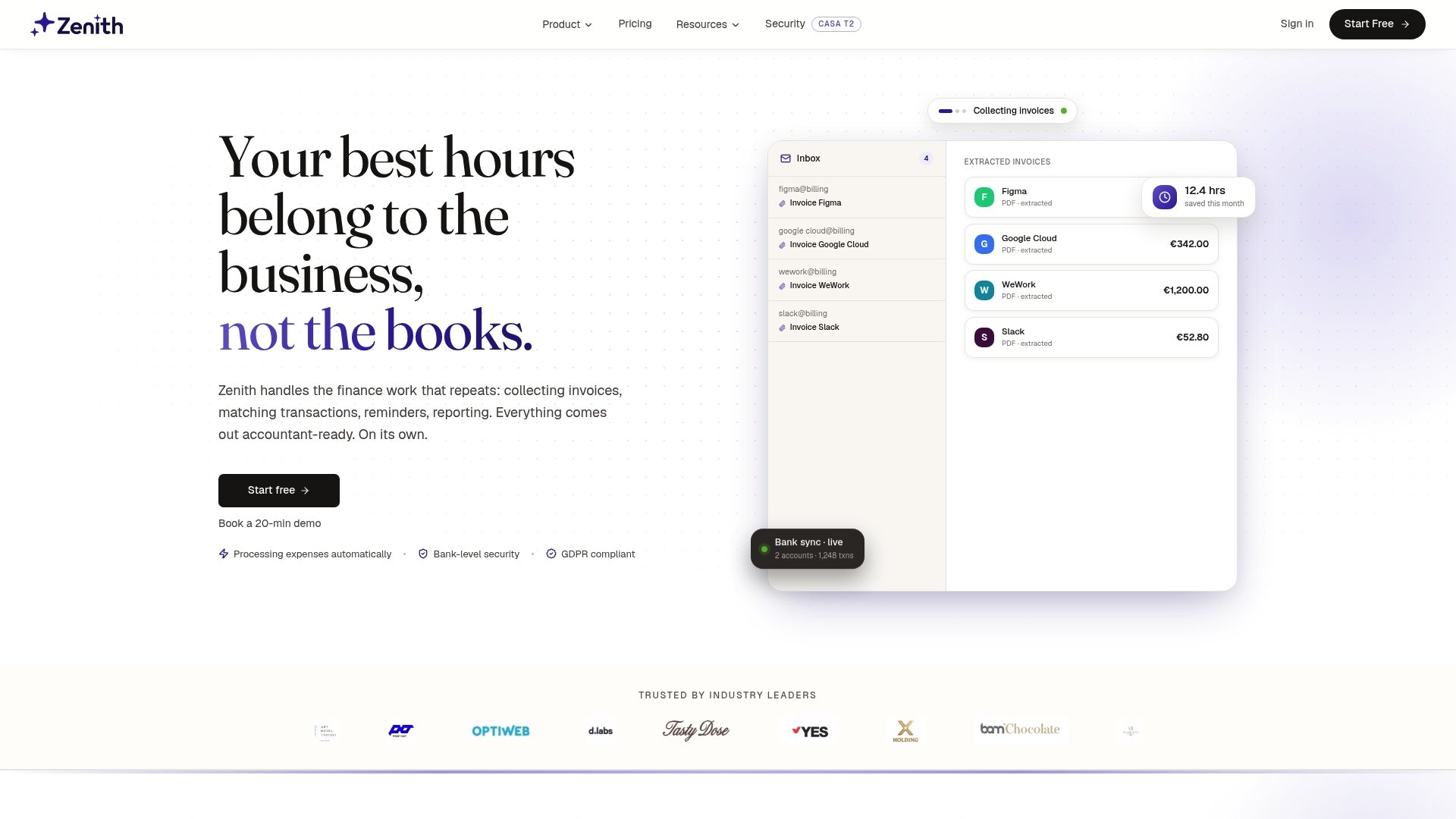
A 30-day pilot with Zenith-books typically covers invoice capture from email, transaction matching against your bank feed, and QR payment codes on outgoing invoices. Those three workflows alone eliminate the manual data entry that consumes most of a small finance team’s week. Clients like Združenje YES and BAM Chocolate report reduced month-end close times and zero manual entry across their invoice workflows after going live.
Zenith-books operates on a free tier with tiered monthly plans, so there is no long-term commitment required to run a real pilot. Start with your finance automation workflows today and measure the impact before you decide.
This article is published by Zenith-books. General information only; confirm current vendor pricing, certifications, and availability directly with each provider before making a purchasing decision.
Useful sources and further reading
The sources below were used during research and vendor evaluation for this article. Each is worth bookmarking for deeper reading on specific dimensions of AR management.
- AICPA Accounts Receivable Management Guidelines — The authoritative professional standard for AR policy formulation, covering credit, collections, and financing policy. Use this to benchmark your own AR policy before evaluating software.
- G2: Best Accounts Receivable Software — Aggregated user reviews across the major AR platforms. Useful for validating vendor claims against real customer experience, particularly for implementation timelines and support quality.
- QuickBooks: What is accounts receivable management? — Practical guidance on when small businesses should move from basic accounting software to dedicated AR automation.
- QuickBooks: Accounts Receivable Software features — Feature-level reference for what basic AR tasks look like inside an SMB accounting platform; useful for setting a baseline before evaluating dedicated tools.
- QuickBooks: What Are Accounts Receivable? — Covers DSO monitoring, billing standardization, and automated reminders as core AR improvement levers. Good reference for pilot KPI definitions.
- NACM: Building a strong foundation with the Five Cs of Credit — Industry-standard credit assessment framework. Relevant when evaluating how a vendor’s credit module handles new or high-risk customer relationships.
- eCapital: Cross-Aged Accounts (10% rule) — Explains the cross-aging signal used by lenders and credit managers to flag portfolio risk. Check whether your shortlisted AR platform surfaces this metric natively.
- Card Service Professionals: Accepting Payments for Service Businesses — Practical guide to payment method options (cards, ACH, digital wallets) for U.S. service businesses; useful when evaluating the payments dimension of any AR platform.
- Zenith-books: What Is Invoice Reconciliation? — Plain-English explanation of how AI and rules-based matching reduce manual reconciliation work; useful for setting pilot KPIs around match rate and exception handling.
- Zenith-books: How to Automate Invoice Processing From Email — Step-by-step guide to automating invoice intake from email using OCR and rules; directly relevant to the Zenith-books pilot setup described in this article.