


Finance automation for startups delivers three things fast: fewer hours lost to manual bookkeeping, near real-time cash visibility, and a faster month-end close. The evidence is specific enough to act on. Startups that automate bank feeds and invoice capture first typically see the fastest payback, because those two processes create the most manual work and the least strategic value when done by hand, according to Zenith-books’s guidance on fast bookkeeping setup.
Two data points matter before you write a single automation ticket. First, IFRS 15 governs how revenue gets recognized from contracts, which means any automated invoicing or reporting workflow has to capture contract terms accurately, not just line totals. Second, AI-driven invoice extraction removes the repetitive data entry that eats up a bookkeeper’s week and speeds up how fast you can close the books, per Zenith-books’s platform overview.
Your next step, this week: audit your current bank reconciliation and invoice intake process for two weeks, then turn on a bank sync. That single move usually surfaces where the real bottlenecks live.
- Run a 14-day process audit before buying anything
- Enable bank-to-sheet syncing as your first automated workflow
- Treat IFRS 15 compliance as a design requirement, not an afterthought
Quick fact: Startups that sequence bank sync and invoice capture before tackling payroll or R&D credits avoid the “complexity cliff” that stalls most DIY automation projects.
Key Takeaways
Finance automation succeeds when startups sequence bank sync and invoice capture first, measure hours saved against a clear KPI set, and treat compliance as a design input rather than an afterthought.
| Point | Details |
|---|---|
| Start with bank sync | Connect your bank feed first since every other automation depends on clean, current transaction data. |
| Sequence, don’t automate everything at once | Prioritize AP, invoice capture, and expense management before tackling payroll or R&D credits. |
| Track five core KPIs | Watch hours saved, close time, DSO, error rate, and automated transaction coverage monthly. |
| Build compliance into the design | Align automated invoicing with IFRS 15 principles and keep a full audit trail of every automated match. |
| Zenith-books covers the full sequence | AI invoice extraction, bank-to-sheets sync, and Drive integration give startups zero manual entry and faster closes. |
Table of Contents
- Why Finance Automation Matters for Early-Stage Startups
- Which Finance Processes Should You Automate First?
- What Technologies and Integrations Actually Enable This?
- What Does a 6-12 Week Rollout Actually Look Like?
- How Do You Measure ROI on Finance Automation?
- What Should Be on Your Vendor Checklist?
- What Do Real Results Look Like?
- What Mistakes Should You Avoid When Automating?
- What Compliance Rules Apply to Automated Finance Workflows?
- How Zenith-books Helps You Get There Faster
- Frequently Asked Questions
- Sources
Why Finance Automation Matters for Early-Stage Startups
The case for automated finance solutions for startups isn’t theoretical. It shows up in three areas: time, accuracy, and speed of decision-making.
Time savings are the easiest to see. Every hour a founder or finance lead spends retyping invoices or chasing bank statements is an hour not spent on hiring, product, or investor conversations. AI-powered invoice extraction eliminates that retyping entirely by pulling data straight from the source document, according to Zenith-books. For a ten-person startup processing a few hundred invoices a month, that’s the difference between a finance function that runs itself and one that consumes a founder’s Friday afternoons.
The core benefit stack looks like this:
- Time and FTE reallocation. Manual data entry and reconciliation get removed, freeing your bookkeeper or finance lead to focus on forecasting instead of transcription.
- Fewer errors, better audit readiness. Automated matching reduces the transposition and duplication mistakes that make tax season and IFRS-aligned reporting painful.
- Faster close. Near real-time P&L and cash forecasts mean you know your runway this week, not three weeks after month-end, which matters when you’re deciding whether to extend an offer letter.
- Cleaner investor reporting. Automated, consistent financials are easier to hand to a board or a due diligence team than a spreadsheet stitched together the night before a call.
That last point deserves emphasis. Investors don’t just want accurate numbers, they want financials produced on a predictable cadence. A finance stack that closes in two days instead of two weeks changes how confidently you can raise.
Which Finance Processes Should You Automate First?
Not every finance task deserves the same priority. Startups that try to automate everything at once usually stall, so sequence matters as much as the tooling itself.
- Bank connectivity and transaction sync. This is the foundation. Every other automation depends on clean, current transaction data, and syncing your bank feed to a live sheet gives you cash visibility on day one, as Zenith-books’s bank-to-sheets tool demonstrates.
- Invoice capture and OCR. Once transactions are flowing, automated invoice extraction removes the single most tedious task in early-stage bookkeeping: retyping vendor bills.
- Expense management. Automating receipt capture and categorization prevents the expense backlog that piles up right before a fundraise, a process Zenith-books outlines in detail for teams heading toward Series A.
- Accounts payable automation. Once invoices are captured, automating approval routing and payment scheduling cuts the back-and-forth over who approved what.
- Automated reconciliation. Matching transactions to invoices and bank entries is where rules engines earn their keep, catching mismatches a tired human eye would miss.
- Accounts receivable and invoicing. Automating outgoing invoices and payment reminders shortens the gap between delivering work and getting paid.
Delay the harder cases. Multi-state payroll and R&D tax credit capture involve compliance nuances that punish a rushed rollout, and bolting them onto an automation platform after the fact raises audit risk rather than lowering it.
Pro Tip: Scope each automation as an MVA, a minimum viable automation. Automate the 80% of transactions that follow a predictable pattern first, and handle exceptions manually until volume justifies building a rule for them. This keeps your first rollout weeks shorter and your error rate lower.
What Technologies and Integrations Actually Enable This?
Finance automation for startups rests on five technical building blocks, and knowing what each one does helps you ask sharper questions in a vendor demo.
OCR and invoice extraction reads the data off a PDF or scanned invoice and turns it into structured fields, eliminating the manual keying that slows down early-stage bookkeeping. Bank API connectivity, often built on open banking standards, pulls transaction data directly from your bank rather than requiring manual statement uploads. A rules engine handles auto-matching, pairing invoices to bank transactions based on amount, date, and vendor name. AI categorization tags transactions into the right expense or revenue category, and forecasting layers use that categorized data to project cash flow. Google Drive and Sheets integrations turn that data into live dashboards your whole team can see, including automated invoice filing to Drive.
Before signing anything, confirm four things:
- Does the platform offer open API access, or are you locked into their interface only?
- Can you export your data in a standard format if you switch platforms later?
- What security certifications and access controls does the vendor maintain?
- What uptime and support response times does their SLA actually guarantee?
Ask each vendor to walk through a real invoice, from email inbox to categorized transaction, during the demo. If they can’t do it live, that’s a signal.
What Does a 6-12 Week Rollout Actually Look Like?
Startup finance management doesn’t need a year-long ERP implementation. A focused rollout fits into three phases.
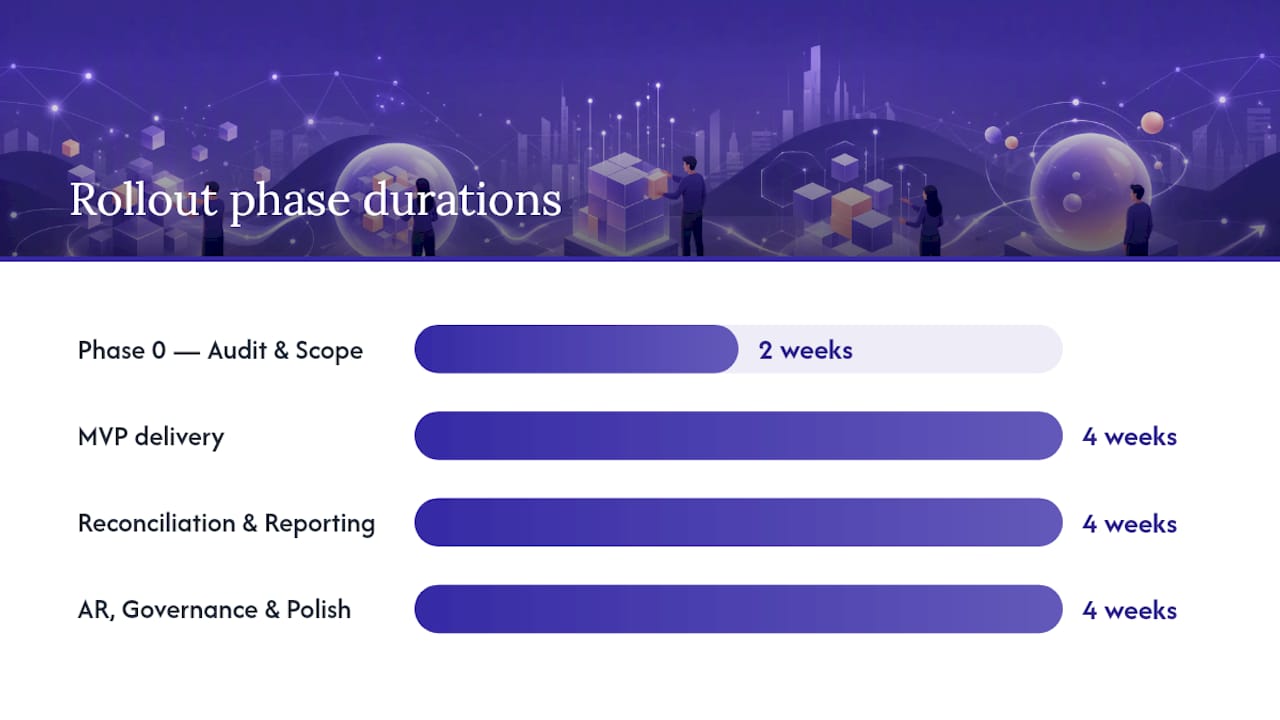
Phase 0, weeks 1 and 2: audit and scope. Map every data source you currently touch, from bank statements to vendor emails, and identify where manual effort is highest. This is where you find your quick wins.
Weeks 1 through 4: MVP delivery. Turn on bank sync, invoice capture, and basic expense automation. This phase alone often removes the majority of weekly manual entry, since fast setup is designed for early-stage teams rather than enterprise IT departments.
- Connect bank accounts and verify transaction sync accuracy
- Enable invoice capture and test extraction against a week of real invoices
- Automate expense categorization rules for your top recurring vendors
- Run parallel manual and automated processes for one billing cycle to confirm accuracy
Weeks 5 through 8: reconciliation and reporting. Layer in auto-matching rules, connect P&L automation, and build the dashboards your team will actually check daily. Train whoever owns finance on the new workflow before removing the old spreadsheet.
Weeks 9 through 12: AR, governance, and polish. Automate outgoing invoicing and payment reminders, set up monitoring so someone gets alerted when a match fails, and assign clear ownership: who reviews exceptions, who audits the rules monthly, who owns vendor relationship management.
- Go/no-go checkpoint after each phase: don’t move forward until the prior phase’s accuracy rate is verified
- Ownership matrix: one person owns bank sync, one owns AP, one owns reporting output
- Document every automation rule so a new hire can understand the system without a handoff meeting
How Do You Measure ROI on Finance Automation?
Founders should track five numbers, and none of them require a data science team to calculate.
- Hours saved per month. Compare time spent on bookkeeping before and after automation, tracked by whoever owns the process.
- Month-end close time. A close that took two weeks should shrink measurably once bank sync and reconciliation automation are live.
- DSO (days sales outstanding). Automated invoicing and payment reminders tend to shorten the gap between billing and getting paid.
- Error rate. Track how many transactions need manual correction after automated matching runs.
- Automated transaction coverage. What percentage of transactions now flow through the system without a human touching them.
Quick math: if your finance lead spends 15 hours a month on manual entry and reconciliation, and their fully loaded cost is $50 an hour, that’s $750 a month in labor tied up in tasks a rules engine can absorb.
Set targets in phases rather than all at once.
What Should Be on Your Vendor Checklist?
Choosing among automated finance solutions for startups comes down to six criteria, and you should be able to get a straight answer on each during a single demo call.
- Security and compliance. Ask what certifications the vendor holds and how they handle data encryption, both at rest and in transit.
- Integration coverage. Confirm the platform connects to your actual bank, your accounting software, and reporting tools like Google Sheets.
- Data portability. You should be able to export your full transaction history in a standard format if you ever leave.
- SLA and uptime. A finance tool going down during month-end close is not a minor inconvenience.
- Pricing model. Startups need usage-based or tiered pricing that scales with invoice volume, not a flat enterprise contract.
- Support and onboarding speed. How fast can you go from signup to your first automated bank sync?
In a demo, ask these four questions directly:
- What happens when an invoice fails OCR extraction, does it flag for manual review or fail silently?
- Can we build custom matching rules, or are we limited to preset categories?
- What format does data export take if we migrate later?
- What does a typical onboarding timeline look like for a team our size?
Zenith-books fits this checklist by design: AI-driven invoice extraction and categorization remove manual entry, bank-to-sheets sync gives near real-time cash visibility, and standardized export formats support data portability rather than lock-in. Think of it this way: a criterion like “plug-and-play workflow” should mean you’re syncing your first bank account within a day, not submitting a ticket and waiting a week for an implementation specialist.
What Do Real Results Look Like?
Case studies matter more than feature lists because they show what actually happens once a startup flips automation on. Client teams at Združenje YES and BAM Chocolate report substantial time savings and streamlined operations after adopting Zenith-books, including reduced month-end close times and zero manual entry across transactions, according to Zenith-books’s platform documentation.
Reduced month-end close times and zero manual transaction entry are the two outcomes that show up most consistently once bank sync and invoice extraction are fully live.
Key metric: zero manual entry across transactions is the benchmark worth aiming for, and it’s achievable once your automated transaction coverage climbs high enough that exceptions become rare rather than routine.
- Faster close cycles free up finance leads for forecasting and fundraising prep
- Zero manual entry reduces the error rate that triggers audit questions
- Streamlined operations compound: each automated workflow makes the next one easier to add
What Mistakes Should You Avoid When Automating?
Most automation failures at startups trace back to four predictable mistakes, and all of them are avoidable with a bit of discipline upfront.
- Poor data hygiene. Feeding messy, inconsistent vendor names or category labels into an automated system just automates the mess faster. Clean your chart of accounts before you connect anything.
- Automating the wrong process first. Teams that start with complex AR workflows before nailing basic bank sync often end up debugging two problems at once.
- Insufficient testing. Skipping the parallel-run period, where automated and manual processes run side by side, means you find errors after they’ve already hit your books.
- Neglecting training. A rules engine only works if the person reviewing exceptions understands why a transaction got flagged.
The fix for all four is the same discipline: don’t skip the audit phase, and don’t automate a process you don’t already understand manually.
Pro Tip: Schedule a 30-minute automation health check every month. Review flagged exceptions, confirm your matching rules still reflect your current vendor list, and retire any rule that hasn’t fired in 90 days. Automation drifts if nobody owns it.

What Compliance Rules Apply to Automated Finance Workflows?
Automating your books doesn’t remove your compliance obligations, it just changes where the risk sits. If your automated invoicing or revenue tracking misclassifies a contract event, that error now propagates automatically instead of getting caught by a careful bookkeeper.
IFRS 15 sets out how revenue from contracts with customers should be recognized, and that principle has to be baked into how your automated system captures contract terms, not just invoice totals. If your automation treats every invoice as recognized revenue the moment it’s issued, you risk misrepresenting revenue timing to investors or auditors, particularly for subscription or milestone-based contracts.
Data security is the second compliance pillar. Any platform handling bank connections and invoice data should offer clear encryption standards and access controls, and you should be able to name them without checking a vendor’s marketing page from memory.
Finally, keep an audit trail. Every automated match, categorization, and approval should be logged and reviewable, so if a tax authority or auditor asks why a transaction was categorized a certain way, you have an answer beyond “the system did it.” This is also where the complexity cliff shows up again: multi-state payroll tax rules and R&D credit documentation carry their own regulatory demands that a general-purpose automation platform usually isn’t built to handle alone. Plan to integrate with a specialist for those functions rather than forcing a generic rule to cover them.
A Practitioner’s View on Getting This Right
The startups that get automation right treat it as a sequence of small, measurable bets, not a single big migration. Start with bank sync and invoice capture, measure the time saved, then reinvest that confidence into the next workflow. Bring in specialist help only when you hit genuinely regulated territory, like multi-state payroll, rather than trying to force a general tool to cover it. Choose integrations that can grow with you now, because ripping out a finance stack at Series A is far more painful than choosing carefully at seed stage.
How Zenith-books Helps You Get There Faster
Zenith-books is built around the exact sequence this article recommends: AI invoice extraction, live bank sync, and automated reconciliation, wired directly into the Google Drive and Sheets tools most early-stage teams already use.
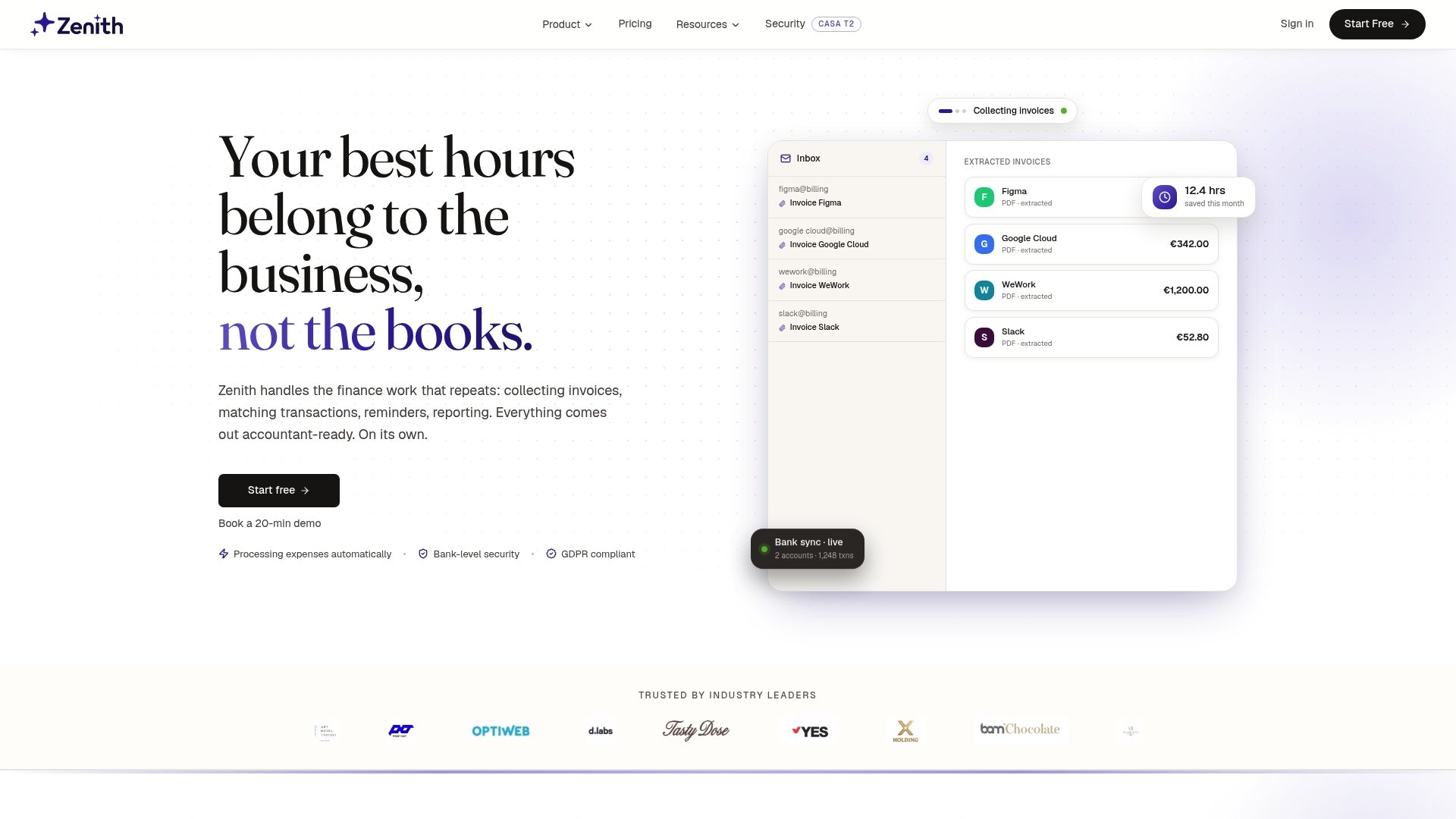
Instead of manually filing invoices from your inbox, Zenith-books auto-files them to Drive with consistent naming, and instead of updating a cash flow spreadsheet by hand, bank data syncs live to Google Sheets. Teams at Združenje YES and BAM Chocolate have used this exact combination to reach zero manual transaction entry and shorter month-end closes. If invoice payment collection is your current friction point, the free QR code generator is a no-cost place to start seeing the difference immediately.
The next step is simple: explore Zenith-books’s full automation suite and connect your bank account to see your first live cash sync within a day, not a quarter.
Frequently Asked Questions
How long does finance automation for startups take to implement? A focused rollout covering bank sync, invoice capture, and basic reconciliation typically takes 6 to 12 weeks, with initial quick wins visible in the first two to four weeks.
What’s the first process a startup should automate? Bank connectivity and transaction sync come first, since nearly every other financial workflow, from reconciliation to reporting, depends on accurate, current transaction data.
Do I need an accountant to automate startup finances? No, but you should involve one when you approach regulated complexity like multi-state payroll or R&D tax credits, where a specialist prevents compliance mistakes an automation platform alone won’t catch.
How much time does finance automation actually save? It depends on transaction volume, but startups often remove the majority of manual bookkeeping hours once bank sync, invoice extraction, and categorization are all running together.
What should I check before choosing finance software for a startup? Confirm API access, data export formats, security certifications, and pricing that scales with your invoice volume rather than locking you into enterprise-tier costs.
Sources
- IFRS 15 — Revenue from Contracts with Customers