


Start with a ledger-first stack: connect cloud accounting, billing and spend management so nothing needs manual rekeying, ever. That’s the single organising principle behind every well-run finance function, and it holds whether you’re three months post-incorporation or closing a Series A. Get this right and three priorities follow immediately: cloud accounting software with a live bank feed, billing that posts straight to the general ledger, and spend controls on cards and accounts-payable so nobody’s retyping receipts at midnight.
Do these three things and the payoff shows up fast. Founders who wire billing and payroll into the ledger report month-end close dropping from weeks to days, because the reconciliation work that used to eat a bookkeeper’s Friday afternoon simply doesn’t exist any more. Forecasting gets faster too, since your numbers are current rather than three weeks stale.
- Ledger-first: the general ledger is the single source of truth; every other tool writes into it, never the reverse.
- PSD2-compliant bank connections: open banking standards under PSD2 mean your accounting software can pull live transaction data without manual statement uploads.
- Zenith: automation layers like Zenith exist precisely to stop the rekeying that breaks this principle in practice.
Key Takeaways
A finance tech stack for startups works when the general ledger stays the single source of truth and billing, payroll and spend integrations post into it automatically, without manual rekeying.
| Point | Details |
|---|---|
| Adopt ledger-first architecture | Route billing, payroll, and card/AP data into the GL automatically so no one retypes figures by hand. |
| Buy in stages, not all at once | Match tools to pre-seed, seed, Series A and scale triggers rather than buying scale-stage tools too early. |
| Run a focused 6 to 12 week sprint | Automate bank matching, invoice capture, and expense extraction before tackling recurring journals. |
| Vet vendors on data ownership | Ask about rollback plans, export formats, and security attestations before signing anything long-term. |
| Automate invoice capture with Zenith | Zenith extracts, categorises and matches invoices automatically, cutting manual entry across transactions. |
Table of Contents
- What are the core components of a finance tech stack for startups?
- When should startups add each finance tool?
- How do you connect finance tools without breaking your ledger?
- What’s a realistic 6 to 12 week plan to automate your finance stack?
- What should you check before choosing a finance tool?
- What security and compliance checks matter, and what does migration cost?
- How does Zenith fit into a ledger-first finance stack?
- Where to read more on finance automation and compliance
- The advice nobody wants to hear about sequencing
- Stop retyping invoices and start trusting your ledger
- Sources
What are the core components of a finance tech stack for startups?
A finance tech stack for startups is really a handful of specialist tools, each doing one job well, all reporting back to a single ledger. Miss a category and you get blind spots. Duplicate one unnecessarily and you get reconciliation headaches nobody asked for.
General ledger (GL) and accounting. This is your book of record, the place every financial fact eventually lands. Cloud accounting platforms handle double-entry bookkeeping, chart of accounts, and statutory reporting. Everything else in your stack should feed this one system, not compete with it.
Billing and revenue recognition. Subscription businesses need tools that generate invoices, handle proration, manage upgrades and downgrades, and recognise revenue over the right period rather than all at once. Get this wrong and your P&L lies to you about how the business is actually performing.
Payments and banking. Business current accounts with API access, plus payment processors for collecting customer money. The operational outcome here is straightforward: money moves and the record of it moving matches your books without anyone typing figures twice.
Expense and spend management. Corporate cards with built-in controls, receipt capture, and approval workflows. This is where most early leakage happens: an employee spends on a personal card, forgets to submit the receipt, and three months later nobody remembers what the £340 charge was for.

Accounts payable automation. Vendor invoice capture, approval routing, and payment scheduling. AP automation cuts the single biggest source of vendor-payment mistakes: someone manually copying an invoice number wrong or paying the same bill twice.
Payroll. Calculates salaries, tax withholding, and pension contributions, then needs to post that cost accurately into the GL every pay cycle without a bookkeeper manually splitting it by department.
FP&A and forecasting. Tools that pull actuals from the GL and let you model scenarios, runway, and hiring plans without rebuilding a spreadsheet from scratch each month.
Treasury and cash management. Real-time visibility into where cash sits across accounts, plus automated sweeps and alerts. Treasury automation can cut reconciliation errors by up to 95% and speed up payments by roughly 40% compared with manual processes, according to a treasury automation playbook aimed at startup founders and CFOs.
Reporting and BI. Dashboards that turn GL data into something a board member or investor can actually read in five minutes.
Integrations and APIs. The connective tissue. Every component above is only as useful as its ability to talk to the ledger without a human in the middle.
Most of these categories, billing, payroll, and card/AP spend, need to post into the GL on a schedule, whether that’s a nightly journal entry or a webhook firing the moment a transaction clears. The tighter that link, the less time anyone spends chasing numbers that don’t match.
When should startups add each finance tool?
Buying tools in the wrong order is one of the most expensive mistakes early founders make. A five-layer model from CentSight, covering general ledger, billing and revenue recognition, metrics, spend/AP, and FP&A, argues that companies should add these layers in sequence rather than buying everything a well-funded competitor uses on day one.
-
Pre-seed: survival-level hygiene. Get cloud accounting software running with a connected bank feed and basic invoicing. This is not optional, and it is not glamorous. It is the bare minimum that lets you answer “how much cash do we have” without opening three spreadsheets. Mercury’s founder guide makes the same point: get payroll accuracy and basic bookkeeping sorted before anything else, and consider outsourcing bookkeeping early rather than letting it eat founder time.
-
Seed: add spend controls and simple subscription billing. Once you have a handful of employees spending company money, corporate cards with built-in approval limits stop the leakage that unmonitored expense claims create. If bookkeeping is eating more than roughly 10 hours a month of anyone’s time, that’s your trigger to hire a bookkeeper or bring in a fractional CFO.
-
Series A: revenue management and real FP&A. By this stage, spreadsheet-based board reporting starts to crack under its own complexity. A stage-aware automation roadmap flags concrete triggers worth watching: once vendor invoice volume passes roughly 20 a month, AP automation stops being a nice-to-have. Daily GL integrations become non-negotiable here, because weekly or monthly imports leave your board deck stale by the time anyone reads it.
-
Scale: evaluate consolidation. Multi-entity structures, multiple currencies, or genuine IPO-readiness are the signals that justify moving to a consolidated finance platform or ERP, as detailed in this business scalability checklist for mid-market growth. Below those triggers, consolidation usually adds cost and disruption without a matching benefit.
The cost and time bands widen sharply as you move through these stages. A pre-seed accounting setup takes an afternoon and costs little beyond a monthly subscription. A Series A revenue-management implementation might run several weeks with an implementation partner. A full ERP migration, by contrast, typically takes three to twelve months and can cost tens of thousands of pounds, depending on data complexity and how many custom integrations you need built. Buy each layer when the trigger appears, not before, and you avoid paying scale-stage prices for a problem you don’t have yet.
How do you connect finance tools without breaking your ledger?
The general ledger has to stay the single source of truth, the book that every auditor, investor and tax adviser trusts above all the source systems feeding it. That only works if data flows into it consistently, not sporadically, and not through someone’s manual copy-paste routine.
Three integrations are genuinely non-negotiable, and buyer guides across the industry converge on the same list: billing into the GL, payroll into the GL, and cards or AP spend into the GL. Miss any one of these and you’re back to manual rekeying, which defeats the entire point of building a stack in the first place.
- Billing to GL: revenue and deferred revenue journals should post at least daily, ideally in near real time as invoices are issued or revised.
- Payroll to GL: each pay run needs to land as a structured journal entry, split correctly across departments and cost centres, not as one lump sum someone allocates by guesswork.
- Cards/AP to GL: transaction-level detail, not batch totals, so categorisation and matching stay accurate.
Integration patterns vary. Some tools connect via direct bank APIs under open banking standards; others push data through webhooks the moment an event happens; larger stacks sometimes route everything through an ELT pipeline into a data warehouse before it reaches reporting tools. Whichever pattern you choose, validate it: check that transaction counts match between source and GL, and spot-check that matched amounts tie out to the penny, not just to the nearest pound.
The most common failure point is a chart-of-accounts mismatch, where your billing tool categorises revenue one way and your GL expects another, silently misclassifying entries for months before anyone notices. Lagging imports are the second most common issue, where a “daily” sync actually runs every few days under load.
Pro Tip: Run a reconciliation report weekly during your first month with any new integration, not monthly. Catching a mismatch after four days of drift is a ten-minute fix; catching it after five weeks means unpicking a quarter’s worth of misposted journals.
What’s a realistic 6 to 12 week plan to automate your finance stack?
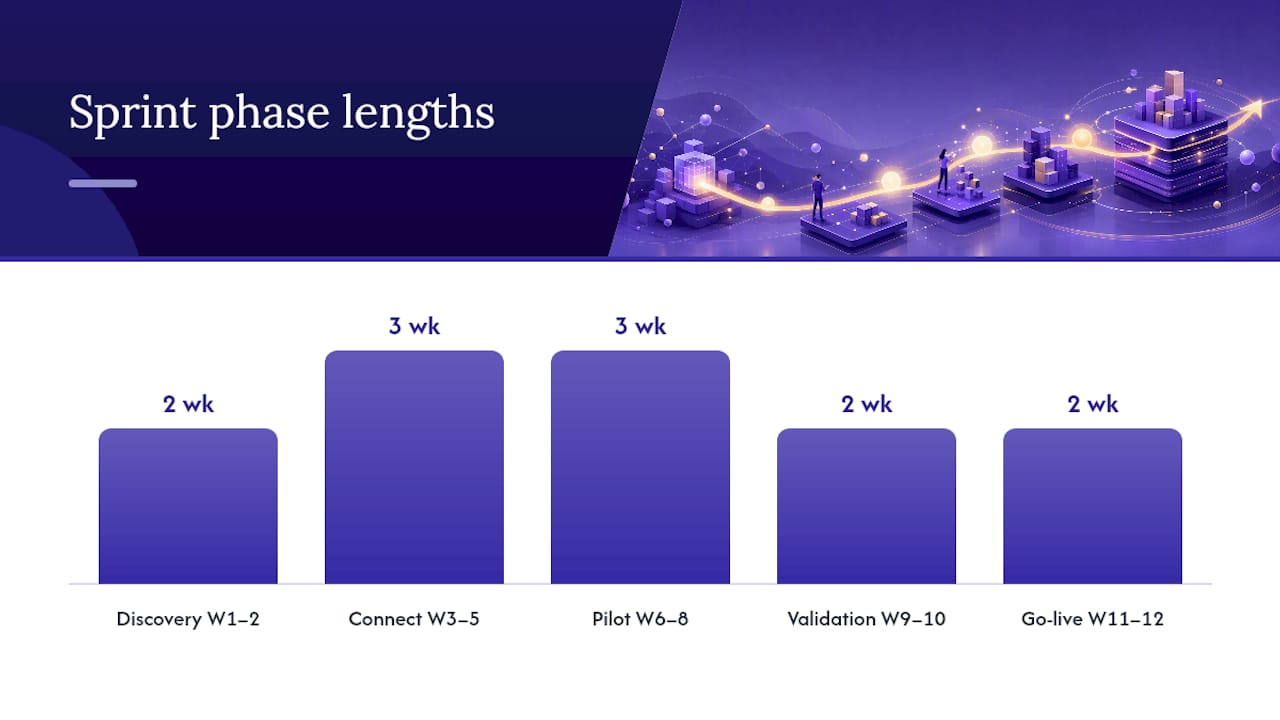
Automation only pays off when you tackle it in a focused sprint rather than a sprawling, unfocused rollout. A six to twelve week automation sprint that targets a handful of high-impact automations tends to produce better adoption and ROI than a slow, everything-at-once migration that drags on for six months and loses momentum halfway through.
Prioritise in this order: bank feed matching first, since it’s the highest-frequency task and the easiest automation win. Invoice capture and OCR second, because manual data entry from PDFs is where most bookkeeping hours actually go. Expense extraction third. Recurring journal automation last, once the earlier three are stable and trustworthy.
- Weeks 1 to 2, discovery. Map every tool currently in use, every manual process, and where data currently breaks or duplicates.
- Weeks 3 to 5, connect. Wire up bank feeds, billing integrations, and card feeds into the GL.
- Weeks 6 to 8, automation pilot. Turn on invoice OCR and expense extraction for one team or one category of spend before rolling it out company-wide.
- Weeks 9 to 10, data validation. Reconcile pilot-period transactions against the old manual process to confirm accuracy.
- Weeks 11 to 12, go-live. Roll out fully, decommission the manual workaround, and set a review date 30 days out.
You’ll need a founder or CFO to own priorities, a bookkeeper who understands the current pain points, and someone with basic integration or IT literacy to handle API connections and troubleshoot sync failures. Zenith-books’s own finance automation plan for startups covers a comparable rollout in more granular detail if you want a template to adapt.
Track reconciliation time, manual journal entry count, and days to close the month, throughout the rollout. If manual journal entries haven’t dropped by week 10, something in your integration chain still isn’t posting automatically.
Pro Tip: Pick one metric, reconciliation time, and post it somewhere visible to the whole finance team every week. Momentum dies quietly when nobody can see the improvement.
What should you check before choosing a finance tool?
Every finance tool you evaluate should clear the same checklist before it earns a place in your stack. API depth matters more than almost anything else, because a tool with a thin or unreliable API will eventually force you back into manual exports.
- Integration frequency: does it post to the GL daily, hourly, or only via a manual export button?
- Sandbox access: can you test the integration with real transaction data before committing?
- Migration tooling: does the vendor offer a genuine data export in a usable format, or does your data get held hostage?
- Implementation support: is there a named contact during onboarding, or are you left reading documentation alone?
- Pricing model: does cost scale predictably with usage, or does it jump in ways that punish growth?
At demo stage, ask direct questions: who owns the data if you leave, what does rollback look like if the integration fails mid-migration, how deep does the reporting actually go beyond the dashboard screenshots, and what security attestations does the vendor hold. Vague answers to any of these are a red flag worth taking seriously.
The single biggest signal a vendor isn’t ready for you: they can’t tell you exactly what happens to your historical data if you cancel. If they hedge on that question, they haven’t built for it, and you’ll find that out the hard way during a migration, not before one.
Run a short proof of concept with real transactions, not sample data the vendor provides, before signing anything longer than a monthly contract. Sample data is designed to make every tool look perfect.
What security and compliance checks matter, and what does migration cost?
Every tool in your stack needs encryption in transit and at rest, role-based access control so junior staff can’t approve their own expenses, and audit logs that record who changed what and when. SOC 2 or ISO 27001 attestations are the baseline credential worth asking for, not a bonus feature.
If you’re VAT-registered in the UK, your accounting software needs to meet Making Tax Digital requirements, and gov.uk publishes guidance on checking software compatibility before you commit to a platform. It’s worth checking this before signing, not after your first VAT return bounces back.
On cost: expect a mid-tier accounting platform migration to take a few weeks and cost relatively little beyond the subscription itself. A full ERP migration is a different order of magnitude entirely, typically three to twelve months and tens of thousands of pounds, with the biggest cost drivers being data cleanup, how many entities and currencies you’re consolidating, and how many custom integrations the implementation partner needs to build from scratch. Multi-entity structures routinely double timeline estimates, so budget accordingly if that’s on your roadmap within the next year.
How does Zenith fit into a ledger-first finance stack?
Zenith sits exactly where the non-negotiable integrations live: between your incoming invoices, your bank feed, and your general ledger. It uses AI to extract and categorise invoice data automatically, matches transactions against bank statements, and eliminates the retyping that eats bookkeeping hours at most early-stage companies.
Two integration patterns show this working in practice. Invoices arriving by email get pulled into Zenith, extracted, and posted straight to the GL, with files automatically filed and named in Google Drive so nothing sits in an inbox unfiled. Bank data syncs live into Google Sheets, giving founders real-time cash visibility without waiting for a monthly export.
Clients including Združenje YES and BAM Chocolate report zero manual entry across transactions and materially shorter month-end close times after adopting Zenith.
For a seed-stage company drowning in PDF invoices, capture and categorisation is the fastest win. By Series A, the highest-leverage use case shifts to AP automation and live cash sync, exactly where daily GL posting starts to matter for board reporting.
- Invoice capture at seed stage: fastest time to first ROI, least implementation effort.
- AP automation and cash sync at Series A: supports daily GL integration and cleaner board reporting.
- eSlog-standardised accounting exports: keeps output format consistent regardless of which downstream system consumes it.
Where to read more on finance automation and compliance
- Find software that’s compatible with Making Tax Digital for VAT, gov.uk guidance on checking accounting software before you commit.
- How to build the ideal finance tech stack that will grow with your business, a SaaS finance buyer’s guide on hybrid stack decisions.
The advice nobody wants to hear about sequencing
Most founders overbuild their finance stack out of anxiety, not necessity. They see a well-funded competitor running an ERP with six integrated modules and assume that’s the bar, when the actual bar at pre-seed is a connected bank feed and clean invoicing. The five-layer model from CentSight’s buyer guide gets this right: buy in sequence, and resist the urge to skip ahead because a tool looks impressive in a demo.
The bigger blind spot is treating integrations as optional polish rather than the foundation. A stack full of excellent individual tools that don’t post cleanly into the GL is worse than a smaller stack that does, because it creates false confidence in numbers nobody’s actually reconciled. Treasury automation is the clearest example of an underused lever here. Most early-stage teams treat it as a scale-stage luxury, when the marginal gain in cash visibility and fraud detection shows up the moment core processes stabilise, often well before Series A.
If you take one thing from this: fix your integrations before you add another tool. The stack that wins isn’t the one with the most features. It’s the one where nobody has to check twice.
— Gašper
Stop retyping invoices and start trusting your ledger
There are other routes to a tidier finance stack: hiring a full-time bookkeeper, building custom scripts to bridge your billing tool and your GL, or simply accepting a longer month-end close as the cost of being small. Each works, up to a point, but each also asks you to trade either money, engineering time, or accuracy for the convenience the others promise.
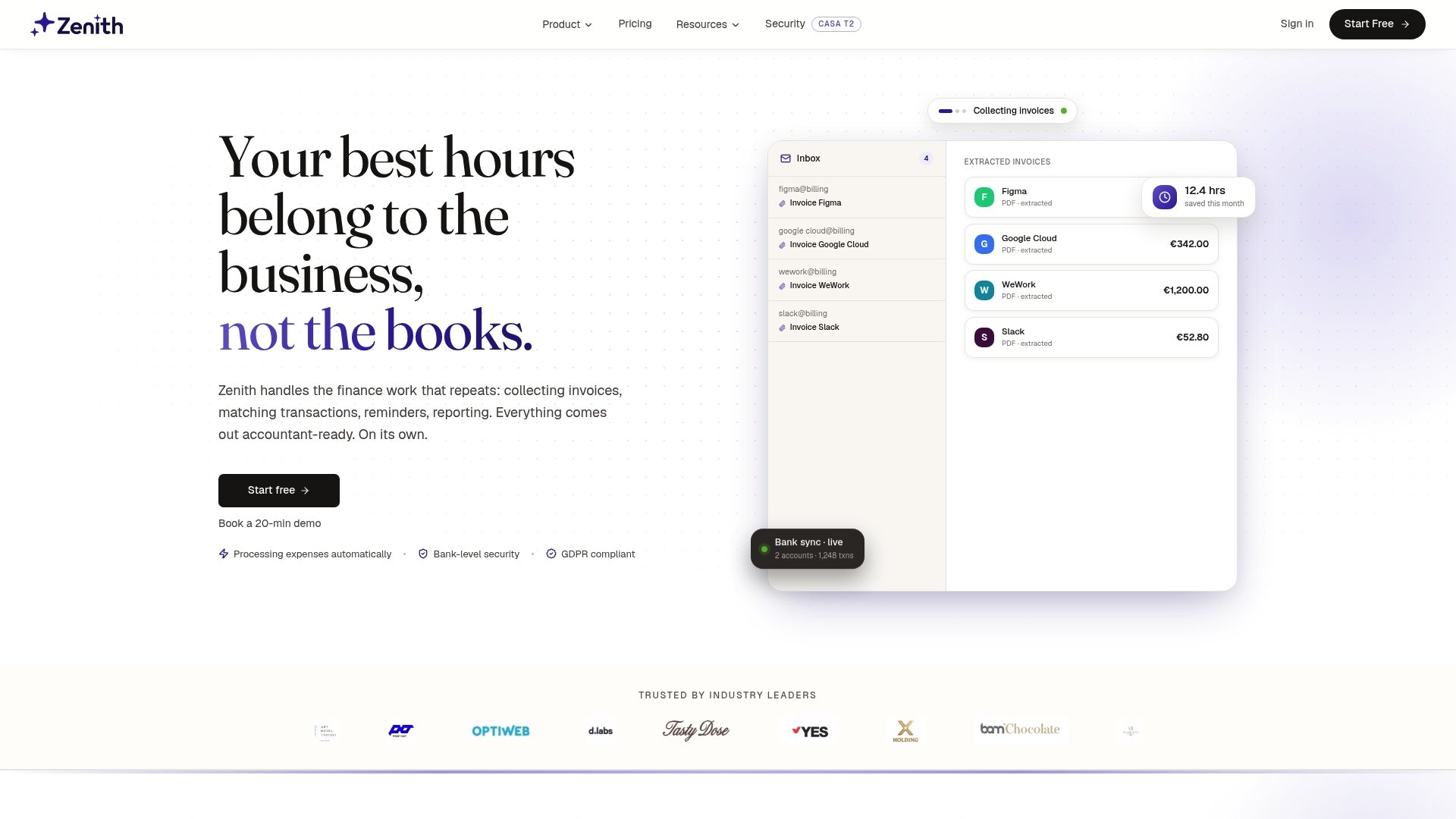
Zenith-books gives you the fastest route to the ledger-first setup this guide describes, without hiring anyone new or writing a single integration script. It extracts and categorises invoices automatically, matches them against your bank feed, and posts clean journals into your GL, the exact non-negotiable integration this article keeps circling back to. Clients like Združenje YES and BAM Chocolate now run with zero manual entry across their transactions and materially shorter month-end closes. If you’re at the seed stage drowning in PDF invoices, or heading toward Series A and need AP automation that actually holds up under board scrutiny, explore Zenith’s finance workflows and see which plan matches how many invoices and bank accounts you’re running today.
Sources
- Find software that’s compatible with Making Tax Digital for VAT
- SaaS financial software: a 2026 buyer’s guide for $1M–$50M ARR companies | CentSight
- Finance Automation Roadmap for Growing Startups: What to Prioritise Versus What to Ignore
- How to build the ideal finance tech stack that will grow with your business | Drivetrain