


Use a unique, sequential invoice number on every invoice you issue. For VAT-registered businesses, this is a legal requirement under the VAT Regulations 1995. For everyone else, it is still the single most important thing you can do to keep your records auditable. The practical steps are straightforward: pick one numbering series, configure your software to auto-increment from your last used number, and write down the starting value in a short policy note.
A few quick facts worth knowing before you read further:
- HMRC requires a unique sequential number on every full VAT invoice, per VATREC5010.
- Every invoice must show a unique identifying number, whether or not you are VAT-registered.
- VAT-related records must be kept for at least 6 years.
- Zenith-books can automate number assignment and file every invoice to Google Drive, eliminating the most common source of duplicate numbers.
Pro Tip: Set zero-padding from day one (INV-0001 rather than INV-1) so your files sort correctly at 10,000 invoices. When you switch systems, log the date, the last number used, and the new starting value in a simple change-log document.
Key Takeaways
UK invoice numbering compliance comes down to one discipline: every number must be unique, sequential, and documented — with automation as the most reliable way to maintain that standard at scale.
| Point | Details |
|---|---|
| HMRC legal requirement | VAT invoices must carry a unique sequential number; the format is flexible but the sequence must be unbroken. |
| Retention rule | VAT-registered businesses must keep invoice records for several years from the end of the relevant accounting period. |
| Voids, not deletions | Never delete or reuse a number; void the invoice with a written reason and keep the record in your system. |
| Year in the number | If you reset counters annually, embed the year (2026-001) so each number remains globally unique across years. |
| Zenith-books automates compliance | Auto-increment, isolated counters, and Drive filing remove the manual steps where numbering errors occur. |
Table of Contents
- What do UK law and HMRC require about invoice numbers?
- Three core rules every invoice numbering system must follow
- What do practical invoice number formats look like?
- When can you reset counters, and how do you run multiple sequences safely?
- How should you handle mistakes, voids, and gaps?
- How does automation reduce numbering risk, and what features should you look for?
- Implementation checklist and copy-and-paste templates
- Why the numbering question is really an audit-trail question
- Zenith-books takes the numbering risk off your plate
- Sources
What do UK law and HMRC require about invoice numbers?
The legal baseline is clear. HMRC’s VAT manual states that a full VAT invoice must carry a sequential number based on one or more series that uniquely identifies the document. The format is yours to choose — numbers, letters, or a mix — but the sequence must be unbroken and no number may ever be reused.
That phrasing matters for auditors. “One or more series” means you can run separate sequences (say, one per subsidiary), but each series must be internally consecutive. A gap is not automatically a problem. An unexplained gap is. Auditors treat missing numbers as a potential sign of unreported income, so every skip needs a documented reason: a voided invoice record, a system migration note, or a test invoice marked as such.
Non-VAT businesses are not exempt from good practice. Gov.uk’s invoicing guidance requires a unique identifying number on every invoice regardless of VAT status. The 6-year retention rule applies to VAT records; for non-VAT businesses, HMRC recommends keeping records for at least 5 years after the self-assessment deadline for the relevant tax year.
If you invoice customers in EU member states, EU VAT invoicing rules set parallel requirements for invoice identification and required particulars. Post-Brexit, UK businesses issuing invoices to EU customers should confirm which country’s rules govern each transaction.
What audit-ready documentation looks like: a complete export of your invoice register showing every number in sequence, a separate void log explaining any gaps, and a system change log recording any counter resets or software migrations. If your accounting software can produce that export in under two minutes, you are in good shape.
Three core rules every invoice numbering system must follow
Industry consensus distills invoice numbering best practices into three rules: sequential, unique, and consistent. Each one does a specific job.
- Sequential means each new invoice gets the next number in line. No skipping ahead, no going back. The sequence is the audit trail.
- Unique means no two invoices, across your entire history, share the same number. This includes voided invoices — the number is consumed even if the invoice was never sent.
- Consistent means you apply the same format and series rules every time, without switching conventions mid-year or mid-client.
Beyond those three, a few operational rules keep the system reliable in practice:
- Never delete an invoice. If you made an error, void it with a written note and issue a corrected invoice with the next available number.
- Never reuse a voided number. Mark the void record clearly (e.g., “VOID — issued in error, replaced by INV-0047”) and keep it in your system.
- Document every policy change. If you switch from a plain sequential format to a year-prefixed one, write down when the change happened and what the last number in the old format was.
- Use separate prefixes for different document types. INV- for invoices, CN- for credit notes, QT- for quotes. Mixing document types in one sequence creates confusion during reconciliation.
Pro Tip: Keep a one-page numbering policy document. It should state your chosen format, your starting number, the date you started, and the rules for resets. If HMRC ever asks, that document demonstrates intent and control.
What do practical invoice number formats look like?
UK-focused guides recommend five main format families. The right one depends on your business structure and how many invoices you issue.
| Format | Example series | Best for | Counter reset? |
|---|---|---|---|
| Pure sequential | INV-0001, INV-0002 | Freelancers, sole traders | Never |
| Year-prefixed | 2026-001, 2026-002 | Small businesses, annual reset | January 1 each year |
| Year-month | 2026-06-001 | High-volume businesses | Monthly, with year+month in number |
| Client-coded | ACME-001, SMITH-002 | Agencies, per-client billing | Per client, with master log |
| Combined | INV-2026-ACME-001 | Multi-entity, complex projects | Per entity/year |
A few worked examples show how these play out in practice. A freelance designer starting out would use INV-0001 through INV-9999 and never reset. A small agency billing multiple clients might use year-prefixed numbers (2026-001) and reset to 2027-001 in January, always including the year so the reset is self-documenting. A company with two subsidiaries could run two isolated series, NORTH-2026-001 and SOUTH-2026-001, with a master mapping document proving uniqueness across both.
When you reset a counter, the year or month prefix in the number is what makes the reset audit-safe. Without it, 2026’s invoice 001 and 2027’s invoice 001 look identical. With it, they are unambiguously different documents.
File naming follows the same logic. Pair your invoice number with client name and date to make retrieval fast: INV-2026-001_AcmeLtd_2026-06-15.pdf. This approach treats the filename as searchable metadata, so you can find any invoice by number, client, or date without opening a folder hierarchy.
- Use underscores or hyphens as separators, not spaces (spaces break some file systems and search tools).
- Keep the invoice number at the start of the filename so files sort correctly.
- Include the ISO date format (YYYY-MM-DD) so chronological sorting works automatically.
When can you reset counters, and how do you run multiple sequences safely?
Resets are acceptable, but they need guardrails. The safest approach is to reset only at a calendar or tax-year boundary, and only when the year is embedded in the number itself. Resetting mid-year without a prefix change creates ambiguity that is hard to explain to an auditor.
For multiple sequences, the key principle is isolation plus documentation:
- Each series must have its own counter that never overlaps with another series.
- A master mapping document (a simple spreadsheet works) should list every active series, its prefix, its starting number, and the date it was created.
- The combination of prefix and number must be globally unique across all your series. NORTH-001 and SOUTH-001 are different documents; 001 and 001 are not.
Prefix design matters more than most people realize. A prefix like INV-2026-NORTH- leaves no room for ambiguity. A prefix like A- leaves plenty. Choose prefixes that are self-explanatory to someone who has never seen your system before.
Pro Tip: When migrating to new invoicing software, manually set the new system’s starting counter to the next number after your last historical invoice. Do not let the new system default to 1. That single step prevents the most common post-migration duplicate-number problem.
How should you handle mistakes, voids, and gaps?
Gaps happen. The question is whether they are documented. Auditors look for unexplained gaps, not gaps per se. A voided invoice with a clear record is a legitimate explanation. A missing number with no record is a red flag.
When you discover a gap:
- Identify the missing number(s) and check your system for any deleted or unrecorded invoices.
- Create a void record for each missing number, noting the reason (test invoice, system error, accidental deletion).
- Log the void in your change log with the date and your name.
- Do not reuse the number under any circumstances.
When you issue a credit note:
Credit notes should carry their own prefix and sequence (CN-0001, CN-0002) rather than sharing the invoice series. Reference the original invoice number in the credit note body. This keeps your invoice sequence clean and makes reconciliation straightforward.
When you find a duplicate number:
- Identify which invoice was issued first (check send dates, client records, or email timestamps).
- Renumber the second invoice with the next available number and reissue it to the client with a brief explanation.
- Notify your accountant and update your records.
- Add a note in your change log describing what happened and how it was resolved.
Short audit checklist:
- Complete invoice register export (all numbers, dates, amounts, clients)
- Void log with reason for each gap
- Change log covering format changes, counter resets, and system migrations
- Original invoice files retained for 6 years (VAT-registered businesses)
- Credit note register with references back to original invoices
Pro Tip: Store your void log and change log in the same folder as your invoice archive. If HMRC requests records, you want everything in one place, not scattered across three systems.
How does automation reduce numbering risk, and what features should you look for?
Manual numbering fails in predictable ways: someone types the wrong number, a spreadsheet formula breaks, two people issue invoices simultaneously and grab the same number. Automation removes all of those failure modes by making the next number a system output rather than a human decision.
The features that matter most in invoicing or accounting software:
- Auto-increment with no manual override — the system assigns the next number; users cannot type a custom one.
- Configurable prefixes and series — you can set INV-, CN-, and series-specific prefixes without workarounds.
- Custom starting counter — you can set the counter to continue your historical sequence on day one.
- Isolated counters per entity — each subsidiary or project series has its own counter that cannot collide with another.
- Immutable or append-only logs — issued invoices cannot be deleted, only voided with a record.
- Exportable audit trail — a one-click report showing every invoice number, status, and timestamp.
- Auto-filing to document storage — invoices are saved automatically with a consistent filename, removing the manual save step.
The most common post-migration numbering failure is not a software bug — it is a default setting. New systems start at 1 unless you tell them otherwise. Check that setting before you issue your first invoice.
Consider a finance team that migrated from a spreadsheet to accounting software mid-year. They set the new system’s counter to continue from their last spreadsheet invoice (INV-0312), used a consistent INV- prefix, and configured auto-filing to Google Drive. Month-end close time dropped because no one spent time hunting for missing invoices or resolving duplicate numbers.
Zenith-books addresses several of these requirements directly. It auto-files invoices to Google Drive with consistent naming, supports configurable starting counters, and maintains isolated counters per entity. The automated invoice processing workflow extracts invoices from email and files them without manual intervention, which keeps the sequence intact even when invoice volume spikes. The invoices-to-Drive feature also creates an immutable copy of every filed document, supporting the retention requirement.
Implementation checklist and copy-and-paste templates
You can set up a compliant numbering system in one sitting. Work through the steps in order:
- Choose your format. Pick from the five families above. For most small UK businesses, year-prefixed (2026-001) or pure sequential (INV-0001) covers everything.
- Set your starting number. If you have existing invoices, your starting number is the next one after your last issued invoice. Write it down.
- Configure your software. Set the prefix, the starting counter, and the auto-increment rule. Disable manual number entry if your software allows it.
- Run a dry run. Issue one test invoice, void it, and confirm the void record appears correctly. Check that the next invoice gets the right number.
- Document your policy. One page: format chosen, starting number, date started, reset rules, and who is responsible for the change log.
- Set retention rules. Configure your document storage to retain invoices for at least 6 years. For Google Drive, this means not deleting the archive folder.
Quick format templates:
- Pure sequential:
INV-0001/INV-0002/INV-0003 - Year-prefixed:
2026-001/2026-002/2027-001(reset January 1) - Year-month:
2026-06-001/2026-06-002/2026-07-001 - Client-coded:
ACME-2026-001/SMITH-2026-001(master log required) - Credit note:
CN-2026-001referencingINV-2026-047
File-naming template: [InvoiceNumber]_[ClientName]_[YYYY-MM-DD].pdf
Example: INV-2026-047_AcmeLtd_2026-06-15.pdf
Pro Tip: Keep your change log and policy document in your invoice archive folder, not in a separate “admin” location. When you need them during an audit, you will find them in under 30 seconds.
Why the numbering question is really an audit-trail question
Most finance teams treat invoice numbering as a formatting decision. It is not. The invoice number is the primary key of your audit trail. When HMRC reviews your records, the sequence is the first thing inspectors check — not because they expect to find fraud, but because gaps and duplicates are the fastest signal that records are incomplete.
The practical implication is that the format matters far less than the discipline. A simple INV-0001 sequence maintained perfectly for five years is more defensible than an elaborate year-client-project coding scheme with three unexplained gaps and two duplicate numbers. Complexity without consistency is worse than simplicity with it.
What I consistently see in businesses that struggle during audits is not that they chose the wrong format. It is that they never documented their format choice, changed it without a record, or let manual entry create duplicates that nobody noticed until the audit. The fix is not a better numbering scheme. It is a written policy and software that enforces it automatically.
For most small-to-midsize UK businesses, a year-prefixed sequential format (2026-001) with auto-increment enabled and a one-page policy document is the right starting point. Add automation as soon as invoice volume makes manual management unreliable.
Zenith-books takes the numbering risk off your plate
Manual numbering is where compliance breaks down. Zenith-books assigns the next valid number automatically, files the invoice to Google Drive with a consistent name, and keeps an immutable record of every document issued — so your audit trail builds itself.
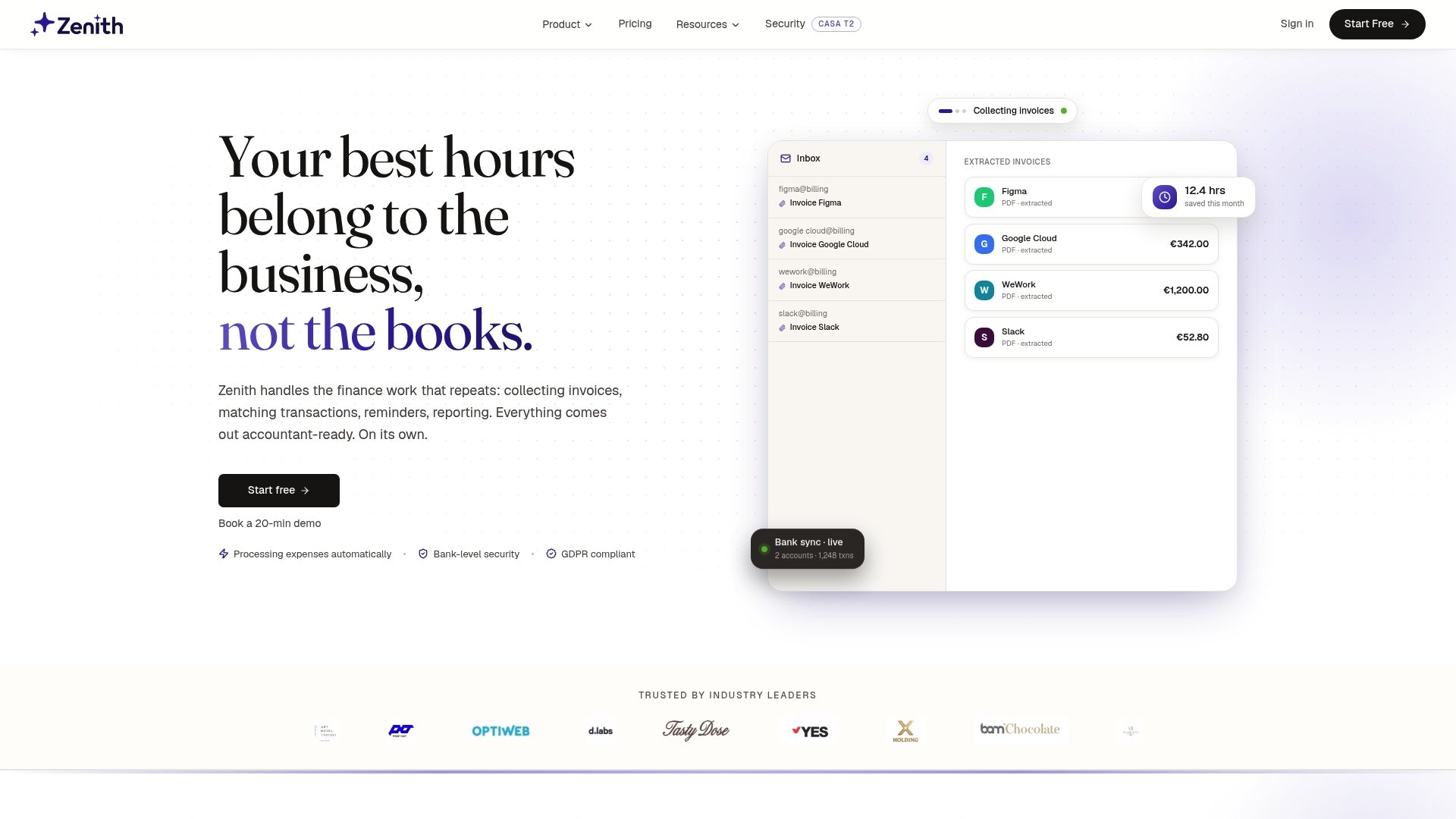
The invoices-to-Drive workflow handles auto-filing with configurable naming conventions, isolated counters per entity, and exportable logs you can hand to an auditor without any preparation. You also get a free payment QR code on every invoice, which speeds up reconciliation by linking payment directly to the invoice number. Start with a free trial and set your starting counter to continue your existing sequence on day one.
Sources
These are the primary references used in this article. Save them for audit prep or to verify any specific rule.
- Gov
- VAT invoicing rules - European Commission
- Invoice Numbering: Rules and Best Practices | Billstride
This article is general information, not a substitute for advice from a qualified financial advisor. Consult a qualified financial professional about your own circumstances before acting on anything here.