

Multi Bank Data Aggregation: Implementation First, 2,400+ Bank Option

Multi-bank data aggregation pulls read-only balances and transactions from every bank account a business holds into one consolidated feed, using regulated APIs under PSD2 or protocols like EBICS. The outcome is a single source of truth for cash position, reconciliation, and reporting, replacing manual logins and spreadsheet exports across multiple banking portals.
TL;DR:
- Using PSD2 APIs with proper consent management ensures read-only access, but data may vary in coverage and transaction depth depending on the bank.
- Building a canonical data schema and validation layer is essential to handle inconsistent raw bank data and prevent ongoing reconciliation issues.
- Hybrid integration approaches, combining open banking APIs with EBICS or host-to-host connections, are common for mid-sized businesses handling diverse bank relationships.
- Security practices like encryption, detailed audit logs, and anomaly detection are critical to prevent silent data gaps and ensure ongoing compliance.
- Zenith’s Bank Sync offers quick setup across over 2,400 banks, simplifying the implementation of multi-bank aggregation without custom development.
Table of Contents
- How multi-bank data aggregation works: AISPs, consent flows and data normalisation
- Use cases and business benefits finance teams actually get
- Which integration approach fits: open banking APIs, EBICS or host-to-host?
- What data protection and consent rules apply under PSD2 and GDPR?
- Implementation checklist: rolling out multi-bank aggregation step by step
- How does Zenith’s bank-sync approach map to this checklist?
- Comparison of leading multi-bank data aggregation vendors and platforms
- Security best practices beyond regulatory compliance
- Performance metrics and SLAs critical for aggregation solutions
- What’s next: AI-powered insights and deeper automation
- Build versus buy: honest criteria for finance operators
- Get consolidated bank data running without building the pipeline yourself
- Sources
- FAQ
How multi-bank data aggregation works: AISPs, consent flows and data normalisation
The regulatory engine behind multi-bank data aggregation is the account information service provider, or AISP. Under PSD2, an AISP has the legal right to request read-only access to a customer’s payment account data directly from the bank’s API, provided the customer gives explicit consent and the AISP is properly registered. This is what separates modern aggregation from the screen-scraping tools of a decade ago, which logged into banking portals using stored credentials and parsed the HTML.
Once consent is granted, Open Banking guidance allows some ASPSPs to skip re-authentication for up to 90 days after the initial strong customer authentication (SCA) step. That sounds convenient until a bank changes its token expiry logic without warning, which happens more often than most integration teams expect.
Two connectivity models dominate in practice:
- API-based retrieval: near real-time pulls via REST endpoints, usually polling every few hours or using webhooks where the bank supports them.
- EBICS or host-to-host (H2H): bulk file exchange, typically for enterprise statement formats like MT940 or CAMT.053, common across German and French corporate banking.
Whichever route you take, raw bank data arrives in wildly inconsistent shapes. One bank labels a field “narrative”, another calls it “reference”, a third splits it across three columns. A canonical schema, with a mapping and validation layer sitting between the raw feed and your accounting system, is not optional. Skip it and you will spend more time firefighting malformed IBANs than you saved by automating the connection in the first place.
Use cases and business benefits finance teams actually get
Consolidated bank data only matters if it changes what a finance team does day to day. The realistic wins, roughly in order of how fast they pay back:
- Live cash position reporting — balances across every account, in one sheet or dashboard, updated without anyone logging into five banking portals.
- Automated reconciliation — transactions matched against invoices and general ledger entries without a bookkeeper manually cross-referencing statements.
- Faster month-end close — reconciliation that used to take days compressed into hours because the matching logic runs continuously, not once a month.
- Fewer duplicate payments — cross-account visibility catches a supplier paid twice from different accounts before it becomes a write-off.
- Better forecasting — a rolling, accurate cash picture instead of a stale export from last Tuesday.
Platform operators use the same underlying data for slightly different jobs: merchant onboarding checks (does this business actually hold the account it claims?), payout validation before releasing funds, and credit decisioning based on real transaction history rather than a static bank statement PDF. The technical plumbing is identical. Only the business logic on top changes.
Which integration approach fits: open banking APIs, EBICS or host-to-host?
The right choice depends on four things: how many banks you need, what SLA you can tolerate, how complete the data needs to be, and how much operational overhead your team can absorb. There is no single correct answer, only trade-offs.
- API-first (PSD2/open banking) gives the broadest coverage across retail and business banking with the least setup friction, but data completeness varies by bank and some ASPSPs still lag on transaction history depth.
- EBICS suits enterprise treasury teams needing bulk statement files and payment initiation across large European corporate banking relationships, particularly in Germany and France, though it demands more specialised setup than a typical API integration.
- Host-to-host (H2H) works when a bank offers a bespoke, high-volume connection outside standard open banking rails, usually for large corporates with existing bank relationships that predate PSD2.
Most mid-market finance teams end up running a hybrid: open banking APIs for the majority of accounts, with EBICS or H2H reserved for the one or two enterprise banking relationships that need it. Whatever the mix, build a canonical data layer once and route every connection type through it, rather than writing bespoke logic per bank.
Pro Tip: Build your retry and backfill logic before you go live, not after the first outage. Token refresh failures and missed SCA windows are the single most common cause of silent data gaps in bank aggregation, and they rarely announce themselves loudly.
What data protection and consent rules apply under PSD2 and GDPR?
An AISP’s right to pull bank data under PSD2 is not unlimited. It runs alongside GDPR, and the two frameworks interact in ways that catch teams out if they treat consent as a one-time checkbox rather than an ongoing obligation. EDPB guidance is explicit that AISPs and banks must design consent and data flows around minimisation, meaning you request only the data your use case actually needs, not everything the API happens to expose.
Open Banking’s own guidance recommends grouping requested data into permission clusters shown clearly on the consent screen, rather than one long list of technical field names nobody reads properly. Customer research behind that standard found grouped, plain-language permissions genuinely improve how well people understand what they are agreeing to.
Practical controls worth building from day one:
- Consent expiry tracking, so access does not quietly outlive the customer’s actual authorisation.
- Full audit logging of every data pull, for both compliance evidence and debugging.
- A defined breach-response path specific to financial data, not a generic incident template.
- Anonymisation or aggregation before feeding data into secondary uses like credit scoring, which industry submissions to the EDPB flag as a legitimate use case provided the lawful basis is properly documented.
Implementation checklist: rolling out multi-bank aggregation step by step
A working pilot beats a perfect specification document. Here is the sequence that avoids the most expensive mistakes:
- Define scope first. List the exact data elements the use case needs, balances only, full transaction history, or statement-level detail, before touching any API.
- Choose connectivity and design the schema. Pick API, EBICS, or a hybrid, then build the canonical transaction model and validation rules before connecting a single bank.
- Build the consent and token lifecycle. Handle SCA renewal, expired tokens, and failed re-authentication as expected events, not edge cases.
- Pilot with a representative bank mix. Three or four banks with genuinely different data formats will surface more mapping problems than twenty banks that all behave the same way.
- Validate data quality, then scale. Only once reconciliation accuracy holds up under real data should you widen the rollout, with an operational playbook for handling the banks that misbehave.
Pro Tip: Agree your canonical field list before you connect your second bank. Teams that try to normalise every possible field from every bank at once usually rebuild the schema twice; teams that start with ten essential fields rarely need to.
How does Zenith’s bank-sync approach map to this checklist?
Zenith’s Bank Sync is a read-only PSD2 connection covering 2,400+ banks across 30 European countries, with setup claimed at around five minutes per account. Data delivers to Google Sheets, Claude via MCP, a REST API, or CSV, covering steps three and four of the checklist above (connectivity and delivery format) without custom development. These are publisher-stated facts, and the Zenith documentation is the place to verify current coverage and setup detail against your own bank mix before committing.
Comparison of leading multi-bank data aggregation vendors and platforms
The vendor landscape splits into three broad categories rather than a single ranked list, and which one fits depends heavily on where you sit in the stack.
Enterprise treasury platforms focus on large corporates running EBICS or H2H alongside API connections, usually bundled with cash management and liquidity forecasting tools. They tend to carry longer implementation timelines and higher minimum contract sizes, which suits multinational treasury teams more than a growing SMB finance function.
Pure-play open banking API providers specialise in broad European bank coverage delivered through a single integration layer, aimed at fintechs and platforms that need to embed account data into their own product rather than consume it directly as a finance team.
Finance-automation platforms with bank sync built in, the category Zenith sits in, pair bank data directly with the accounting and reconciliation workflow, so the aggregated feed does something immediately (matching, categorising, exporting) rather than landing as a raw dataset that still needs building on top of. For a finance operator who wants cash visibility and reconciliation in the same tool rather than a data pipe to build against, that bundling is usually the deciding factor over raw API breadth alone, supported by expert accounting for Amazon sellers.
Coverage depth, delivery format flexibility, and how the SLA changes when a bank connection breaks all vary meaningfully within each category. Test with your actual bank mix rather than a published coverage number, since headline bank counts rarely reflect data completeness for less common account types.
Security best practices beyond regulatory compliance
Regulatory compliance is the floor, not the ceiling. PSD2 and GDPR tell you what you must do; they do not tell you what a genuinely secure aggregation setup looks like in practice.
Encryption should cover data both in transit and at rest, which sounds obvious until you check whether cached balance data sitting in an intermediate database is actually encrypted or just assumed to be, because “the API connection is encrypted.” Token storage deserves the same scrutiny as password storage: hashed, scoped to the minimum permissions needed, and rotated on a schedule rather than left to expire naturally.
Anomaly detection matters more in aggregation than in most other data pipelines, because the failure mode is not obvious. A bank silently returning stale balances, or a token quietly failing to refresh, does not throw an error. It just produces wrong numbers that look plausible. Build monitoring that flags:
- Balances that have not updated within an expected window per bank.
- Transaction volumes that drop sharply compared with the same period last month.
- Repeated authentication failures on a single account, which can indicate either a technical fault or a genuine security event.
Access logging matters too, not just for compliance audits but because a full log of every data pull is often the fastest way to diagnose a reconciliation discrepancy weeks later. Treat your bank data pipeline with the same operational seriousness you’d apply to a payments system, because functionally, that’s close to what it is.
Performance metrics and SLAs critical for aggregation solutions
Uptime alone tells you almost nothing useful about an aggregation service. A connection can report 99.9% uptime while still delivering stale or incomplete data, because uptime measures whether the pipe is open, not whether what’s flowing through it is correct.
The metrics that actually matter for finance operators are data freshness (how long after a real transaction does it appear in your feed), completeness (what percentage of transactions arrive with all required fields populated), and reconciliation match rate (what percentage of transactions match automatically against invoices or GL entries without manual intervention). A connection that refreshes every fifteen minutes but drops 10% of reference fields is often worse in practice than one that refreshes hourly but delivers clean, complete records every time.
SLAs worth pinning down before you commit to a provider:
- Maximum acceptable delay between a transaction posting at the bank and it appearing in your feed.
- Guaranteed re-authentication support when a token expires mid-cycle, and how quickly a broken connection gets flagged.
- A defined process, and ideally a time limit, for restoring a connection when a specific bank changes its API without notice, which happens more often than any vendor likes to admit.
Ask any provider what their actual reconciliation match rate looks like across a representative mix of banks, not just their best-performing ones. That number tells you more about real-world reliability than any headline uptime figure.
What’s next: AI-powered insights and deeper automation
The next phase of multi-bank aggregation is less about connecting more banks and more about what happens to the data once it lands. Categorisation that today relies on rule-based matching (this reference string usually means this supplier) is shifting toward models that learn from transaction patterns across a much larger dataset, catching matches that a fixed rule set would miss entirely.

Anomaly detection is heading the same direction. Instead of a threshold alert (“balance dropped by more than X”), pattern-based detection can flag a transaction that looks wrong for a specific account’s normal behaviour, even when it falls within an otherwise sensible range. That distinction matters for fraud detection specifically, where the suspicious transactions are rarely the ones that trip an obvious threshold.
Expect deeper integration between bank data and forecasting too: rolling cash flow projections that update automatically as real transactions land, rather than a monthly manual forecast built from a stale export. The direction of travel across the industry is toward less manual normalisation work for finance teams and more automated exception handling, catching the transaction that doesn’t match rather than requiring someone to check every transaction that does.
Build versus buy: honest criteria for finance operators
If you’re connecting fewer than a dozen banks with no in-house integration team, building your own aggregation layer rarely pays off once you account for field-mapping drift and SCA token handling. Pilot with a real bank mix, three or four accounts with genuinely different formats, before committing either way.
— Gašper Anderle
Get consolidated bank data running without building the pipeline yourself
Everything covered above, the AISP consent flows, the canonical schema, the token monitoring, the validation layer, is real engineering work, and building it properly for even a handful of banks takes longer than most finance teams budget for. Zenith’s Bank Sync is the alternative to building that pipeline in-house: a read-only PSD2 connection across 2,400+ banks in 30 European countries, live in around five minutes per account, at €5 per account per month, with data landing in Google Sheets, Claude via MCP, a REST API, or CSV depending on how your team already works.
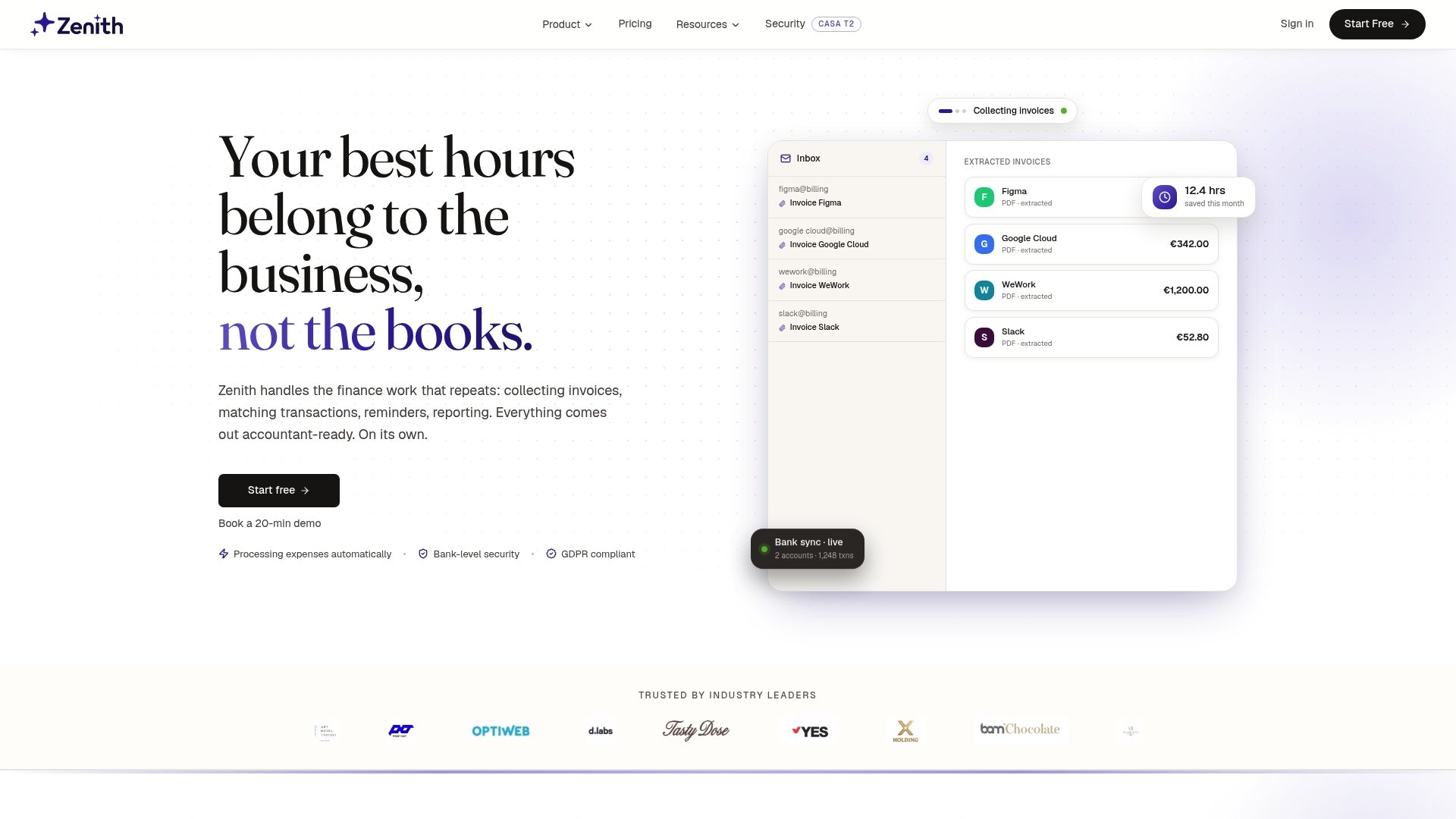
There’s a 30-day money-back guarantee if it doesn’t fit your bank mix once you’ve actually tried it against your own accounts. If invoice processing and reconciliation sit alongside your bank data problem, the same platform runs AI-powered invoice capture too, worth testing via Zenith’s OCR. Full plan details sit on the pricing page, so you can check what a full rollout costs before committing beyond a pilot.
Sources
Consult PSD2 for AISP legal rights, OBIE for consent UX, EDPB for GDPR interplay, and EBICS for host-to-host norms.
- EDPB guidelines on the interplay of PSD2 and the GDPR