
Ramp Alternatives for Finance Teams: Pick by Roadmap

Finance teams prioritizing invoice automation should choose Zenith-books. Its AI-powered OCR, email-to-invoice ingestion, bank sync, and eSlog accounting exports handle the full bookkeeping loop without manual entry. For every other roadmap, the right category depends on what your team actually spends time on.
- Invoice/AP-first: Zenith-books. AI invoice extraction, automated transaction matching, and eSlog exports cover the core workflow. Clients like Združenje YES and BAM Chocolate report zero manual entry and shorter month-end close times.
- Card-first: Corporate card platforms with virtual card issuance and spend controls. As IndustryLens notes, Ramp itself is card-first — switching makes sense only when your roadmap demands something Ramp doesn’t prioritize.
- Travel/T&E-first: Dedicated T&E platforms with full hotel and flight inventory, self-serve modifications, and policy enforcement. Ramp Travel currently supports round-trip flights only and ties bookings to the Ramp card, making it weak for T&E-heavy teams.
- Banking-led: Platforms that consolidate accounts, cash positions, and payment rails into one dashboard.
- Procurement/AP-first: Tools built around PO matching, three-way reconciliation, and approval workflows for mid-market and enterprise teams.
Two trust signals worth anchoring to: Zenith-books publishes 99.7% OCR accuracy on its test page, and the platform carries SOC 2 compliance and eSlog export support for standardized accounting handoffs.
Table of Contents
- Which Ramp alternative fits your team at a glance?
- How do you choose the right Ramp alternative for your finance team?
- When to pick each alternative and how to migrate
- Key Takeaways
- Why invoice-first automation keeps winning
- Try Zenith-books on your own invoices before you commit
- Useful sources for vendor verification
Which Ramp alternative fits your team at a glance?
| Dimension | Zenith-books (invoice-first) | Card-first platforms | Travel/T&E platforms | Banking-led bundles | Procurement/AP platforms |
|---|---|---|---|---|---|
| Best for / size | SMBs and startups automating bookkeeping | Startups needing spend controls | T&E-heavy teams, frequent travelers | Teams consolidating accounts | Mid-market needing PO matching |
| Core focus | Invoice OCR, AP automation, bookkeeping | Corporate cards, virtual cards | Expense reports, travel booking | Cash management, payments | Procurement, three-way reconciliation |
| Banking & payments | Bank sync to Google Sheets, ACH, QR payments | Virtual cards, ACH | Card-tied travel payments | Multi-account aggregation, wires | ACH, vendor payments |
| Invoice automation / OCR / AI | AI extraction, email ingestion, auto-categorization | Basic or none | Receipt capture | Limited | PO matching, invoice approval |
| Procurement & approvals | Invoice approval workflows | Spend limits, card controls | Policy enforcement | Limited | Full PO and approval chains |
| Accounting integrations | Google Sheets, eSlog, CSV exports | QuickBooks, Xero | QuickBooks, Xero, NetSuite | Varies | NetSuite, SAP, QuickBooks |
| Pricing model | Tiered subscription, pay-as-you-go by invoice/page | Per user/card; Ramp Plus pricing is anchored at $12 per user per month for mid-market tiers, aligning with commonly published information. | Per user or transaction | Per account or user | Per user, enterprise tiers |
| Ease of implementation | Fast; no-code email and bank connections | Fast for card setup | Moderate | Moderate | Complex; longer timelines |
| Security & compliance | SOC 2, encryption at rest | SOC 2 common | SOC 2 common | SOC 2, bank-grade | SOC 2, enterprise audit trails |
| Support & SLA | Published SLA, dedicated onboarding | Varies by tier | Varies | Varies | Enterprise SLAs |
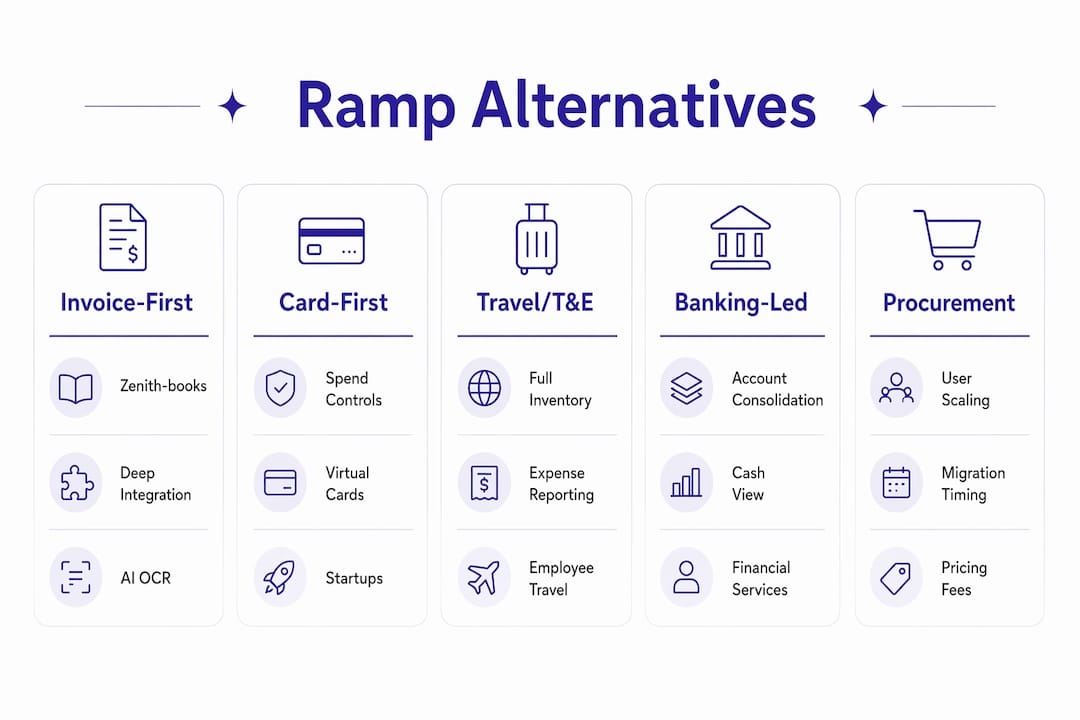
Zenith-books wins for invoice/AP-first teams. Card-first platforms suit startups that need to spend visibility before they have heavy AP volume. Procurement/AP platforms earn their complexity for mid-market firms with PO-driven purchasing.
Quick selection tips:
- If month-end close time is your primary pain point, pick an invoice-first platform.
- If you run more than 50 expense reports per month, a T&E-first tool pays for itself quickly.
- If your team issues purchase orders regularly, procurement-first platforms reduce reconciliation errors.
How do you choose the right Ramp alternative for your finance team?
Choose by primary roadmap need, not by feature count. A platform with 200 features that doesn’t export eSlog or connect to your bank is harder to use than a focused tool that does both well.
Evaluation checklist:
- Integration depth: does it connect natively to QuickBooks, Xero, or NetSuite? Can it export eSlog or CSV for your accountant?
- OCR accuracy and AI matching: ask for a sample test on your own invoices, not a demo dataset.
- Payment rails: does it support ACH, virtual cards, and international wire if you pay foreign vendors?
- Procurement controls: do you need PO matching and three-way reconciliation, or just invoice approval?
- Pricing transparency: is pricing published? Are there per-invoice, per-page, or per-transaction fees that compound at scale?
- Time-to-close impact: ask vendors for references who can speak to month-end close speed before and after migration.
Vendor questions to ask during demos:
- Show me a sample eSlog export from a real transaction.
- Provide your SOC 2 Type II report or a summary letter.
- What is your published SLA for support response?
- Walk me through a sample data migration timeline for a team our size.
- How is data encrypted at rest and in transit, and what is your retention policy?
Red flags: no published integration list, pricing only available after a sales call, support handled by a single person with no backup, and no reference customers willing to discuss time-to-close results.
Pro Tip: Before your final vendor decision, run a one-week parallel test: process your last month’s invoices through the new platform while keeping your current system live. Measure OCR accuracy, export quality, and how long reconciliation takes. That single test reveals more than any demo.
Score vendors on a 1–5 rubric across six dimensions: integration depth, OCR accuracy, payment rails, pricing clarity, support quality, and time-to-close references. Any vendor scoring below 3 on integration or OCR should be eliminated regardless of price.
When to pick each alternative and how to migrate
Invoice/AP-first: Zenith-books
Zenith-books fits teams where the biggest time drain is manual invoice entry, bank reconciliation, and month-end reporting. It automates invoice collection from email, matches transactions, and syncs bank data live to Google Sheets. Pricing is tiered by usage (invoice pages, bank accounts), with a free tier and pay-as-you-go options. Implementation is fast because connections are email-based and no-code.
Card-first platforms
The right pick for startups that need spend controls and virtual cards before AP volume justifies a dedicated invoicing tool. These platforms price per user or per card. Implementation is quick, but invoice automation is limited or absent.

Travel/T&E-first platforms
Built for teams where employee travel is the dominant expense category. They offer full hotel and flight inventory, self-serve itinerary changes, and policy guardrails. Ramp’s travel module lacks self-serve hotel modifications and ties bookings to its card, which frustrates frequent travelers. T&E platforms price per user or per transaction and take moderate effort to configure policy rules.
Banking-led bundles
Best for teams consolidating multiple accounts and needing a single cash position view — see financial services tailored for high-net-worth individuals. These tools handle payment rails well but rarely match the invoice automation depth of AP-first platforms. Useful for treasury-focused finance teams at growth-stage companies. For teams evaluating banking consolidation, Zenith-books also offers live bank-to-Sheets sync as a complementary feature.
Procurement/AP-first platforms
Mid-market and enterprise teams with PO-driven purchasing need three-way reconciliation and approval chains. These platforms are the most complex to implement and price at enterprise tiers. Company size and complexity determine fit: a 20-person startup rarely needs full procurement structure, but a 300-person operation team almost always does.
Migration checklist:
- Pre-migration audit: export your current chart of accounts, open invoices, and vendor list.
- Map chart of accounts to the new platform’s categories and confirm eSlog or CSV export format.
- Run sample data tests: process 20–30 real invoices and verify OCR output and categorization.
- Parallel run: operate both systems for one full billing cycle.
- Cutover: migrate live data, disable old system access, and confirm bank sync is active.
- Post-cutover reconciliation: match the first month-end close against your previous system’s output.
Sample timelines: small teams (under 50 users) typically complete migration in 2–3 weeks; mid-market (50–500 users) in 4–8 weeks; enterprise (500+) in 3–6 months depending on ERP complexity.
Pricing dimensions to budget for: per-user or per-card fees, per-invoice or per-page OCR charges, transaction fees on payments, and enterprise tier minimums. To get a predictable total cost of ownership, ask vendors to model your actual monthly invoice volume and user count, not a generic estimate.
Pro Tip: Preserve month-end reporting continuity by running a full close in both systems during your parallel period. Export eSlog or CSV from the new platform and reconcile it line-by-line against your existing close. Any discrepancy caught here is far cheaper to fix than one discovered after cutover.
Key Takeaways
For invoice-first finance teams, Zenith-books is the strongest Ramp alternative because it combines AI invoice OCR, email ingestion, bank sync, and eSlog exports in one subscription with no per-seat pricing complexity.
| Point | Details |
|---|---|
| Pick by roadmap, not features | Match the platform category to your primary need: invoice, card, travel, banking, or procurement. |
| Zenith-books for invoice-first teams | AI OCR, email ingestion, eSlog exports, and SOC 2 compliance make it the focused AP automation pick. |
| Integrations beat feature counts | Native QuickBooks, Xero, or NetSuite exports and eSlog support reduce migration risk more than any feature list. |
| Watch pricing dimensions | Per-invoice, per-page, and per-transaction fees compound; model your actual volume before signing. |
| Run a pilot before full migration | Test OCR accuracy and eSlog export quality on real invoices for 2–4 weeks before committing to cutover. |
Why invoice-first automation keeps winning
The shift toward invoice-first platforms isn’t a trend. It’s a correction. For years, finance teams adopted card-first or all-in-one spend tools because the UX was polished and the sales cycle was short. Then they discovered that invoice processing, the actual source of most month-end pain, was an afterthought in those platforms.
Integration maturity beats feature counts for any finance leader who has lived through a bad migration. A platform with 50 integrations listed on its website but no working eSlog export is worse than a focused tool with three solid connections. Zenith-books clients like Združenje YES and BAM Chocolate report reduced month-end close times and zero manual entry across transactions. Those outcomes come from the combination of AI extraction, automatic categorization, and clean accounting exports, not from a long feature list.
That said, not every team should go invoice-first. If your primary pain is employee travel or corporate card sprawl, an AP automation tool won’t fix it. The honest answer is that the right platform is the one that eliminates your biggest manual bottleneck, and for most small and mid-sized finance teams, that bottleneck is still invoice entry and reconciliation.
Try Zenith-books on your own invoices before you commit
If invoice OCR and hands-off bookkeeping are your main goal, a short Zenith-books pilot is the fastest way to validate fit before a full migration.
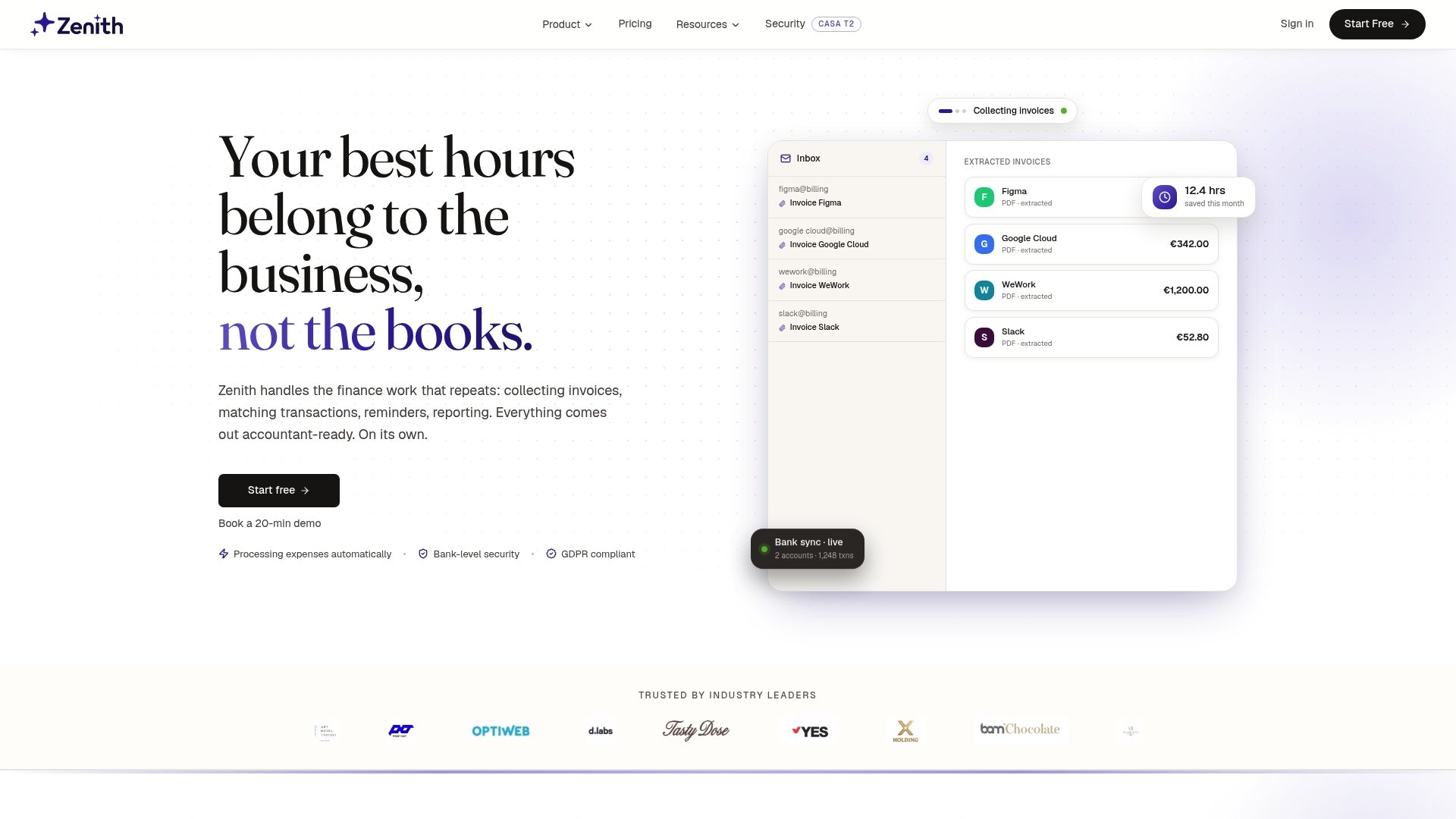
What to test in a 2–4 week pilot:
- Email-to-invoice ingestion: forward a batch of vendor invoices and confirm they land in Google Drive, named and categorized correctly.
- OCR accuracy: run your last 30 invoices through the invoice OCR test and check line-item extraction against the originals.
- Bank-to-Sheets sync: connect one bank account and confirm live cash flow data appears in Google Sheets within the expected refresh window.
- eSlog export: generate a sample eSlog file and open it in your accounting software to confirm field mapping.
Start the pilot at Zenith-books invoice automation or test OCR accuracy directly before signing up for anything.
Useful sources for vendor verification
Before finalizing any vendor, verify claims directly rather than relying on marketing pages alone.
- Gartner Peer Insights — Ramp alternatives: buyer reviews covering evaluation, integration, deployment, support, and product capabilities. Use the review filters to find companies your size.
- IndustryLens — Ramp alternatives 2026: roadmap-first framing and category comparisons; useful for validating the card-first vs. AP-first decision.
- ITILITE — Ramp alternatives 2026: feature matrix with T&E-specific detail, including Ramp Travel’s current limitations.
- Precoro — Ramp competitors 2026: practitioner notes on company-size fit and migration disruption risks.
During vendor due diligence, request the SOC 2 Type II report directly (not a marketing summary), ask for bank partnership disclosures in writing, and pull the published integration list from the vendor’s documentation site rather than the sales deck. Published SLAs should appear in the contract, not just the website. Any vendor that cannot produce these on request during procurement is a red flag worth taking seriously.
This article is general information for evaluation purposes. Confirm current pricing, compliance certifications, and integration support directly with each vendor before making a procurement decision.