


Real-time financial reporting gives you minute-level visibility into cash, revenue and transactions instead of waiting for a monthly close. Most mid-market firms get more value from a faster close and near-real-time refreshes than from full streaming, according to CFO Upgrade’s analysis. Full real-time earns its cost only where decisions genuinely turn on minutes, such as treasury, fraud, or high-volume transaction flows. For most finance teams, the smarter first move is fixing the close, not buying a streaming platform.
TL;DR:
- Faster decision-making requires decision windows in minutes, not hours or days, making real-time data essential only for specific high-frequency flows.
- Prioritizing a faster close and improved dashboards yields more value for most firms than investing in full streaming architectures, which are costly and complex.
- Building trust in real-time data demands rigorous validation, automation, ownership, and continuous monitoring to prevent acting on inaccurate numbers.
- Implementing real-time reporting involves hybrid architectures with selective streaming and careful integration with legacy systems to avoid silent data discrepancies.
- Data security, privacy risks, and compliance requirements, especially with open banking rules and cross-border regulations, must be embedded in the architecture from the start.
Table of Contents
- What is real-time financial reporting, exactly?
- The business case: when should you actually invest in real-time?
- What benefits should you actually expect?
- How is a real-time reporting system actually built?
- How long does implementation actually take, and what does it cost?
- How do you make fast data trustworthy enough to act on?
- Where does real-time reporting actually change outcomes?
- Zenith’s evidence: how automation reduced month-end work in practice
- Your first 90 days: a practical checklist
- What security and privacy risks come with real-time data?
- Why does connecting to legacy systems cause so many problems?
- How do compliance rules shape what you can actually build?
- How do you keep a real-time system fast as data volume grows?
- Author perspective: lessons learned and pitfalls to avoid
- Ready to make your financial data decision-grade?
- Sources
What is real-time financial reporting, exactly?
The word “real-time” gets used loosely, and that vagueness costs finance teams money when they buy the wrong tool. There are three distinct latency tiers, and each one supports a different class of decision.
- Real-time (seconds to minutes): data updates almost instantly. This tier matters for treasury desks watching intraday liquidity, payment processors tracking failed transactions, or trading operations where a delay of ten minutes is a delay too long.
- Near-real-time (minutes to a few hours): data refreshes on a schedule frequent enough that it feels current without the infrastructure cost of true streaming. Cash position dashboards, sales pipeline tracking, and daily P&L snapshots usually sit here.
- Batch (hours to days): the traditional model. Data loads overnight or on a fixed schedule, which is entirely adequate for monthly board packs, statutory reporting, and most historical trend analysis.
There’s a fourth concept worth separating out: continuous close. That’s not about data speed at all. It’s a process discipline: closing the books incrementally throughout the month rather than compressing everything into a five-day scramble at month-end. You can run continuous close on batch data. Confusing the two leads teams to buy streaming infrastructure to solve what is really a process problem.
The business case: when should you actually invest in real-time?
Run a three-condition test before you spend a pound on streaming infrastructure. If your situation fails any of the three, near-real-time or a faster close will serve you better and cost a fraction as much.
- Decision window. Does the decision this data supports get made within minutes, or within days? A treasurer deciding whether to draw on a credit facility needs minutes. A CFO preparing quarterly guidance does not.
- Cost of delay. What does a six-hour lag actually cost you? For a payments business watching failed transactions, that lag can mean thousands in lost revenue. For a professional services firm, it usually means nothing measurable.
- Data trustworthiness. Can your source systems produce clean, reconciled data fast enough to stream? If your reconciliation process still takes three days to catch errors, streaming just moves bad numbers faster.
The uncomfortable red flags: if your auditors keep raising reconciliation issues, if your close regularly overruns five business days, or if your engineers are burning significant hours firefighting broken data feeds, you have a data-quality problem, not a speed problem. Solve that first.
For most mid-market finance teams, the honest recommendation is to prioritise a faster close and near-real-time dashboards. CFO Upgrade’s guidance is direct on this point: speed only adds value when the decision window is measured in minutes. Reserve full streaming for a demonstrated use case with a clear financial return, not because a vendor demo looked impressive.
What benefits should you actually expect?
The genuine payoff from faster financial data isn’t a vague sense of “being more informed.” It shows up in specific, trackable numbers.
- Cash visibility. Live bank feeds mean you see a payment failure or an unexpected large debit the moment it happens, not three days later during reconciliation.
- Shorter month-end close. Automating ingestion and matching removes the manual re-typing and chasing that eats most of a close cycle.
- Faster forecasting. With current data feeding your models, forecasts reflect this week’s reality rather than last month’s.
- Earlier anomaly detection. A duplicate payment or an unusual spike in expenses gets flagged while it’s still cheap to fix.
Companies that automate ingestion and reconciliation see measurably faster decision cycles and lighter month-end workloads, according to Phase3’s analysis of real-time financial data. That’s the actual mechanism: it isn’t the dashboard that saves time, it’s removing the manual steps feeding it.
Track these four KPIs to know whether an investment is working: close days (target a measurable reduction quarter over quarter), reconciliation error rate, hours spent per month on manual matching, and time between transaction and first review. If none of these move after six months, the investment isn’t paying off yet, whatever the dashboard looks like.
How is a real-time reporting system actually built?
Underneath any real-time reporting claim sits a fairly standard set of components, and understanding them helps you ask vendors sharper questions rather than nodding along to buzzwords.
Ingestion and CDC. Change data capture (CDC) watches source systems, your ERP, your bank feeds, your billing platform, and pushes out only what has changed, rather than re-pulling the whole dataset on a schedule.
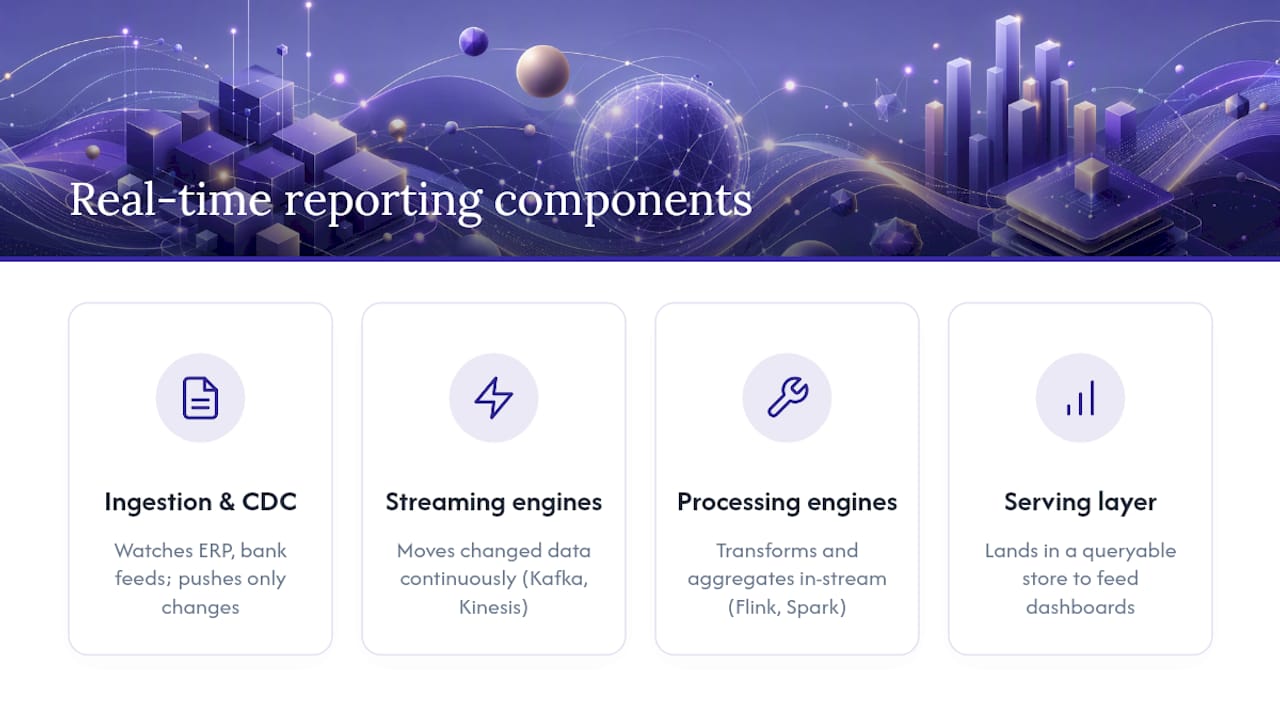
Streaming engines. Tools like Apache Kafka or AWS Kinesis move that changed data through the pipeline continuously rather than in scheduled batches.
Processing engines. Apache Flink or Spark transform and aggregate the stream, applying business logic (currency conversion, categorisation, matching) as data flows rather than after it lands.
Serving layer and dashboards. The processed data lands somewhere queryable, feeding the dashboards your finance team actually looks at.
The pragmatic pattern most firms should adopt is hybrid: stream the handful of metrics where minutes genuinely matter, and batch-process everything else. HST Solutions’ cost analysis puts full streaming architecture at roughly €7,000 to €15,000 a month, while a hybrid approach cuts that by 60 to 70 percent and still meets most reporting needs.
When you’re evaluating connectors, ask each vendor about four categories specifically: ERP integration depth, payment processor coverage, bank feed reliability (including how they handle PSD2 requirements for open banking access), and billing system support. A tool that streams beautifully from one ERP but can’t reconcile your actual bank feed isn’t solving your problem.
How long does implementation actually take, and what does it cost?
Budget this in three phases, not one big build. Skipping straight to Phase 3 is the single most common way finance teams waste money on real-time projects.
- Weeks 1 to 6: fix data hygiene and compress the close. Before any streaming conversation, map every data source, resolve your worst reconciliation errors, and get your existing close process as tight as manual work allows. This phase alone often delivers most of the benefit people expect from “real-time.”
- Weeks 6 to 10: automate ingestion and pilot one near-real-time view. Connect your bank feeds and core system automatically, build one focused dashboard (cash position is the usual starting point), and run it alongside your existing reports to validate accuracy.
- Weeks 10 to 12 and beyond: selective streaming for critical flows only. If the pilot proves out and a genuine minute-level use case exists, extend streaming to that one flow, not your entire reporting suite.
Teams with reasonable existing data capability typically complete a working pipeline in six to eight weeks; organisations starting from a weaker technical base, or needing to hire specialist data engineering support, should plan for ten to twelve weeks. Staffing usually means one data engineer or a fractional contractor for the build, plus ongoing finance ownership of the metrics themselves. Full streaming infrastructure runs into the thousands of pounds monthly; the hybrid path costs a fraction of that.
Pro Tip: Set a decision gate at the end of Phase 2, not Phase 3. If your near-real-time pilot hasn’t measurably changed a decision within four weeks, don’t build the streaming layer, you’ve probably found your ceiling already.
How do you make fast data trustworthy enough to act on?
Speed without accuracy is worse than no speed at all, because wrong numbers delivered instantly get acted on faster too. Data quality is not an add-on to a real-time project, it’s the precondition for one.
Every pipeline needs automated validation at each stage, not just at the end. Phoenix Strategy Group’s build guidance recommends embedding reconciliation checks throughout the flow and assigning a unique run ID to every batch or stream event, so that any number on a dashboard can be traced back to the specific transactions that produced it.
- Set explicit freshness SLAs (how old can this number be before it’s flagged stale?) and error-rate thresholds for every automated feed.
- Build an incident playbook: who gets alerted when a feed breaks, and what’s the fallback reporting method while it’s fixed?
- Keep full lineage and retention records; auditors need to reconstruct exactly how a reported figure was calculated, months after the fact.
- Assign clear ownership of each metric to a named person, not a team, so that validation failures don’t get lost between desks.
Streaming reduces reporting latency, but it doesn’t remove the need for ongoing engineering ownership and automated quality gates. Treat a real-time pipeline as continuous operations, not a project you finish and walk away from.
That distinction, project versus operation, is where most real-time reporting investments quietly fail after the first six months.
Where does real-time reporting actually change outcomes?
Some use cases genuinely justify the investment. Others just sound impressive in a pitch deck.
- Treasury and cash monitoring. A payment failure alert that fires within minutes lets you fix a supplier or payroll issue before it cascades. This is the clearest, most defensible real-time use case in finance.
- Subscription revenue recognition. Under IFRS 15, timing matters, recognising revenue as it’s earned across a contract term needs data current enough to catch mid-cycle changes like upgrades or cancellations.
- Retail and hospitality inventory. Same-day promotions and stock decisions need current sales data, not yesterday’s batch load, particularly around high-volume trading periods.
- Everything else. Board reporting, statutory filings, quarterly trend analysis: near-real-time or even a well-run batch process is entirely adequate, and cheaper.
If your use case isn’t on that first list, near-real-time refresh, updated every few hours rather than continuously, will very likely deliver the same practical benefit at a fraction of the infrastructure cost.
Zenith’s evidence: how automation reduced month-end work in practice
Zenith-books automates the manual work that makes fast reporting untrustworthy in the first place: AI-powered invoice extraction, automatic bank-to-sheet syncing, and transaction matching that runs without a bookkeeper re-typing figures. That’s the practical route to decision-grade near-real-time data.
- AI invoice extraction and categorisation removes the retyping step that introduces most reconciliation errors.
- Live bank data syncing to Google Sheets gives finance teams a current cash position without waiting for a monthly bank reconciliation.
- Automated transaction matching closes the gap between what a bank feed shows and what the books say, continuously rather than at month-end.
Clients including Združenje YES and BAM Chocolate report shorter month-end close times and zero manual entry across their transaction volume after adopting this approach. Neither started with a streaming platform. Both started by automating the ingestion and matching steps that were previously eating days of manual work, which is precisely the Phase 1 to Phase 2 sequence described above.
Your first 90 days: a practical checklist
You don’t need a data engineering team to see most of the benefit. You need discipline in this order.
- Days 1 to 30: Map every data source feeding your reports. Fix your three worst recurring hygiene errors (duplicate entries, mismatched vendor names, unreconciled bank lines are the usual suspects). Build one near-real-time dashboard, cash position is the highest-value starting point.
- Days 30 to 60: Automate your bank and invoice connectors so data lands without manual entry. Write explicit reconciliation rules rather than relying on someone noticing discrepancies by eye.
- Days 60 to 90: Install monitoring and alerting on your automated feeds. Review your KPIs, close days, error rate, reconciliation hours, and decide whether any single flow justifies selective streaming.
If, after 90 days, one specific decision is still bottlenecked by data that’s hours rather than minutes old, that’s your signal to scope a targeted streaming pilot, not a full platform rebuild.
What security and privacy risks come with real-time data?
Continuous data flows widen your attack surface in ways a monthly export never did. Every live connection between your bank, ERP, and dashboard is a standing pipe that has to be secured, not just checked once at setup.

Bank connectivity is the sharpest example. Under PSD2 rules governing open banking in the UK and EU, any service pulling live bank data needs proper regulated access, either direct API integration under an authorised framework or a licensed intermediary. A finance team building its own direct bank feed carries the compliance burden of maintaining that authorisation itself.
Access control matters more with real-time systems than batch ones, because a compromised credential exposes current data immediately rather than a stale export. Role-based permissions, so a junior analyst sees the dashboard but not the raw bank credentials, are a baseline requirement, not a nice-to-have.
Encryption needs to cover data in transit between every system in the pipeline, not just data at rest in a database. A stream moving between your bank feed, your processing layer, and your dashboard passes through several handoff points, and each one is a place data could leak if it’s sent unencrypted.
Retention policy deserves explicit thought too. Real-time systems generate far more granular data than batch reports ever did, transaction-level events, not monthly summaries, and that granularity means more personal and commercial data sitting in more places. Decide deliberately what gets kept, for how long, and who can query it, rather than defaulting to “keep everything forever” because storage is cheap.
Why does connecting to legacy systems cause so many problems?
Most finance teams don’t build real-time reporting on a blank slate. They’re bolting it onto an ERP that’s been running for a decade, and that’s where projects genuinely stall.
Older ERP systems were built for batch processing, nightly jobs, scheduled exports, not continuous data flow. Some don’t expose a usable API at all, which forces you into screen-scraping or file-drop workarounds that are fragile and hard to monitor. Others expose an API that technically works but wasn’t designed for high-frequency polling, and hammering it with real-time requests can slow down the core system your whole finance team depends on.
Data model mismatches cause quieter damage. A legacy system’s chart of accounts, customer IDs, or transaction categories rarely map cleanly onto what a modern streaming pipeline expects. Getting that mapping wrong doesn’t throw an error, it just silently produces slightly wrong numbers that look plausible until someone spots the discrepancy weeks later.
The practical fix isn’t ripping out the legacy system. It’s building a clean integration layer, using connectors purpose built for your specific ERP rather than generic file exports, and validating the data mapping thoroughly before trusting a single dashboard number. This is exactly why mapping data dependencies before streaming sits at the front of any sensible implementation plan rather than the back.
How do compliance rules shape what you can actually build?
Regulatory requirements aren’t a box you tick after the system works, they shape the architecture itself, particularly around auditability and data provenance.
Auditors need to reconstruct any reported figure back to its source transactions, which means your pipeline needs the run ID and lineage tracking described earlier from the outset, not retrofitted after your first audit flags a gap. Retrofitting traceability into a live system that’s already streaming is considerably harder than building it in from day one.
IFRS 15’s revenue recognition timing rules add specific pressure for subscription and contract-based businesses, since recognising revenue as it’s earned requires data current enough to catch mid-contract changes accurately. Get that data pipeline wrong and you’re not just slow, you’re materially misstating revenue.
Data residency and cross-border transfer rules also constrain where real-time infrastructure can physically sit, particularly for firms handling EU customer or transaction data. A streaming architecture hosted in the wrong region can create compliance exposure that a monthly batch export, processed and stored locally, never would.
The practical implication: build governance and audit trails into your architecture from Phase 1, not as an afterthought once the dashboards are live. It’s considerably cheaper to design for compliance than to bolt it on after a regulator or auditor asks a question you can’t answer.
How do you keep a real-time system fast as data volume grows?
A pipeline that performs well with a few thousand transactions a month can slow to a crawl at ten times that volume if it wasn’t built with growth in mind. Performance problems in real-time systems tend to appear suddenly, not gradually, once you cross a specific volume threshold.
The hybrid architecture discussed earlier is itself a performance strategy, not just a cost one. Streaming everything means every metric competes for the same processing capacity; restricting streaming to the handful of flows that genuinely need minute-level freshness keeps that capacity available where it matters and prevents low-priority data from crowding out high-priority alerts.
Indexing and partitioning your serving layer by the dimensions people actually query, date, entity, cost centre, prevents dashboards from scanning entire datasets for a single number. This is a database design question more than a finance one, but it’s worth finance leaders asking their technical team about directly, because a poorly indexed system will feel sluggish regardless of how good the underlying pipeline is.
Plan for volume growth explicitly rather than reactively. If you’re doubling transaction volume year on year, a system sized for today’s load will need re-architecting within twelve to eighteen months. Building in headroom from the start, and reviewing capacity at each of the decision gates in your implementation roadmap, costs far less than an emergency rebuild once dashboards start timing out.
Author perspective: lessons learned and pitfalls to avoid
The mistake I see most often is teams chasing speed before fixing hygiene, streaming garbage faster doesn’t make it less garbage, just faster garbage. The second most common failure is weak metric ownership: dashboards nobody’s actually accountable for drift out of date within months.
What actually works is unglamorous: assign a named owner to every KPI, automate the boring ingestion work first, and monitor freshness like you’d monitor uptime. Real-time reporting rewards discipline, not infrastructure spend.
— Gašper
Ready to make your financial data decision-grade?
Most of what this article covers, clean ingestion, automated matching, live cash visibility, is exactly what Zenith-books builds for finance teams who’d rather not hire a data engineer to get there. Instead of a streaming platform costing thousands a month, you get AI invoice extraction, automatic bank-to-sheet syncing, and reconciliation that runs without manual re-entry.
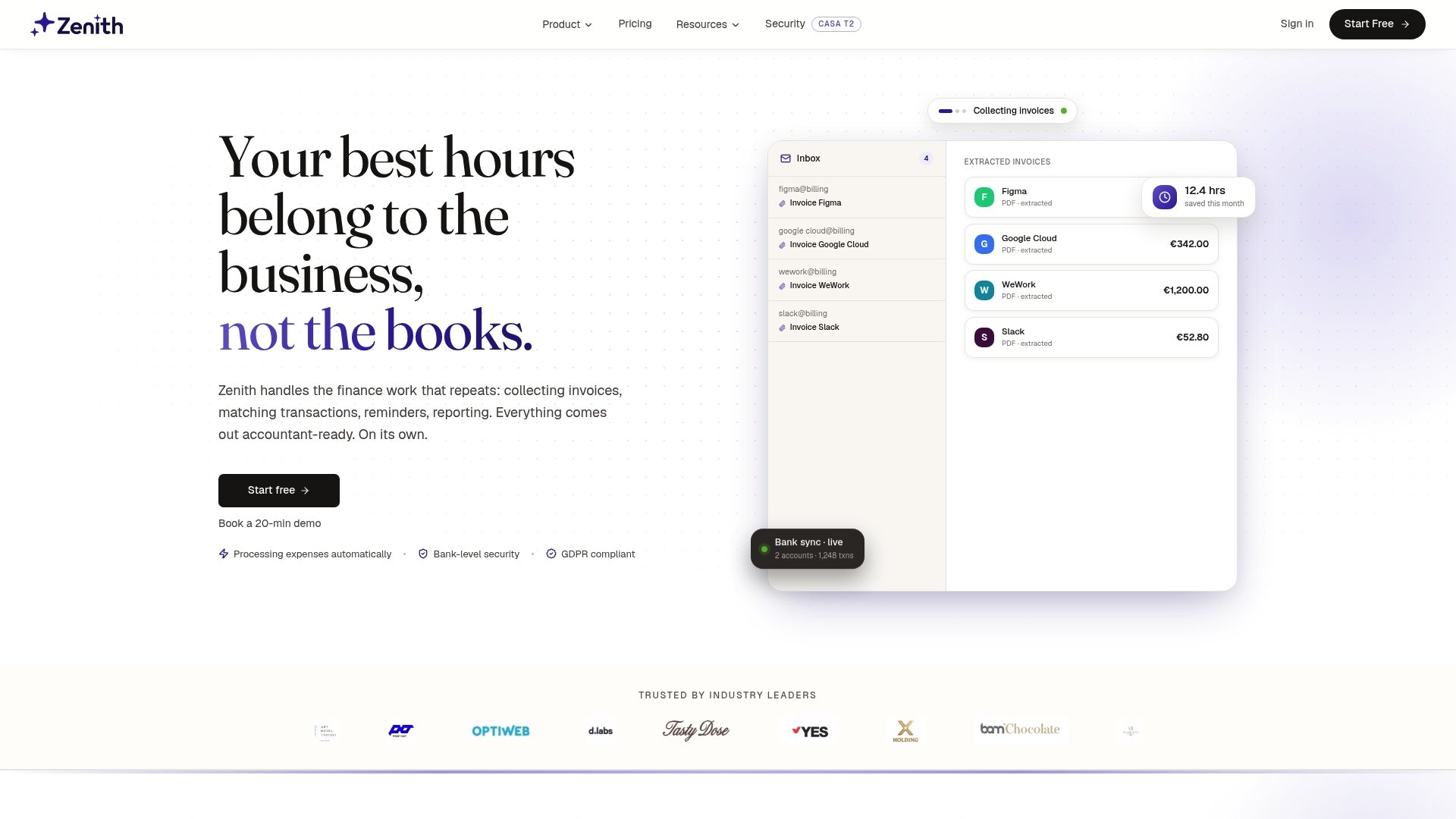
If cash visibility is your priority, live bank sync to Google Sheets gets you a current cash position without touching a streaming architecture. If your close is still eating a week every month, that’s the problem worth solving first, and it’s precisely where Zenith’s finance workflows start. Book a walkthrough and see what your close looks like with the manual steps removed.
Sources
- Real-Time Reporting — When Speed Adds Value and When It Does Not | CFO Upgrade - Modern Data Infrastructure
- How to Build Real-Time Data Pipelines for Faster Financial Reporting and Decision-Making - HST Solutions
- How to Build Real-Time Financial Reporting Systems - Phoenix Strategy Group
- How Real-Time Financial Data Can Benefit Your Business — Phase3