
The Best Tipalti Alternatives for Finance Teams

For mid-to-large U.S. finance teams that need reliable ERP reconciliation, automated tax workflows, and faster payables processing, the strongest alternatives to Tipalti are Zenith-books, Gigapay, and Routable. Zenith-books is the recommended starting point for teams prioritizing AI-powered invoice OCR, live bank-to-sheets sync, and fast implementation without heavy IT lift. Gigapay suits creator and influencer programs where a merchant-of-record model collapses hundreds of vendor entries into one. Routable fits mid-market teams running high-volume domestic payables. Two signals worth noting early: Zenith-books clients report zero manual entry across transactions and measurably shorter month-end close cycles. SOC 2-aligned security is a baseline expectation any credible alternative should meet.
Table of Contents
- Which Tipalti alternatives should you compare side by side?
- How does each vendor actually stack up?
- How do you choose the right alternative for your team?
- What does switching from Tipalti actually look like?
- What do real outcomes look like after switching?
- What does AP automation actually cost, and how do you calculate ROI?
- Key Takeaways
- Why integration depth matters more than feature lists
- Zenith-books cuts the manual work your team is still doing
- Useful sources and vendor documentation to consult next
Which Tipalti alternatives should you compare side by side?
| Dimension | Enterprise P2P suite | Mass payout / MoR platform | ERP-friendly AP automation | Plug-and-play OCR + bank sync |
|---|---|---|---|---|
| Best for | Full procure-to-pay transformation | Creator / contractor programs at scale | Mid-market AP with ERP depth | Fast-ROI invoice automation + reconciliation |
| Core AP automation | Full P2P, sourcing, spend controls | Payout-centric; limited invoice capture | Invoice capture, approvals, workflow | AI OCR, auto-categorization, email ingestion |
| High-volume payouts & MoR | Limited MoR; strong PO-based payables | MoR is core differentiator | Batch ACH/wire; no MoR | Focused on invoice-side automation |
| Payment methods & multi-currency | ACH, wire, card; multi-currency | Card, wallet, local rails, instant payouts | ACH, wire, check, multi-currency | Bank sync; payment QR codes |
| ERP / accounting integrations | SAP, Oracle, Coupa-native | API-based; ERP entry consolidation | NetSuite, QuickBooks, Sage Intacct | Google Sheets, Drive; open API |
| Compliance & tax support | Spend policy, VAT | DAC7, KSK/KU14; 1099-NEC, 1042-S | W-9/W-8, 1099, IRS workflows | eSlog export; tax-ready categorization |
| Reconciliation & reporting | Advanced GL matching | Single-vendor ERP entry per MoR run | Automated matching to GL | Real-time bank-to-sheets reconciliation |
| Security & certifications | SOC 2, ISO | SOC 2 | SOC 2 | SOC 2-aligned |
| Implementation time & IT effort | Several months; high IT | Several weeks to months; moderate | Several weeks to a few months; moderate | A short time frame; minimal IT |
| Pricing model | Enterprise contract | Per-payee or usage-based | Per-invoice or tiered | Subscription tiers; pay-as-you-go |
| Scalability | Large enterprise | High-volume creator programs | Mid-to-large multi-entity | SMB to mid-market |
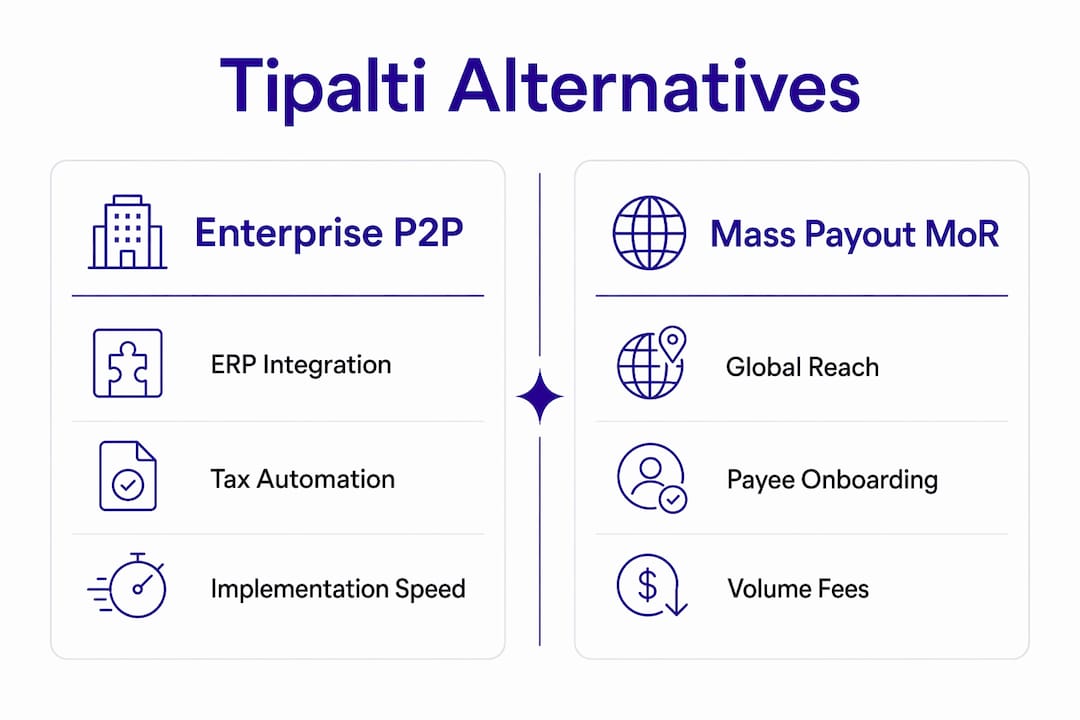
Key differentiators to flag before you go deeper: implementation speed separates Zenith-books from enterprise P2P suites by months, and merchant-of-record capability is a binary axis — either a platform takes on that legal and tax responsibility or it does not.

How does each vendor actually stack up?
Tipalti
- Standout strength: Deep AP automation with built-in W-9/W-8 and 1099 workflows and strong ERP connectors (NetSuite, Sage Intacct, SAP) — the reason mid-market tech and marketplace companies chose it originally.
- Key tradeoff: Implementation is substantial; pricing scales with payment volume in ways that surprise teams at growth inflection points.
- Ideal use case: Multi-entity tech companies running high-volume cross-border supplier payments who already have IT resources to manage the integration.
Zenith-books
- Standout strength: AI-powered invoice OCR extracts and categorizes invoices from email automatically, with live bank-to-Google Sheets sync and real-time cash visibility — all deployable in days, not quarters. Clients like Združenje YES and BAM Chocolate eliminated manual entry entirely.
- Key tradeoff: Focused on invoice automation and reconciliation rather than full procure-to-pay or merchant-of-record payouts; best paired with your existing ERP rather than replacing it.
- Ideal use case: Finance teams that want fast ROI from automation without a six-month implementation project — especially teams drowning in emailed invoices and manual bank reconciliation.
Gigapay
- Standout strength: The merchant-of-record model is the core product. Gigapay takes on tax and contractual obligations for creator payouts, collapsing thousands of vendor entries into a single ERP line and automating DAC7, KSK, and KU14 reporting.
- Key tradeoff: Purpose-built for creator and influencer programs; not a general AP automation platform. Teams needing full P2P or invoice-capture workflows will find gaps.
- Ideal use case: Brands running large creator or affiliate programs where vendor-master complexity and international tax compliance are the primary pain points.
Routable
- Standout strength: Clean, mid-market-friendly UI with solid domestic ACH and check payables, approval workflows, and QuickBooks/NetSuite connectors that get teams live relatively quickly.
- Key tradeoff: International payment rails and tax-automation depth are thinner than Tipalti’s; less suited for heavy cross-border or complex 1042-S workflows.
- Ideal use case: U.S.-focused mid-market teams that want a lighter-weight Tipalti replacement for domestic payables without the enterprise price tag.
Pro Tip: If your program pays more than a few hundred creators or contractors internationally, ask every vendor whether they are the merchant of record or merely a payment processor. The answer changes your 1099/1042-S filing burden dramatically.
How do you choose the right alternative for your team?
Start with a short decision checklist before you book a single demo.
- ERP coverage: Does the vendor have a certified connector for your ERP (NetSuite, Sage Intacct, SAP, QuickBooks)? Ask for the integration runbook, not just a logo on a website.
- Reconciliation automation: Can the platform match payments to GL entries automatically, or does your team still export CSVs and reconcile manually?
- Tax form automation: Does it generate and file W-9, 1099-NEC, and 1042-S forms, or does it hand you raw data and leave the filing to you? Tax-as-a-Service removes significant year-end overhead for high-volume disbursements.
- Multi-entity support: If you run more than one legal entity, verify the platform handles separate payment runs, GL mappings, and audit trails per entity.
- Currency rails: Which corridors does the vendor support natively, and what are the FX margins? Specialized payout platforms often support card, wallet, and local payment rails that standard AP tools do not.
- SLA for payment failures: What is the vendor’s committed resolution time when a payment fails? Get it in writing.
- Security certifications: SOC 2 Type II is the floor. Ask for the actual report, not a badge.
Red flags to watch: opaque per-payment fees that compound at volume, no exportable audit log, payee onboarding that requires your team to chase W-9s manually, and any vendor that cannot demo a live reconciliation flow in your ERP.
What does switching from Tipalti actually look like?
Migration complexity scales with entity count and payment volume. Here is a realistic playbook.
- Requirements mapping (weeks 1–2): Document every payment corridor, tax form type, ERP connector, and approval workflow currently in Tipalti. This list becomes your vendor scorecard.
- Data export (weeks 2–3): Pull vendor master records, historical payment data, tax forms on file, and reconciled bank statements. Confirm the new platform can ingest your vendor IDs and payment history without manual re-entry.
- Sandbox integration (weeks 3–5): Build and test the ERP connector in a non-production environment. Validate that GL mappings, entity codes, and tax classifications transfer correctly.
- Parallel runs (weeks 5–8): Run 1–3 payment cycles on both platforms simultaneously. Parallel payment cycles before cutover typically surface reconciliation gaps early and reduce go-live risk.
- Cutover and verification: Freeze Tipalti for new payments, complete a final reconciliation, and confirm payee payment-method preferences are active in the new system.
| Buyer profile | Realistic timeline | Key risk |
|---|---|---|
| Single-entity mid-market | Several weeks to a couple of months | ERP connector gaps |
| Multi-entity enterprise | A couple of months to several months | Vendor master data quality |
Pro Tip: Validate tax-automation outputs for 1099 and 1042-S before go-live, not after. A mismatch discovered in January costs far more to fix than one caught in the sandbox.
What do real outcomes look like after switching?
Zenith-books clients report measurable results. BAM Chocolate and Združenje YES both achieved zero manual entry across their transaction workflows and reduced month-end close times after deploying Zenith-books’s AI invoice extraction and bank reconciliation automation.
The pattern holds across the category. Finance teams that automate invoice processing from email eliminate the retyping and filing steps that consume AP staff hours every week. On the compliance side, platforms with built-in tax-form generation remove the year-end scramble of chasing contractor W-9s and manually preparing 1099-NEC filings.
- Zenith-books: zero manual entry, faster month-end close (Združenje YES, BAM Chocolate)
- Merchant-of-record platforms: single ERP vendor entry per payout run, automated international tax reporting
- Tax-as-a-Service vendors: reduced year-end recon overhead for high-volume 1099/1042-S programs
What does AP automation actually cost, and how do you calculate ROI?
Pricing models across this category fall into four shapes:
- Per-invoice or per-transaction: Common in AP automation; costs scale directly with volume.
- Per-payee or per-disbursement: Standard in payout platforms; watch for corridor surcharges on international rails.
- Monthly subscription tiers: Fixed cost up to a usage ceiling (OCR pages, bank accounts, invoice count); Zenith-books uses this model with pay-as-you-go options.
- Enterprise contract: Negotiated annually; common in full P2P suites.
| Cost driver | What to watch |
|---|---|
| Multi-entity setup fees | Often a per-entity charge on top of base subscription |
| Tax-filing add-ons | 1099/1042-S generation may be a separate SKU |
| FX margins | Spread on currency conversion compounds at high volume |
| Connector fees | Some vendors charge per ERP integration |
| Implementation services | Enterprise platforms often require paid onboarding |
A simple ROI frame: multiply hours saved per month by your AP team’s fully burdened hourly rate, then add the cost of errors caught before they become payment disputes. For most mid-market teams, eliminating manual invoice entry and bank reconciliation alone justifies the subscription cost within the first quarter.
Key Takeaways
The single most important factor when evaluating Tipalti alternatives is whether the platform automates the specific bottleneck your team hits hardest: ERP reconciliation, tax-form generation, or invoice capture.
| Point | Details |
|---|---|
| ERP integration is the top selection driver | Verify certified connectors for your ERP before shortlisting any vendor. |
| Merchant-of-record changes the equation | Creator programs benefit most from MoR platforms that consolidate vendor entries and handle international tax filings. |
| Tax automation reduces year-end cost | Platforms with built-in 1099/1042-S generation remove significant manual overhead at scale. |
| Migration needs parallel runs | Running 1–3 payment cycles on both systems before cutover surfaces reconciliation gaps early. |
| Zenith-books for fast-ROI automation | Evaluate Zenith-books first if your priority is AI invoice OCR, bank sync, and reconciliation without a long implementation. |
Why integration depth matters more than feature lists
Most finance teams shopping for Tipalti alternatives focus on feature parity — does it do 1099s, does it connect to NetSuite, does it support multi-currency. Those are necessary questions, but they are not the right first question. The right first question is: where does your team lose the most time right now?
ERP integration depth and reconciliation automation are the most frequent drivers of replacement decisions for mid-to-large finance teams. A platform with 50 features but a brittle ERP connector will cost you more in manual cleanup than the subscription saves. Conversely, a platform that does three things well — extracts invoices, syncs bank data, and reconciles to your GL automatically — can deliver ROI in weeks rather than quarters.
The merchant-of-record model is a specific case where the calculus flips. If you pay hundreds of creators internationally, the legal and administrative overhead of managing each as a separate vendor is the real cost. An MoR platform that collapses that into a single ERP entry is not just a convenience — it is a structural change to how your finance team operates. But for teams without creator programs, MoR capability is irrelevant, and paying for it is waste.
My honest recommendation: start with the bottleneck, not the feature sheet. If it is invoice chaos, test Zenith-books’s OCR. If it is creator payout complexity, evaluate an MoR platform. If it is procurement-to-pay transformation, you are looking at a different category entirely.
Zenith-books cuts the manual work your team is still doing
If your AP team is still retyping invoices, manually reconciling bank statements, or chasing month-end close, Zenith-books is the alternative worth testing first. Unlike full enterprise P2P suites that take months to deploy, Zenith-books’s plug-and-play finance workflows go live in days. AI-powered invoice OCR pulls data directly from email, categorizes it automatically, and syncs live bank data to Google Sheets so your team has real-time cash visibility without a single manual export.

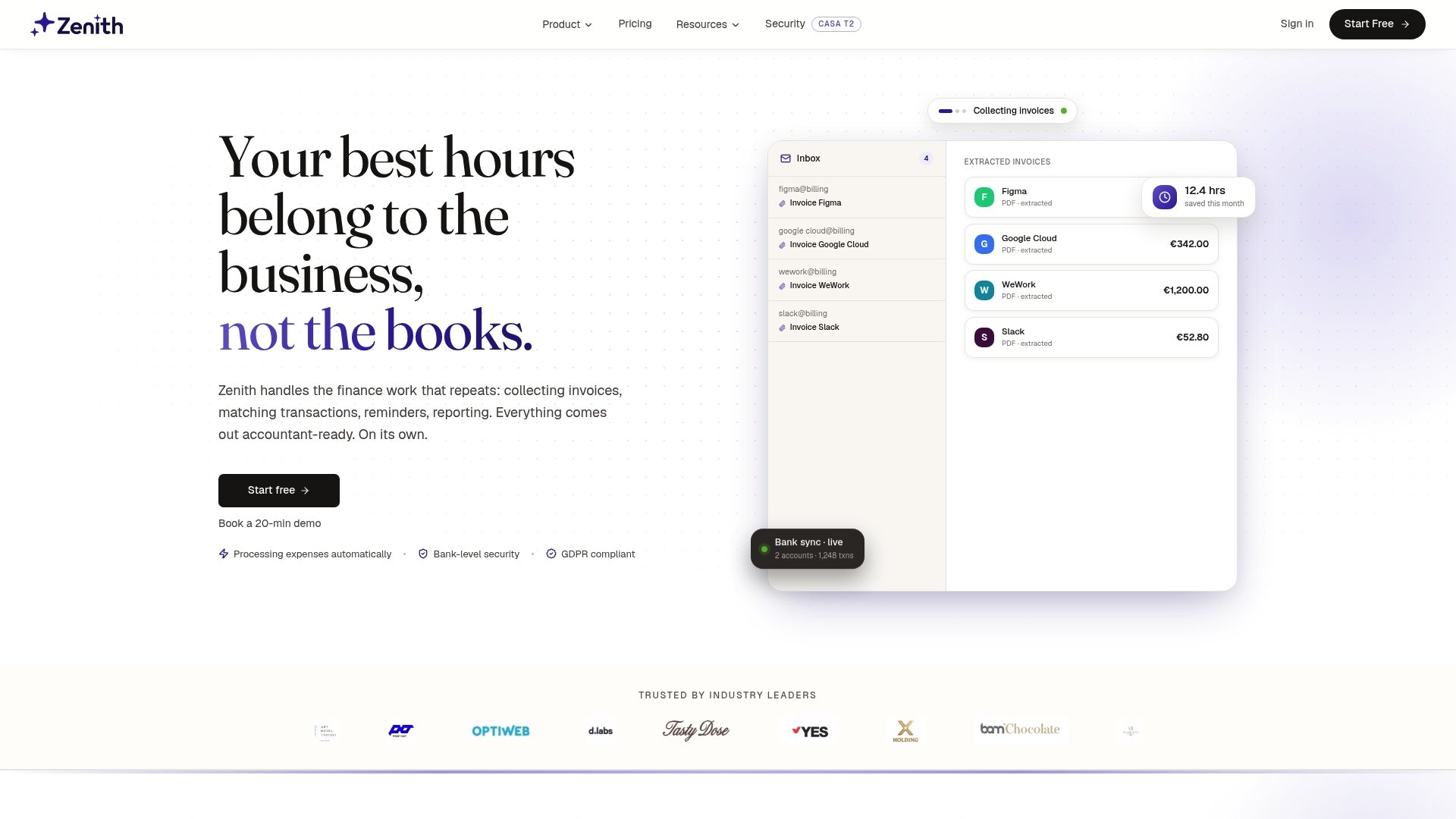
Clients like BAM Chocolate and Združenje YES eliminated manual entry entirely and closed their books faster. Security is built in, with SOC 2-aligned controls and audit-ready exports. For teams evaluating creator payout programs, Zenith-books pairs well with dedicated MoR platforms for the disbursement layer while handling the invoice and reconciliation side cleanly. Start a free trial or test the invoice OCR with your own documents today.
Useful sources and vendor documentation to consult next
When you move into formal vendor evaluation, these resources belong in your RFP package:
- IRS guidance on 1099-NEC and 1042-S filing: IRS.gov — confirm current thresholds and filing deadlines before finalizing your tax-automation requirements.
- Vendor SOC 2 reports: Request the full Type II report, not a summary. Ask for the bridge letter if the report period ended more than six months ago.
- ERP integration runbooks: Ask each vendor for the documented connector spec for your ERP (NetSuite, Sage Intacct, SAP, QuickBooks). A logo on a website is not a runbook.
- Gigapay on merchant-of-record for creator programs: Gigapay blog — useful background on MoR structure and international tax obligations.
- Payout platform comparison (PayQuicker): PayQuicker comparison — covers Tax-as-a-Service differentiators across payout vendors.
- Zenith-books proof points and trial: zenith-books.com — client case studies, OCR demo, and subscription details.
- Payout infrastructure reference: dongip.app — partner tool relevant to payout model comparisons during vendor evaluation.