


A fully compliant UK VAT invoice must carry ten specific data items under HMRC’s invoicing rules and Regulation 14 of the Value Added Tax Regulations 1995. Miss any one of them and your customer’s input tax reclaim is at risk. Here is the complete mandatory field list for a full VAT invoice:
- Unique sequential invoice number (one or more clearly defined series)
- Your business name and address (the supplier)
- Your VAT registration number (GB prefix for Great Britain; XI prefix for Northern Ireland cross-border supplies)
- Customer’s name and address
- A clear description of the goods or services supplied
- Quantity and unit price of each item (excluding VAT)
- Date of supply (the tax point, or time of supply)
- Date of issue (the invoice date, if different from the tax point)
- Net amount payable for each line, excluding VAT
- VAT rate applied to each item
- VAT amount charged, expressed in sterling
- Gross total payable, excluding VAT
VAT Notice 700/21 confirms you must issue this invoice within a specified period after the date you make the supply and keep a copy of every VAT invoice you issue.
Simplified invoices are permitted for supplies totaling a total amount at or below the simplified invoice threshold. They require fewer fields but must still show your name, address, VAT number, time of supply, description, total amount including VAT, and the VAT rate. If a customer who is VAT-registered asks for a full invoice, you must provide one regardless of the amount. Reverse charge and margin scheme supplies require specific additional wording on the invoice face.
Key Takeaways
A compliant UK VAT invoice requires all twelve mandatory fields under Regulation 14 and VAT Notice 700/21, with VAT amounts always expressed in sterling, and must be issued within 30 days of supply.
| Point | Details |
|---|---|
| Mandatory fields | All twelve fields under Regulation 14 must appear on a full VAT invoice, including sterling VAT amounts. |
| Sequential numbering | Gaps or resets in invoice numbering are a primary audit trigger; use voiding, never deletion. |
| Tax point accuracy | The invoice date becomes the tax point when issued before supply — understand this before automating. |
| Six-year retention | Keep copies of every VAT invoice issued and received for at least six years in a readable format. |
| Peppol readiness | The UK’s 2029 e-invoicing horizon means finance teams should assess Peppol compatibility now. |
| Zenith-books | Zenith-books automates sequential numbering, tax-point syncing, and audit-grade invoice archiving to Google Drive. |
Table of Contents
- What must appear on a full UK VAT invoice, field by field
- Simplified and modified VAT invoices: when the £250 threshold applies
- When must you issue a VAT invoice, and how does the tax point work?
- How long must you keep VAT invoices, and in what format?
- Special cases: reverse charge, margin schemes, Northern Ireland, and credit notes
- E-invoicing, Peppol, and what UK finance teams must plan for
- Common audit mistakes HMRC finds, and how to fix them before they find you
- A practical VAT invoice compliance checklist and sample template
- How Zenith-books helps finance teams stay VAT-compliant without the manual overhead
- Sources
What must appear on a full UK VAT invoice, field by field
Every field on a VAT invoice has a legal basis. HMRC’s internal manual VATREC5010 and Regulation 14 together define what “full particulars” means in practice. The table below maps each required field to its practical meaning.
| Field | What HMRC expects |
|---|---|
| Sequential invoice number | A unique number from one or more defined series; gaps or resets trigger audit scrutiny |
| Supplier name and address | Your trading name and registered or principal place of business |
| Supplier VAT registration number | The GB (or XI) number issued by HMRC; must appear in full |
| Customer name and address | The legal name and address of the recipient business or individual |
| Description of supply | Enough detail to identify what was supplied — “consultancy” alone is usually insufficient |
| Quantity and unit price | Per-line quantities and per-unit net price, excluding VAT |
| Date of supply (tax point) | The date the supply actually took place, which governs which VAT period it falls in |
| Invoice date | The date you issued the invoice; relevant when it differs from the tax point |
| Net amount per line | The taxable amount for each line, excluding VAT |
| VAT rate per line | The rate applied (20%, 5%, 0%, or exempt) for each line item |
| VAT amount in sterling | The actual VAT charged, always expressed in pounds sterling |
| Gross total excluding VAT | The sum of all net line amounts before VAT is added |
Sequential numbering: more nuance than most businesses realize
HMRC requires that the number uniquely identifies the document within its series. You can run multiple series — for example, one for domestic invoices and a separate one for Northern Ireland cross-border supplies — but each series must be clearly defined and consistently maintained. A gap in the sequence (say, jumping from INV-1043 to INV-1050) is one of the first things an HMRC compliance officer will flag. If you use accounting software, check that it never reuses or skips numbers when invoices are voided.

Supplier and customer details
Your VAT registration number must appear in full. “GB 123 4567 89” is the standard format for Great Britain registrations. For supplies involving Northern Ireland and EU counterparties, the prefix changes to “XI” — this distinction matters for cross-border VAT treatment and is covered in more detail in the special cases section below.
The customer’s name and address are required on a full VAT invoice, but their VAT number is not mandatory for domestic UK supplies. It becomes relevant for cross-border and Northern Ireland/EU transactions, where the customer’s VAT number affects the VAT treatment of the supply.
Description of supply
This field trips up more businesses than almost any other. A description like “services” or “goods” is not sufficient. HMRC expects enough detail for an officer reviewing the invoice to understand what was supplied without needing to consult a contract. “Website development services for e-commerce platform — Phase 2” is compliant. “IT services” is not.
VAT amounts in sterling
Even if you invoice in euros, US dollars, or any other currency, the VAT amount must be converted to and expressed in sterling on the invoice face. HMRC publishes monthly exchange rates for customs and VAT purposes that you can use for this conversion. Showing only the foreign-currency VAT figure is a compliance failure.

Simplified and modified VAT invoices: when the £250 threshold applies
The £250 threshold is one of the most misunderstood rules in UK VAT invoicing. It applies to the total amount of the supply including VAT, not the net amount. Both retailers and non-retailers can issue simplified invoices for supplies at or below this threshold.
A simplified invoice must still include:
- Your business name, address, and VAT registration number
- The time of supply (tax point)
- A description of the goods or services
- The total amount payable, including VAT, expressed in sterling
- The VAT rate applicable to each item (even if you do not show the VAT amount separately)
What a simplified invoice can omit: the customer’s name and address, the net amount per line, the VAT amount as a separate figure, and the unit price.
Point-of-sale receipts from a till system are the most common example. A receipt showing your business name, VAT number, date, item descriptions, total including VAT, and the VAT rate satisfies the simplified invoice rules for supplies under £250. Emailed receipts work the same way, provided they contain the required fields.
The important exception: if a VAT-registered customer asks for a full VAT invoice, you must issue one, regardless of the supply value. This is not optional. The customer needs the full invoice to support their input tax reclaim, and your obligation to provide it is absolute once they request it.
Modified invoices are a separate category used mainly in retail contexts where the total shown includes VAT. A modified invoice shows the VAT-inclusive price for each line and the total VAT included, rather than separating net and VAT amounts per line. They are only valid when agreed with HMRC in advance and are less common outside large retail operations.
When must you issue a VAT invoice, and how does the tax point work?
The tax point determines which VAT period a supply falls into. Getting it wrong means reporting VAT in the wrong quarter, which can trigger penalties and interest even when the VAT amount itself is correct.
- Standard rule: Issue a VAT invoice within a specified period after the date you make the supply. The date of supply is the basic tax point.
- Invoice issued before supply: If you raise an invoice before the goods are delivered or the service is performed, the invoice date becomes the tax point. This is the “actual tax point” rule and it catches many businesses off guard when they invoice in advance.
- Invoice issued after supply: If no invoice is raised within 30 days of supply, the tax point reverts to the date of supply itself. Delayed invoicing does not push the tax point forward.
- Advance payments and deposits: When a customer pays before supply, the tax point is the date of receipt of payment, not the later delivery date. A VAT invoice must be issued at that point.
- Pro forma invoices: These are not VAT invoices. They do not create a tax point and should be clearly labeled “This is not a VAT invoice.” Issue a proper VAT invoice once payment is received or supply is made.
- Self-billing: Where the customer raises the invoice on your behalf (a self-billing arrangement), the tax point rules still apply, but the customer takes on the obligation to issue a compliant document. Both parties must hold a copy.
- Cash accounting scheme: Businesses using HMRC’s cash accounting scheme account for VAT on the date of payment rather than the invoice date, which changes how the tax point interacts with their VAT return.
Pro Tip: Label every pro forma invoice explicitly as “This is not a VAT invoice” in a prominent position. HMRC has seen cases where customers treated pro formas as VAT invoices and reclaimed input tax on them — a reclaim HMRC will deny, leaving your customer with an unexpected VAT debt and a strained relationship with you.
How long must you keep VAT invoices, and in what format?
HMRC’s record-keeping rules under VAT Notice 700/21 are straightforward in principle but easy to underestimate in practice.
What you must keep:
- A copy of every VAT invoice you issue (not just the ones you receive)
- Every VAT invoice you receive that supports an input tax claim
- Your VAT account (a summary of output tax and input tax for each period)
- Any credit notes, debit notes, or corrective documents
Acceptable formats:
- Original paper invoices
- Scanned copies of paper invoices (provided the scan is a faithful reproduction)
- Electronically issued and stored invoices (PDF, structured XML, or other digital formats)
Retention period: HMRC expects you to keep VAT records for at least six years. For certain capital items subject to the Capital Goods Scheme, the period extends to ten years. These are minimums — many finance teams retain records for longer as a matter of policy, particularly where contracts span multiple years.
Functional compatibility: If you store invoices electronically, the records must remain readable and auditable throughout the retention period. “Readable” means that an HMRC officer must be able to access and review them without specialist software that only you possess. Migrating accounting systems mid-retention period is a common risk: businesses often discover that old invoice files are locked in a format the new system cannot open.
Pro Tip: When you migrate accounting software, export a complete archive of all VAT invoices in a universally readable format (PDF or CSV) before decommissioning the old system. Store it in a location that does not depend on the old software’s continued operation — a dedicated folder in Google Drive with restricted access works well for most small businesses.
Special cases: reverse charge, margin schemes, Northern Ireland, and credit notes
Standard VAT invoicing rules cover most supplies, but several common scenarios require additional wording or a different approach entirely.
Reverse charge supplies
The domestic reverse charge shifts the VAT accounting obligation from the supplier to the customer. It applies in several sectors, most notably construction services under the Construction Industry Scheme and wholesale supplies of mobile phones and computer chips. When reverse charge applies:
- The invoice must state that the supply is subject to the domestic reverse charge
- The VAT amount should be shown as zero (or not shown), with a note that the customer must account for the VAT
- A common compliant wording is: “Reverse charge: customer to account for VAT to HMRC”
- Regulation 14 specifies that the invoice must include a reference to the relevant provision
Margin scheme supplies
Second-hand goods, antiques, works of art, and collector’s items sold under the VAT margin scheme are invoiced differently because VAT is charged on the profit margin, not the full sale price. The invoice must:
- State that the margin scheme applies (e.g., “Second-hand goods — VAT margin scheme”)
- Not show a separate VAT amount (doing so would allow the customer to reclaim VAT they were never charged)
- Include the total selling price
The Tour Operators’ Margin Scheme (TOMS) follows similar principles: the invoice must reference the scheme and must not show a recoverable VAT amount.
Northern Ireland and cross-border supplies
Businesses registered under the Northern Ireland Protocol use the “XI” VAT prefix rather than “GB” for supplies of goods involving EU counterparties. This distinction affects the VAT treatment of the supply and must appear correctly on the invoice face. For exports of goods to non-EU countries, the supply is zero-rated and the invoice should indicate this clearly.
When a Northern Ireland business sells goods to an EU VAT-registered customer, the invoice should show the XI registration number and reference the zero-rating or the EU supply rules. Using the wrong prefix can cause the customer’s VAT authority to reject the reclaim.
Credit notes and corrective invoices
When you need to correct an invoice — whether because of a pricing error, a return, or a cancelled supply — you issue a credit note. A credit note must:
- Be clearly labeled as a credit note (not as a VAT invoice)
- Reference the original invoice number and date
- Show the amount being credited and the VAT being adjusted
- Be retained alongside the original invoice in your records
Both you and your customer must adjust your VAT accounts in the period the credit note is issued, not the period of the original invoice.
E-invoicing, Peppol, and what UK finance teams must plan for
The UK’s invoicing landscape is shifting. Peppol — the international e-invoicing network — has been selected by the UK government as the core interoperability framework for the future UK e-invoicing system. This is not a distant concern: Tolley’s guidance notes a 2029 horizon for broader mandatory adoption, and finance teams that wait until the deadline will face a compressed and expensive transition.
What Peppol actually means in practice:
- A PDF invoice emailed to a customer is not a structured e-invoice. It is a digital image of an invoice, not machine-readable data.
- A Peppol e-invoice is a structured XML file (typically in UBL or CII format) transmitted through the Peppol network, where both sender and receiver are registered access points.
- Structured invoices allow automated validation against VAT rules before transmission, which eliminates a category of errors that PDF invoices cannot catch.
- For cross-border B2B supplies within the Peppol network, the invoice data maps directly to the recipient’s accounting system without manual re-entry.
Practical steps to take now:
- Check whether your current invoicing or accounting software supports Peppol BIS Billing 3.0 (the standard format used in the UK Peppol framework)
- Map your existing invoice data fields to the Peppol data model — most of the required fields overlap with HMRC’s current requirements, but structured data demands more precision in how fields are populated
- Ask your software vendor for a Peppol readiness roadmap and a timeline for when they will support UK Peppol access point registration
- If you supply EU customers, Peppol is already live in most EU member states; connecting now gives you a competitive advantage in cross-border invoicing efficiency
Pro Tip: The VAT Guide (Notice 700) is explicit that automation does not transfer legal responsibility. Even if your software generates and transmits Peppol invoices automatically, the legal obligation for correct VAT amounts, accurate tax points, and compliant field content remains with you as the taxable person. Build a validation step into your workflow — do not treat software output as automatically correct.
Common audit mistakes HMRC finds, and how to fix them before they find you
HMRC compliance checks on VAT invoicing tend to surface the same errors repeatedly. Knowing what they look for lets you fix problems before they become penalties.
- Gaps or resets in sequential numbering. A missing number in a sequence suggests a deleted or suppressed invoice. HMRC will ask for an explanation. If your software allows invoice deletion rather than voiding (which preserves the number with a zero value), switch to a voiding workflow immediately.
- Wrong tax point on the invoice. Reporting VAT in the wrong quarter is a common consequence of invoicing in advance without understanding the tax point rules. Review your invoicing workflow against the timing rules in Section 4 above.
- VAT amount shown in foreign currency only. Any invoice where the sterling VAT amount is absent or unclear is non-compliant. If you invoice in multiple currencies, build a sterling VAT conversion field into your template as a mandatory output.
- Missing reverse charge or margin scheme wording. An invoice for a construction reverse charge supply that shows a VAT amount instead of the required wording will cause the customer to reclaim VAT they should not, and will expose you to a VAT assessment.
- Insufficient supply description. “Consultancy” or “services rendered” is not enough. HMRC expects a description that identifies the supply without reference to external documents.
- Duplicate invoice numbers. Automation that generates invoices across multiple systems or departments can produce duplicates if the numbering series are not coordinated. A single master series, or clearly defined and non-overlapping sub-series, prevents this.
Correction workflow: Issue a credit note referencing the original invoice, then issue a corrective invoice with a new sequential number. Keep both documents and a brief written note explaining the correction. Do not simply delete or overwrite the original.
Pro Tip: Run a monthly audit of your invoice register: sort by number, check for gaps, and spot-check five random invoices against the full field checklist. Fifteen minutes a month catches the errors that become expensive after an HMRC visit.
A practical VAT invoice compliance checklist and sample template
Compliance checklist
Use this against every invoice template or software configuration before you issue invoices to customers.
- [ ] Invoice is labeled “VAT Invoice” (not “invoice,” “receipt,” or “pro forma”)
- [ ] Sequential number assigned from a defined, unbroken series
- [ ] Your full business name and address
- [ ] Your VAT registration number in full (GB or XI prefix as applicable)
- [ ] Customer’s full name and address
- [ ] Clear description of each item or service supplied
- [ ] Quantity and unit price (net of VAT) for each line
- [ ] Date of supply (tax point)
- [ ] Date of issue (if different from tax point)
- [ ] Net amount per line, excluding VAT
- [ ] VAT rate applied to each line (20%, 5%, 0%, or exempt)
- [ ] VAT amount in sterling for each line and as a total
- [ ] Gross total payable, excluding VAT
- [ ] For reverse charge: wording stating customer accounts for VAT
- [ ] For margin scheme: wording identifying the applicable scheme
- [ ] For multi-currency: sterling VAT amount shown alongside foreign-currency amounts
Sample VAT invoice layout
File naming and storage: Use a consistent naming convention that includes the invoice number and date (e.g., INV-2026-00147_2026-03-14_ApexConsulting.pdf). Store issued invoices in a folder structure that mirrors your VAT periods so you can retrieve all invoices for a given quarter in under a minute during an audit. Zenith-books’s automatic invoice filing to Google Drive applies this kind of structured naming automatically, which removes the human error that comes with manual filing.
For multi-currency invoices, add a dedicated “VAT in sterling” row beneath the foreign-currency totals, and note the exchange rate used and its source (HMRC’s published rate for the period).
Why compliance and automation are not the same thing
Most finance teams I work with assume that once they have switched to accounting software, their invoices are automatically compliant. The software handles the fields, so the fields must be right. That assumption is where the problems start.
Software enforces the structure you configure it with. If the template was set up without a sterling VAT field, or with a description field that defaults to “services,” the software will produce thousands of non-compliant invoices with perfect consistency. The error is invisible until an HMRC officer asks to see your records.
The tax point rules are the most common casualty of this blind trust. A system that invoices on dispatch is correct for goods. The same system applied to staged services invoices on the wrong date, creating a tax point in the wrong VAT period. No alert fires. The return goes in. The error compounds across quarters.
Sequential numbering across multiple entities or departments is the other persistent problem. A group that runs three legal entities through one accounting system, or a business that switched software mid-year, often ends up with overlapping or restarted number series. HMRC does not accept “the software did it” as a defense — the legal responsibility sits with the taxable person, as Notice 700 makes clear.
The right approach is to understand the rules well enough to configure and audit your software, not to delegate understanding to it. Use the checklist in the section above as a quarterly configuration review, not just a one-time setup step. And when you automate invoice capture and processing, build in a human validation layer for the fields that carry the most audit risk: tax point, description, and sterling VAT amount.
How Zenith-books helps finance teams stay VAT-compliant without the manual overhead
Fixing VAT invoice errors after the fact is expensive. The smarter move is building compliance into the invoice workflow from the start, and that is exactly where Zenith-books’s finance automation earns its keep.
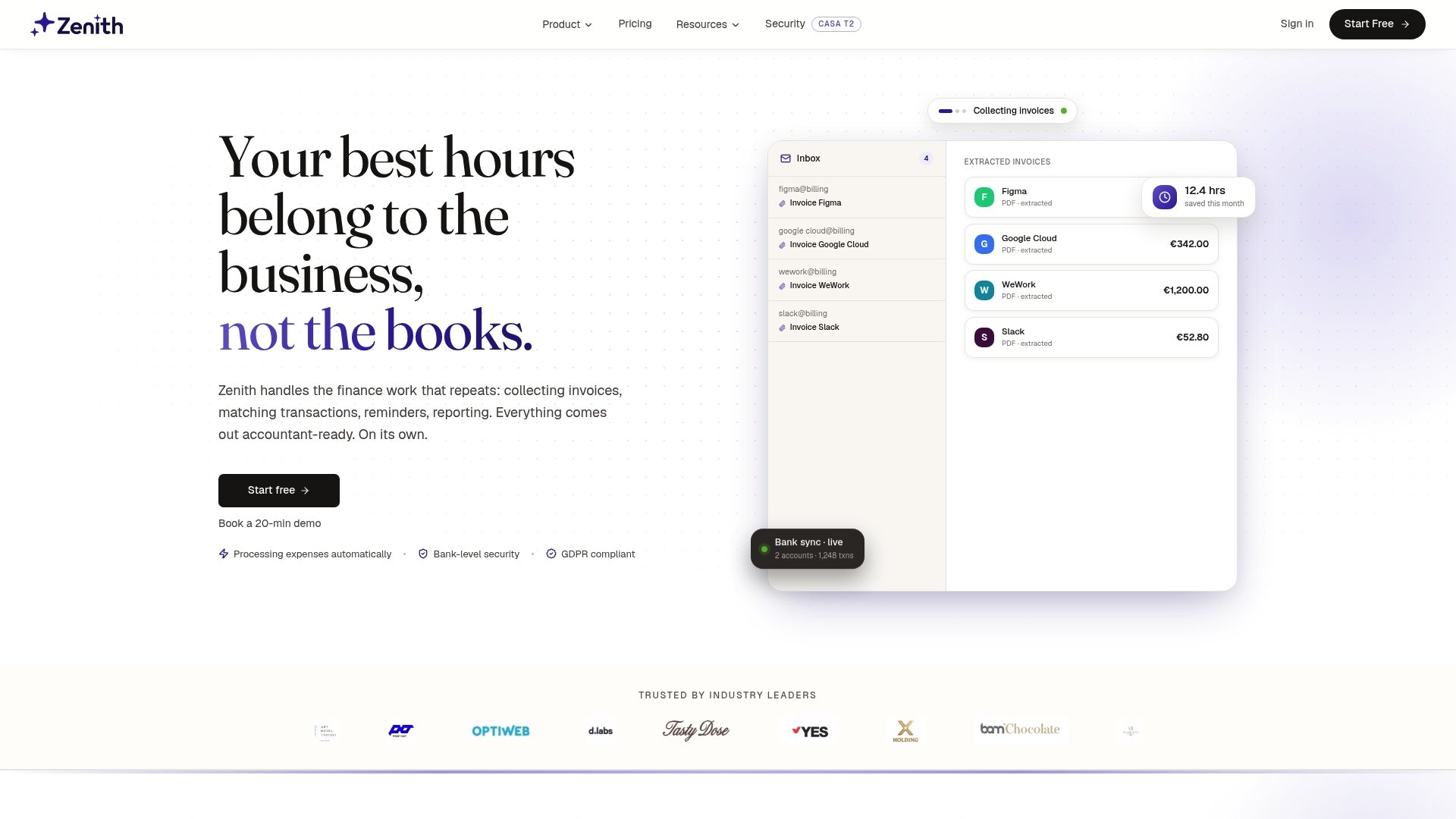
Zenith-books enforces sequential invoice numbering, syncs invoice data with bank transactions for accurate tax-point matching, and auto-files every issued and received invoice to Google Drive with a structured naming convention that mirrors your VAT periods. When HMRC asks for all invoices from Q3, you retrieve them in seconds rather than hours. The platform also supports structured eInvoice export formats, positioning your business ahead of the 2029 Peppol readiness curve rather than scrambling to catch up. For businesses that want to test the workflow before committing, the free payment QR code generator is a practical starting point for improving invoice usability today. Start your free trial at Zenith-books and see how quickly a compliant, automated invoice workflow replaces the manual checks.
Sources
The sources below are the primary references for everything covered in this article. Each one is worth bookmarking if you manage VAT compliance regularly.
This article provides general information about UK VAT invoice requirements and does not constitute professional tax or legal advice. VAT rules can change and individual circumstances vary — confirm current requirements with HMRC directly or with a qualified tax adviser.
This article is general information, not a substitute for advice from a qualified financial advisor. Consult a qualified financial professional about your own circumstances before acting on anything here.