


Bank reconciliation best practices come down to five things: reconcile frequently, automate the matching, standardize your procedures, enforce segregation of duties, and resolve discrepancies the day you find them. The Association of Certified Fraud Examiners estimates organizations lose about 5% of annual revenue to fraud every year, and disciplined reconciliation is one of the cheapest defenses against it. Industry guidance on treasury workflows also points to frequent reconciliation for active accounts rather than a monthly scramble.
If you’re starting this week, do three things:
- Set a reconciliation frequency based on transaction volume (daily for high-activity accounts, weekly or monthly for quiet ones).
- Turn on bank feeds so transactions land automatically instead of manual re-keying.
- Build a one-page reconciliation checklist your whole team follows the same way, every time.
Pro Tip: Copy those three actions straight into your task tracker this week. You’ll feel the difference by your next close.
Key Takeaways
Reconciling frequently and automating the matching process together shrink your fraud detection window and cut close time more than either change does alone.
| Point | Details |
|---|---|
| Reconcile by volume | Daily for high-activity accounts, weekly or monthly for quieter ones. |
| Automate the matching | Use rules-based or AI matching so humans only handle true exceptions. |
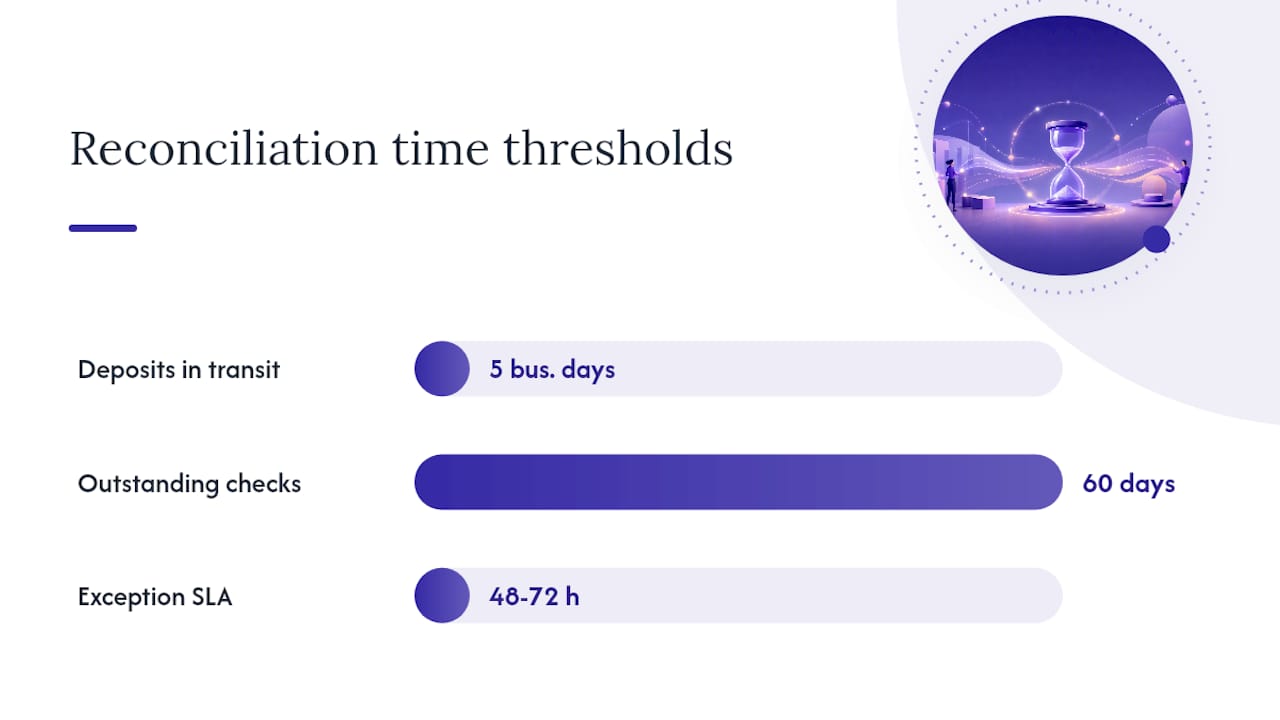
| Set exception SLAs | Resolve flagged items within 48 to 72 hours, escalate anything older. |
| Segregate duties | The person posting entries shouldn’t approve their own reconciliation. |
| Try Zenith-books | Automates matching, exception queues, and journal posting with full audit trails. |
This article is general information, not a substitute for advice from a qualified financial advisor. Consult a qualified financial professional about your own circumstances before acting on anything here.
Table of Contents
- What Is Bank Reconciliation, Exactly?
- Why Does Bank Reconciliation Matter So Much?
- How Do You Perform a Bank Reconciliation Step by Step?
- What Best Practices Should Finance Teams Follow?
- What Should Bank Reconciliation Automation Actually Do?
- Which KPIs Show Whether Your Reconciliation Process Is Healthy?
- What Mistakes Cause the Most Reconciliation Errors?
- What Controls Do Auditors Expect to See?
- Does the Evidence Actually Support Reconciling More Often?
- How Zenith-books Helps You Close Reconciliation Gaps Faster
- Sources
What Is Bank Reconciliation, Exactly?
Bank reconciliation is the process of matching your company’s cash records against what the bank actually reports, then explaining every difference until the two adjusted balances agree. It’s not just a month-end chore. It’s the check that catches the deposit that never landed, the fee nobody logged, and the duplicate payment that slipped through.
This guide covers operating cash accounts, credit card clearing accounts, payroll sweep accounts, and the added wrinkle of multi-currency balances for businesses trading internationally.
Most differences fall into a few predictable buckets:
- Deposits in transit (money you’ve recorded but the bank hasn’t cleared yet)
- Outstanding checks (payments issued but not yet cashed)
- Bank fees and interest you haven’t booked yet
- NSF (non-sufficient funds) items that bounced back
| Reconciling Item | Where It Originates |
|---|---|
| Deposits in transit | Your books, awaiting bank clearing |
| Outstanding checks | Your books, awaiting payee cashing |
| Bank fees/interest | Bank statement, not yet booked |
| NSF/returned items | Bank statement, reversing a prior deposit |
Why Does Bank Reconciliation Matter So Much?
Get this right and you get accurate cash forecasts, a faster month-end close, earlier fraud detection, and books that survive an audit without drama. Skip it, or do it once a month on autopilot, and you lose the thing that matters most: time. Every day between a fraudulent transaction and its discovery is a day the money keeps moving.
The ACFE puts the average organizational fraud loss at roughly 5% of annual revenue. For a business turning over £2 million, that’s a real number worth protecting against with a control that costs almost nothing to run.
Infrequent reconciliation doesn’t just delay fraud detection. It also means:
- Misstated cash positions feeding into bad forecasting decisions
- Errors compounding across multiple periods before anyone notices
- Auditors flagging gaps that turn a routine review into a lengthy investigation
How Do You Perform a Bank Reconciliation Step by Step?
Before you touch a spreadsheet, gather four things: the bank statement for the period, your general ledger or cash subledger, last period’s completed reconciliation, and any supporting documents for unusual transactions. Missing even one of these turns a 20-minute task into a two-hour hunt.
The standard reconciliation sequence that accountants have used for decades still holds up:
- Verify the opening balance matches the closing balance from your last completed reconciliation. A mismatch here poisons everything downstream.
- Tick and tie transactions — match each bank statement line to its counterpart in your books, one by one.
- List every reconciling item that doesn’t have a match: deposits in transit, outstanding checks, bank-only fees.
- Post book-side adjustments for anything the bank charged or credited that you hadn’t recorded yet (fees, interest, card charges).
- Adjust the bank-side balance for timing items that will clear in the next period.
- Confirm both adjusted balances match. If they don’t, you have an error to trace, not a rounding issue to ignore.
A basic reconciliation template needs four columns: transaction date, description, book amount, and bank amount, with a running variance column at the end. That variance column is where you’ll spend most of your time, so keep it visible, not buried in a separate tab.
For timing, investigate any unexplained variance the same day you find it rather than letting it roll into next period. Post adjusting journal entries as soon as you confirm the reason for a discrepancy, not at month-end when you’re trying to close five other accounts at once.
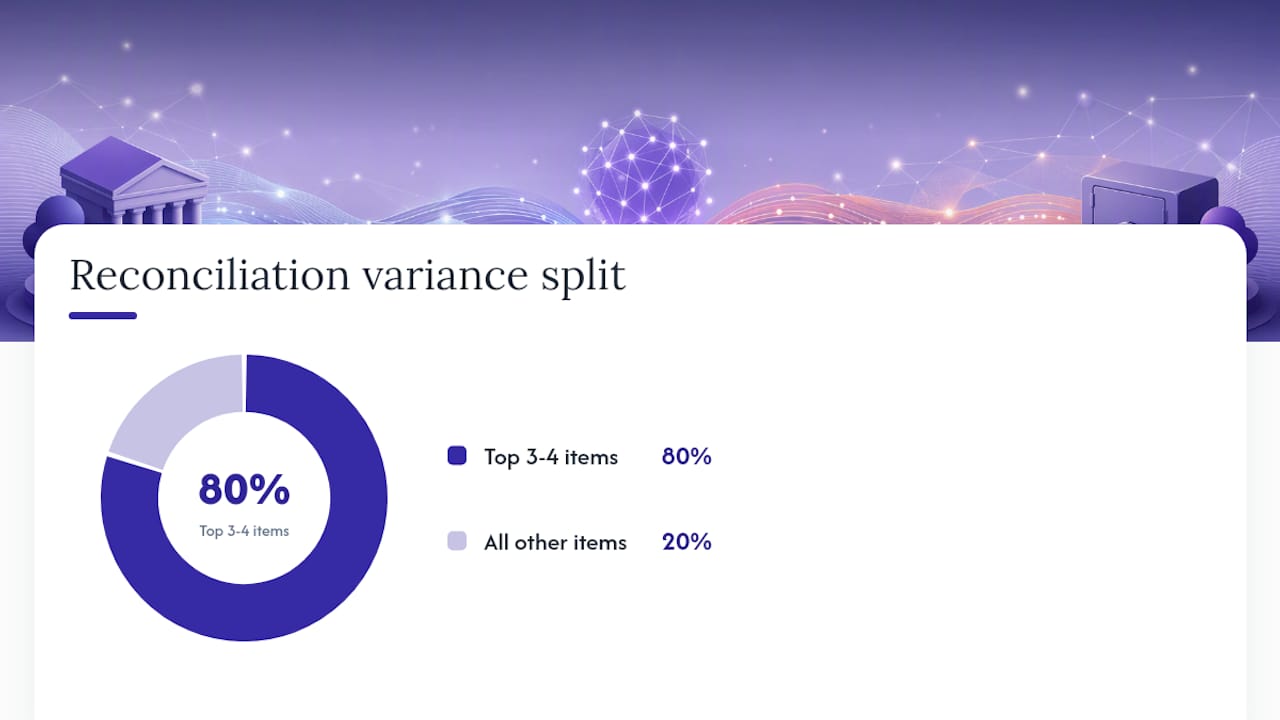
Pro Tip: When you’re staring at a pile of unmatched items, triage first. Sort by dollar amount (biggest first), then by age (oldest first), then by transaction type. You’ll usually find that three or four large, old items explain 80% of your total variance.
If you get stuck, QuickBooks’ own troubleshooting guidance recommends checking your opening balance first, then running a report for changed or deleted transactions before you touch any reconciliation adjustment features. Those adjustments should be a last resort, not a first move.
What Best Practices Should Finance Teams Follow?
Getting reconciliation right isn’t about working harder. It’s about building a system that doesn’t depend on any one person’s memory. Six things separate teams that reconcile smoothly from teams that dread it:
- Set a frequency policy by volume. High-transaction accounts get reconciled frequently. Moderate accounts receive regular attention. Low-activity accounts can run monthly, but no less often than that.
- Automate what can be automated. Bank feeds and matching rules should handle routine transactions so humans only touch exceptions.
- Standardize your checklist. Every reconciler should follow the identical sequence, regardless of who’s covering for whom.
- Segregate duties. The person posting transactions shouldn’t be the same person approving the reconciliation.
- Build exception workflows with SLAs. An unresolved item sitting for three weeks is a control failure, not a footnote.
- Document everything. Every adjusting entry needs a reason, a date, and a name attached to it.
For thresholds, a seven-step reconciliation framework suggests flagging deposits in transit older than 5 business days and outstanding checks older than 60 days for active follow-up. Below those lines, most items clear on their own. Above them, they need a named owner and a deadline.
Your policy checklist should assign a review owner for every account, set a resolution SLA for exceptions (48 to 72 hours is realistic for most SMB teams), and define an escalation path when an item blows past that window.
Pro Tip: Treasury teams that reconcile well often run a “soft close,” matching transactions continuously through the month instead of waiting for statement day. By the time the official close arrives, most of the work is already done.
Pro Tip: Try a rolling cut-off: reconcile the first three weeks of a period as you go, then only the final week needs attention at month-end. This alone can cut close time by more than half for busy accounts.
What Should Bank Reconciliation Automation Actually Do?
Automation shouldn’t be a black box you trust blindly. It should replace the tedious matching, not the judgment calls. Look for a rules engine that matches transactions on amount, date, and description, flags anything it can’t confidently match into an exception queue, keeps a full audit trail, and can post journal entries automatically once a match is confirmed.
When you’re evaluating reconciliation software, the checklist looks like this:
- Does it integrate directly with your ERP or general ledger, or does someone still have to export and re-import files?
- Can it handle multi-currency accounts without manual conversion steps?
- Does it maintain a full audit log for every automated match and adjustment?
- What’s the uptime and refresh SLA on the bank feed itself?
| Evaluation Criteria | What Good Looks Like |
|---|---|
| Matching logic | Fuzzy/AI matching, not exact-string only |
| Exception handling | Dedicated queue with assigned owners |
| Integration | Direct ERP/GL sync, no manual export |
| Audit trail | Every match and edit timestamped and attributed |
Start small. Pilot the tool on your single highest-volume account first, map your data fields before you build matching rules, and set clear SLAs for how fast exceptions get resolved. Track your match rate before and after. That single number tells you more about ROI than any vendor demo will.
Pro Tip: Ask any vendor for their exception rate on a real customer’s data set, not a curated demo. A tool that claims a 99% match rate on clean, staged transactions often performs very differently on your messy, real-world feed.
Which KPIs Show Whether Your Reconciliation Process Is Healthy?
Numbers tell you what a checklist can’t. Track your match rate (percentage of transactions auto-matched without human touch), exception aging (how long unresolved items sit), median time-to-reconcile per account, the percentage of accounts closed within SLA, your unreconciled balance at period end, and the count of manual adjustments posted per cycle.
A falling match rate usually means your rules haven’t kept pace with new vendors or payment types. Rising exception aging means your team is drowning, not just busy. Neither trend fixes itself.
Report these weekly to finance leadership and monthly to your audit committee, with a callout on any account that’s missed SLA two cycles running. That’s the early warning system most teams don’t build until after something’s already gone wrong.
What Mistakes Cause the Most Reconciliation Errors?
A handful of recurring mistakes account for most of the pain teams report:
- Timing differences — fix by maintaining a running outstanding-items list, not by re-explaining the same gap every month.
- Duplicate entries — catch these with duplicate-detection rules on amount, date, and payee.
- Missed bank fees or interest — set these to auto-post from the bank feed rather than relying on someone remembering to check.
- Transposition errors — a variance evenly divisible by 9 is the classic tell of two digits swapped; check that first before you go hunting elsewhere.
Investigate anything older than 60 days or above your materiality threshold immediately, not at quarter-end.
Pro Tip: If the same vendor or account keeps generating the same type of exception month after month, that’s not bad luck. It’s a pattern worth investigating for either a systemic posting error or something more deliberate.
What Controls Do Auditors Expect to See?
Auditors want proof the process can’t be manipulated by one person acting alone. That means segregation of duties between the person posting entries and the person approving the reconciliation, independent review with a documented sign-off, evidence attached for every adjusting entry, and an archived, version-controlled history of past reconciliations.
Your audit pack should include the completed reconciliation worksheet, supporting documentation for adjustments, the journal entries themselves, a reviewer’s sign-off, and a log of any exceptions still open at period close.
| Audit Pack Component | Purpose |
|---|---|
| Reconciliation worksheet | Shows the matched and unmatched items |
| Supporting documents | Evidence for every adjustment posted |
| Adjusting entries | The actual accounting impact |
| Reviewer sign-off | Proof of independent review |
| Exception log | Record of unresolved items and their status |
Keep these packs for the retention period your jurisdiction and auditor require, and don’t let “we’ll clean it up later” become policy.
Does the Evidence Actually Support Reconciling More Often?
Yes, and the case is stronger than most finance teams assume. The ACFE’s fraud-loss estimate of roughly 5% of annual revenue exists precisely because slow detection windows let losses compound. A shorter reconciliation cycle shrinks that window directly, since you can’t lose two months of undetected fraud if you’re checking every week.
Treasury guidance backs this with a practical framing: continuous or “rolling” reconciliation turns a dreaded month-end task into a background process, which is where most of the real time savings show up.
If you want to prove the case internally, track three numbers before and after any process change: your match rate, your median time-to-reconcile, and the actual headcount-hours spent per close. Those three, tracked over two or three cycles, make the argument for you.
- Match rate improvement shows automation is working, not just running
- Time-to-reconcile shows the close is genuinely getting faster
- Headcount-hours saved gives you the number finance leadership actually cares about
One Thing Worth Prioritizing First
If you fix one thing this quarter, fix frequency and automation together, since neither works well alone. Pilot automation on your single busiest account, measure the match-rate change honestly, then scale what works.
How Zenith-books Helps You Close Reconciliation Gaps Faster
Every pain point covered above, the matching backlog, the missed fees, the exception pile nobody owns, is exactly what automation is built to solve, provided it’s built for the job rather than bolted on as an afterthought. Zenith-books matches bank transactions with AI-driven rules, routes anything uncertain into a clear exception queue instead of a spreadsheet nobody checks, and posts the resulting journal entries automatically with a full audit trail attached.
Clients including Združenje YES and BAM Chocolate report meaningfully shorter month-end close times after moving to automated matching, with zero manual data entry across their transactions. If you’re syncing bank data into spreadsheets for visibility, the live bank-to-Google-Sheets sync gives you real-time cash positions without a separate export step. Start with a pilot on your highest-volume account, measure your match rate before and after, and see the difference in a single close cycle. You can start with a free trial today.
Sources
- Organizations lose 5% to fraud each year
- Mastering Bank Account Reconciliation: Best Practices for Treasury Professionals
- How to reconcile a bank statement
- Fix issues when you’re reconciling in QuickBooks Desktop
- Bank Reconciliation Best Practices: 7-Step CFO Guide 2026