

Secure Bank Data in 30/90/180 Days: Finance Data Security for Teams

Finance data security means protecting customer financial records, payment details and transaction data through encryption, strict access controls, and continuous monitoring, backed by written governance policies that satisfy FCA expectations. It requires a named accountable owner, vetted suppliers, and Open Banking connections built on FAPI 1 Advanced. Tools like Zenith can reduce exposure by centralising bank feeds and invoice pipelines under a single, auditable system.
TL;DR:
- Most firms still fail to implement ongoing, rigorous vendor due diligence, risking breaches from subcontractors or outdated controls.
- Adopting FAPI 1 Advanced standards, including regular certificate rotation and DNSSEC, is essential for secure Open Banking API integration.
- Building a security-aware culture with role-specific training and simple reporting channels significantly reduces insider threats and phishing success.
- Locking down manual processes and automating invoice and bank data pipelines can cut attack surfaces by eliminating unencrypted, unmonitored data transfers.
- Regular testing of backups, incident response plans, and continuous monitoring for suspicious activity are critical to catching breaches early and minimizing damage.
Table of Contents
- What finance data security actually covers
- Regulatory expectations: FCA, ICO and governance basics
- Securing bank data: Open Banking, FAPI and API hardening
- Vetting suppliers who touch your financial data
- Locking down invoice and bank-sync pipelines
- Incident response, backups and recovery testing
- A 30/90/180-day security checklist
- Anonymisation and masking for financial datasets
- Monitoring access to catch suspicious activity early
- Emerging threats: ransomware and finance-team phishing
- Building a security-aware finance team
- What breaches actually cost finance firms
- Where finance operators keep getting this wrong
- Reducing exposure with secure bank sync and invoice automation
- Sources
- FAQ
What finance data security actually covers
Financial data isn’t one thing. It spans personally identifiable information (names, addresses, national insurance numbers), payment card details, bank account numbers, transaction histories, and the invoices and remittance data flowing through your accounts payable system. Each category carries different exposure. A leaked transaction history reveals spending patterns and business relationships; a leaked account number enables direct fraud.
Baseline technical controls aren’t optional extras. They’re the floor:
- Encryption at rest and in transit for every database, backup, and API call carrying financial data.
- Access control on least privilege, meaning staff see only the data their role requires, nothing more.
- Multi-factor authentication on every system touching bank data or payment instructions.
- Logging and monitoring that records who accessed what, and when, with alerts on anomalies.
Data minimisation matters more than most compliance checklists suggest. If your invoice OCR tool doesn’t need a customer’s full bank statement, don’t store it. The FCA’s operational guidance treats confidentiality, integrity and availability as equally important, and collecting less data simply shrinks your attack surface.
Regulatory expectations: FCA, ICO and governance basics
The FCA doesn’t ask for a generic security policy. Its FCG5 guidance requires firms to maintain written, proportionate, and up-to-date data security policies covering the full data lifecycle, from collection through to disposal. That includes risk-based monitoring of staff access and defined password and authentication standards.
Governance is where most firms slip. Data security gets treated as an IT ticket rather than a board-level responsibility, and the FCA is explicit that this framing is wrong. You need one named senior manager accountable for data security outcomes, not a diffuse “everyone owns it” arrangement that means nobody does.
Practical governance steps that satisfy both FCA and ICO expectations:
- Appoint a single responsible individual with board reporting lines.
- Maintain records of staff vetting, training completion, and access reviews.
- Encrypt portable devices automatically and use accredited destruction services for old hardware and paper records. Secure Shred’s guidance on document destruction covers the practical side of this under GDPR.
- Report qualifying personal data breaches to the ICO within 72 hours where the breach risks harm to individuals.
None of this is bureaucratic box ticking. Firms that skip the paperwork tend to also skip the substance, and enforcement cases consistently trace back to the same root cause: nobody was actually watching.
Securing bank data: Open Banking, FAPI and API hardening
If your systems touch bank data through an API, the security bar is set by FAPI 1 Advanced, the security profile underpinning UK and EU Open Banking. It stacks OAuth2 and OIDC with mutually authenticated TLS (MATLS), meaning both client and server present certificates before any data moves. Message signing adds a further layer, so even a compromised transport channel can’t quietly alter a request in flight.
FAPI 1 Advanced replaced older, weaker profiles, and conformance tooling exists specifically so implementers can test their integrations before going live. Migrating without staging that testing risks having your requests rejected outright.
Beyond the protocol, operational hardening matters just as much:
- Certificate rotation on a defined schedule, not “whenever someone remembers.”
- DNSSEC to prevent DNS spoofing attacks against your API endpoints.
- Intent IDs and risk indicators that flag unusual payment or data-access patterns before they complete.
Open Banking guidance also calls for SOC monitoring, external penetration testing, and an ISMS built to ISO27001 or an equivalent standard, alongside continuous vulnerability scanning. This isn’t a one-off audit. It’s a standing operational commitment, and firms that treat penetration testing as an annual formality tend to find the gaps a real attacker would exploit within days.
Vetting suppliers who touch your financial data
Outsourcing a function doesn’t outsource the liability. The FCA is clear that firms remain responsible for how their suppliers handle customer data, regardless of the contract terms. A breach at your payroll provider or invoice-processing vendor is still your regulatory problem.
- Run a security audit before signing. Ask for ISO27001 certification or equivalent, and request the vendor’s most recent penetration-test report, not just a summary letter.
- Build audit rights into the contract. You need the ability to review the vendor’s controls periodically, not just at onboarding.
- Map subprocessors and subcontractors. If your vendor uses a fourth party to store or process data, you need visibility into that chain, and a mechanism to be notified when it changes.
- Review access on a fixed schedule. Quarterly is a reasonable cadence for any supplier with standing access to bank data or customer records.
- Formalise offboarding. When a supplier relationship ends, revoke credentials and confirm data deletion in writing, with a deadline.
Vendor risk isn’t static. A supplier that passed your audit two years ago may have changed ownership, outsourced development, or quietly weakened its controls since. Treat vendor due diligence as a recurring exercise, not a one-time gate.
Locking down invoice and bank-sync pipelines
Accounts payable automation introduces its own attack surface. Invoices arriving by email or Google Drive need secure ingestion, meaning the pipeline should authenticate the source, limit which fields get extracted, and flag duplicates before they reach payment approval. A tool that pulls a full bank statement when it only needs an invoice number and amount is collecting data it doesn’t need, and every extra field stored is another thing to secure and eventually breach.
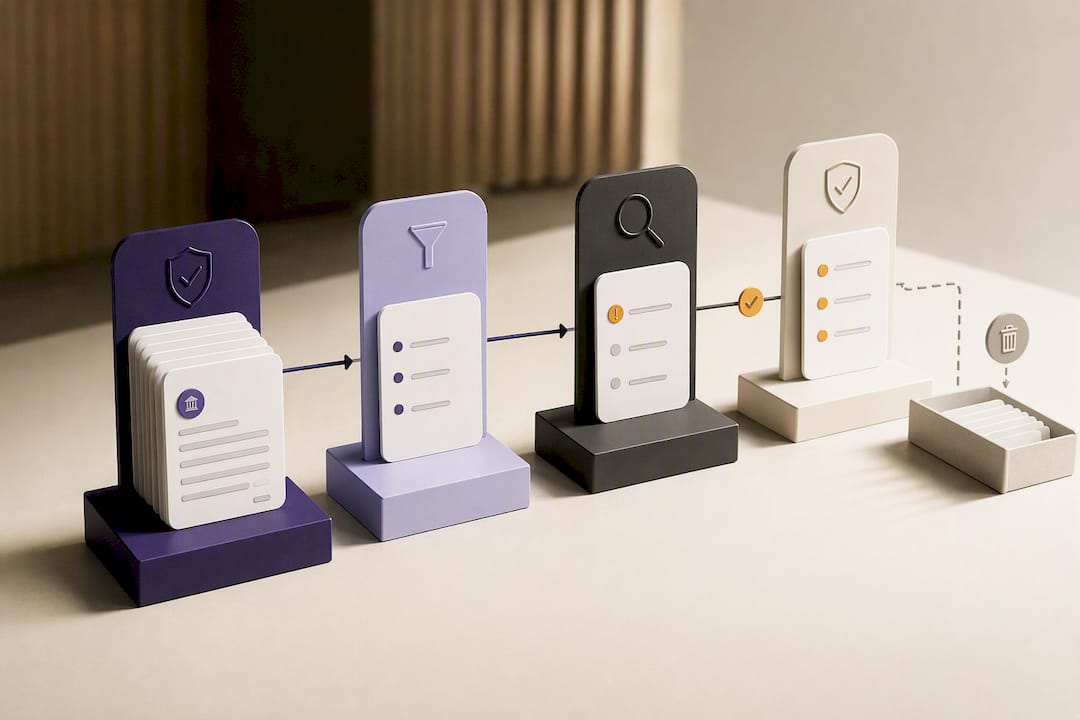
Bank sync introduces different risks. A properly built connection is read-only under PSD2, meaning the integration can view balances and transactions but never initiate a payment or move money. Certificate validation on every connection, short-lived access tokens instead of permanent credentials, and clear token-revocation processes all matter here.
Operationally, three rules keep AP and bank-sync workflows tight:
- Give reconciliation staff granular roles, not blanket access to every account.
- Review access quarterly, matching the cadence you use for supplier reviews.
- Keep test and production data segregated, so a development sandbox never touches live customer records.
If you’re building or buying an invoice extraction pipeline, these principles should sit in your vendor evaluation from day one, not get bolted on afterwards.
Incident response, backups and recovery testing
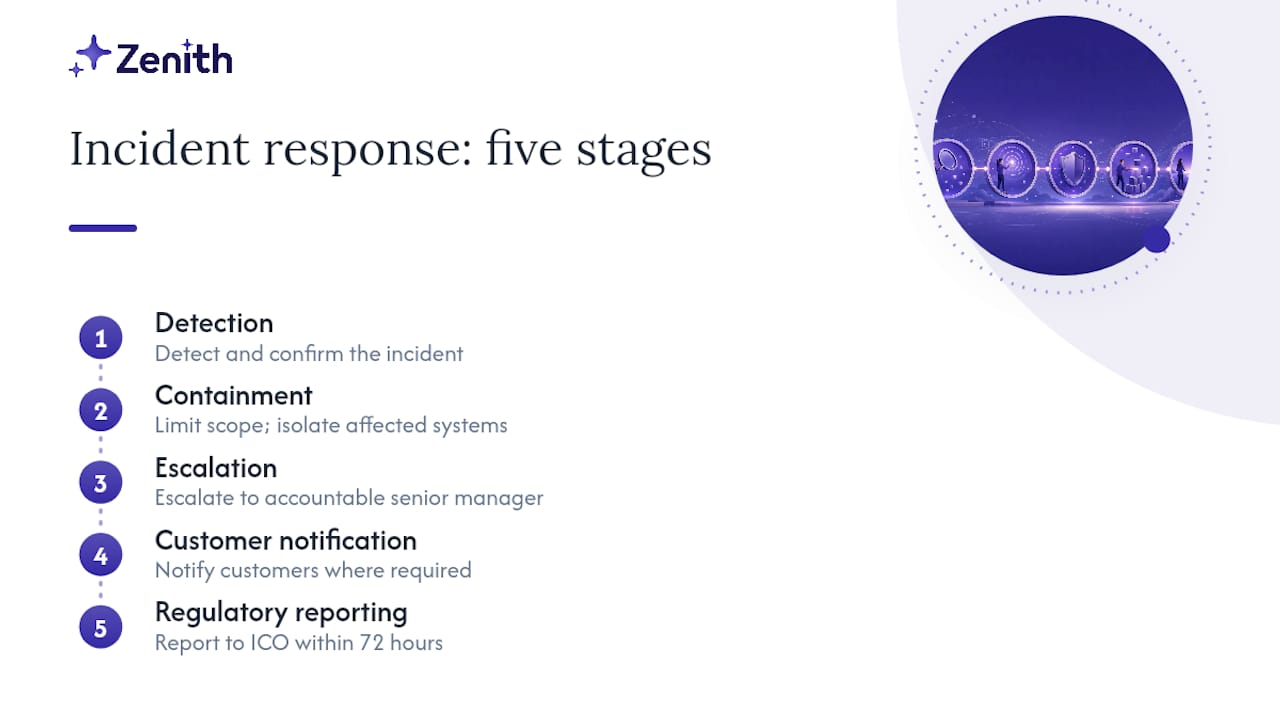
A response plan that exists only as a document nobody has read isn’t a plan. It’s decoration. Your incident playbook needs clear stages: detection, containment, escalation to the accountable senior manager, customer notification where required, and regulatory reporting within the ICO’s 72-hour window for qualifying breaches.
Backups need the same rigour. Encrypt them, store copies off-site or in a separate cloud region, and run restore exercises regularly rather than assuming the backup works because it completed without an error message. Set explicit recovery time and recovery point objectives, and test against them, because the moment you discover your restore process takes fourteen hours during a live incident is the worst possible moment to discover it.
After any incident, however minor, run a post-mortem that reassesses affected suppliers and updates the relevant policy. Incidents that don’t change anything tend to repeat.
A 30/90/180-day security checklist
Start with the fundamentals before layering on anything advanced:
- Immediately: appoint one accountable lead for data security, enforce MFA everywhere, and confirm encryption is active on all storage and transport.
- 30 days: complete a full supplier inventory and flag any vendor without a current security certification.
- 90 days: commission an external penetration test and close any critical findings.
- 180 days: run a full incident-response tabletop exercise and a live backup-restore test.
Pro Tip: If budget is tight, prioritise access control and vendor due diligence first. Weak vendor checks are a recurring root cause behind FCA enforcement cases, and they cost far less to fix than a breach costs to clean up.
Anonymisation and masking for financial datasets
Not every use case needs raw data. Testing environments, analytics dashboards, and staff training materials rarely require a real account number or a genuine customer name, yet plenty of firms use production data for all three.
Masking replaces sensitive fields with realistic but fake substitutes, so a developer testing a reconciliation feature sees a plausible account number that traces to nothing real. Anonymisation goes further, stripping identifying details so thoroughly the record can’t be linked back to an individual even with additional data. Pseudonymisation sits between the two: it replaces identifiers with tokens, but a separate key can reverse the process when there’s a legitimate business reason to do so.
For finance teams, the practical application is straightforward. Development and staging environments should run on masked data, never a live export. Analytics teams building spending-pattern dashboards rarely need the underlying account number at all, only the transaction amount, category, and date. Where a report genuinely needs individual-level detail, tokenisation lets you preserve analytical value without exposing the raw identifier to everyone who can query the report.
The failure mode to watch for is scope creep. A masking policy that covers your primary database but not the CSV export someone downloaded for a one-off analysis leaves a gap that’s easy to miss and easy for an attacker to find. Any system with access to financial data, including spreadsheets, third-party dashboards, and ad hoc reports, needs the same masking discipline as the source database.
Monitoring access to catch suspicious activity early
Most breaches aren’t discovered the moment they happen. They’re discovered weeks or months later, when the damage has already compounded. Continuous audit logging closes that gap, but only if someone is actually reviewing the output.
Effective monitoring starts with a baseline: what does normal access to financial data look like for each role? A reconciliation clerk querying twenty customer accounts a day is routine. The same clerk querying two thousand accounts overnight is not, and an alerting system tuned to that kind of deviation catches insider threats and compromised credentials alike.
Practical monitoring measures worth implementing:
- Log every access to bank data, invoice records, and payment instructions, including read-only queries, not just changes.
- Set alerts on unusual access times, unusual volumes, and access from unfamiliar locations or devices.
- Review privileged account activity separately and more frequently, since these accounts do the most damage if compromised.
- Correlate access logs with HR records, so a departing employee’s access is flagged for immediate review, not discovered three months later.
Open Banking’s security model treats this kind of layered monitoring as core infrastructure, not an add-on. The Open Banking Standards guidance pairs SOC-level monitoring with certificate management and fraud-related risk indicators, on the basis that transport encryption alone catches almost nothing once credentials are already compromised. A stolen but valid API key sails straight through TLS. It’s only caught by something watching for the unusual pattern that key produces once it’s in the wrong hands.
Emerging threats: ransomware and finance-team phishing
Finance teams are a preferred target precisely because they’re the ones authorised to move money. Attackers know this, and the tactics aimed at them have grown more targeted, not more crude.
Business email compromise remains the dominant threat vector. An attacker studies a company’s invoice approval chain, then sends a convincing email, often timed to a real supplier relationship, requesting a change of bank details or an urgent payment. The email looks legitimate because the attacker has done homework: correct supplier name, correct invoice format, sometimes even a correct invoice number lifted from a prior compromise.
Ransomware targeting finance systems specifically aims at backup infrastructure first, encrypting or deleting backups before triggering the main attack, so restore becomes impossible and the ransom demand becomes the only apparent option. This is precisely why off-site, immutable backup copies matter more than backup frequency.
Credential phishing aimed at Open Banking and bank-sync integrations is a newer variant. Rather than targeting the bank directly, attackers target the third-party tools connected to it, on the assumption that a smaller vendor has weaker defences than the bank itself. This is exactly why FAPI 1 Advanced’s certificate-based authentication matters: a stolen password alone can’t authenticate a session that also requires a valid client certificate.
Practical countermeasures include a mandatory callback verification for any bank-detail change request, regardless of how legitimate the email looks, and a strict rule that payment instructions received by email are never actioned without independent confirmation through a separate channel.
Building a security-aware finance team
Technical controls fail quietly when the people using them don’t understand why the controls exist. A finance team that sees MFA as an annoying extra step, rather than the thing that stopped last month’s phishing email from becoming a wire fraud, will find workarounds.
Effective training programmes go beyond an annual slideshow. They use realistic simulations: sending staff a mock phishing email disguised as a supplier payment-detail change, then debriefing whoever clicks it without blame, focused on what the red flags actually were. Staff who’ve clicked a simulated phishing email once are measurably less likely to click a real one later, because the lesson lands when it’s concrete rather than abstract.
Training needs to be role-specific. Someone approving payments needs deep familiarity with callback verification and invoice fraud red flags. Someone with database access needs to understand data classification and why a customer record shouldn’t be exported to a personal spreadsheet for convenience. A single generic training module covering both roles teaches neither well.
Refresh frequency matters as much as content. Annual training against a threat landscape that shifts monthly leaves long gaps where staff are working from stale knowledge. Quarterly micro-training sessions, ten minutes on a single current threat, tend to stick better than a single long annual session covering everything at once.
Finally, make reporting suspicious activity genuinely easy and blame-free. A staff member who suspects they’ve made a mistake needs to feel able to flag it immediately, not hide it out of fear, because the gap between a caught error and a covered-up one is often the gap between a contained incident and a full-blown breach.
What breaches actually cost finance firms
The pattern in FCA enforcement cases is consistent: firms that treated data security as a compliance checkbox, rather than an operational discipline, faced the largest penalties and the most reputational damage. The FCA’s own guidance repeatedly points to the same root causes across separate cases: weak vendor due diligence, no single accountable owner, and monitoring that existed on paper but wasn’t actually reviewed.
The damage from a financial data breach rarely stays contained to the immediate incident. Customer trust erodes, regulatory scrutiny intensifies for years afterward, and the cost of remediation, forensic investigation, legal exposure, and mandatory notifications routinely dwarfs what proper controls would have cost upfront. A firm that skipped a penetration test to save a modest annual fee often ends up paying vastly more in incident response once the gap that test would have caught gets found by an attacker instead.
The lesson from these cases isn’t abstract. It’s specific: appoint the accountable owner, run the supplier audits, encrypt the portable devices, test the backups, and do it before the incident forces the issue. Firms that build this discipline in advance consistently fare better, both financially and reputationally, than firms scrambling to build it after a breach has already gone public.
Where finance operators keep getting this wrong
The recurring failure isn’t a missing firewall. It’s fragmented ownership: security policy sits with compliance, vendor contracts sit with procurement, and access reviews sit with IT, and nobody connects the three. FCA enforcement cases trace back to exactly this pattern more often than to any single technical gap.
The fix is unglamorous. One accountable manager, quarterly supplier audits, and access reviews that actually happen on schedule rather than when someone remembers. Firms that build this discipline before an incident consistently fare better than those scrambling to build it after.
— Gašper Anderle
Reducing exposure with secure bank sync and invoice automation
Every manual step in your finance stack, someone copying a bank statement into a spreadsheet, forwarding an invoice by email, re-keying a transaction into your accounting software, is a point where financial data sits unencrypted, unmonitored, or duplicated somewhere it shouldn’t be. Cutting those manual steps is one of the most direct ways to shrink your actual attack surface, not just your paperwork.
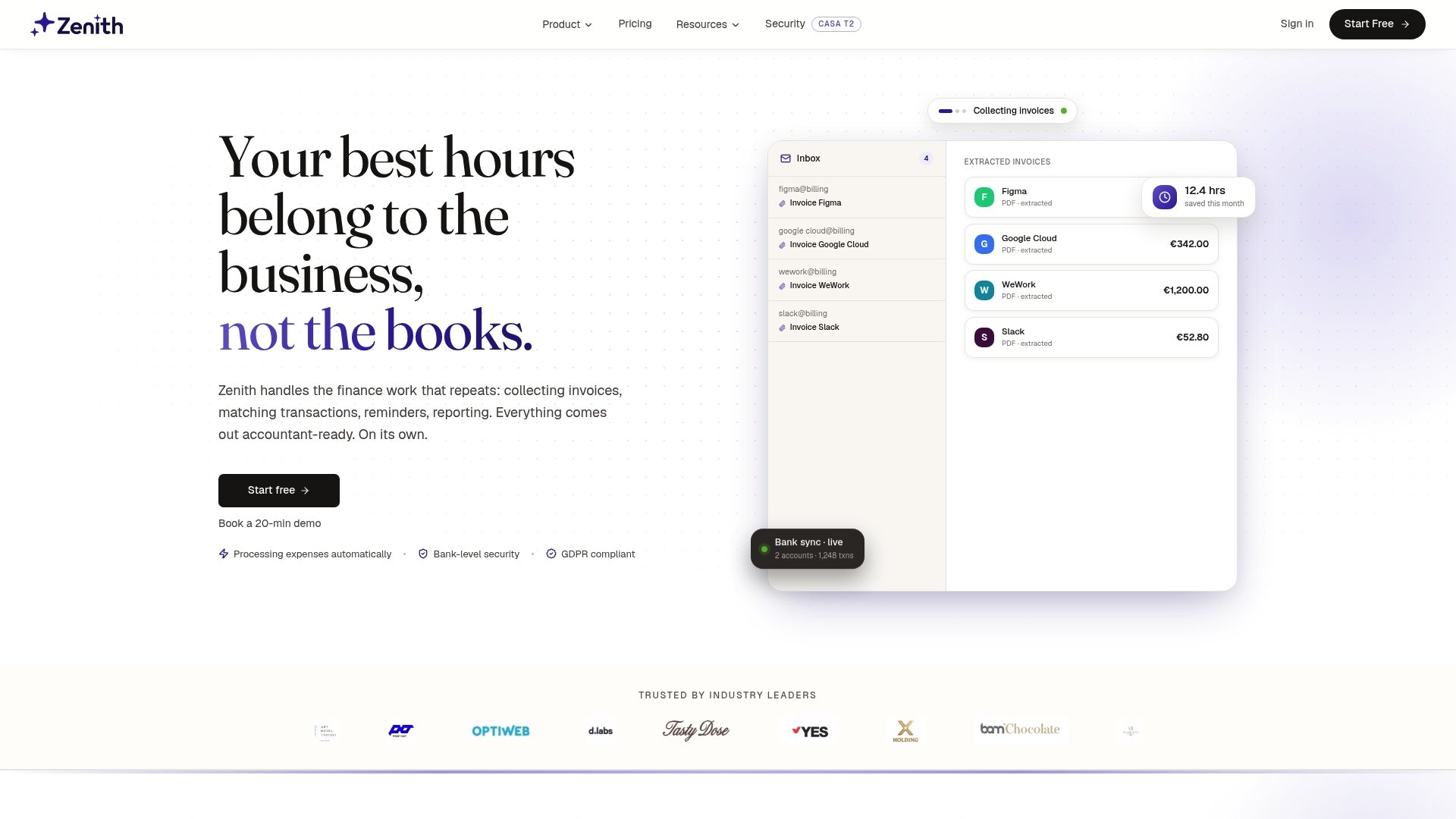
Zenith’s Bank Sync connects to over 2,400 banks across 30 European countries through a read-only PSD2 connection, meaning it can view balances and transactions but never move money. Setup takes about five minutes, data lands wherever your team actually works (Google Sheets, Claude via MCP, a REST API, or CSV), and pricing runs €5 per account per month, backed by a 30-day money-back guarantee. On the invoice side, automated ingestion from email and Google Drive removes the manual re-keying step that so often leaves sensitive data scattered across inboxes and shared folders. If you want live visibility across every account without exporting a single spreadsheet by hand, start with Cash Balances or review the full Bank Sync setup to see whether it fits your stack.
This article is general information, not a substitute for advice from a qualified financial advisor. Consult a qualified financial professional about your own circumstances before acting on anything here.