


Yes, zero manual data entry is achievable for most routine finance workflows, provided you combine AI-driven extraction with reliable integrations and a disciplined discovery phase. Expect touchless processing on standardised, high-volume documents like invoices, with humans still reviewing exceptions and low-confidence matches. The path there starts with a scoped pilot, not a wholesale system rip-out.
TL;DR:
- Automation projects should focus on standardised, high-volume documents like invoices and use phased rollouts to manage risks effectively.
- Baseline metrics such as processing time, error rate, and cost per document are essential to demonstrate ROI and guide automation priorities.
- Reliable integration of AI extraction, direct API connections, and RPA are key for achieving touchless processing with minimal human review.
- Common pitfalls include skipping discovery, trying to automate all document types simultaneously, and neglecting controls and segregation early in the process.
- Role changes involve staff focusing more on exception review and analysis rather than routine data entry, requiring additional training and change management.
Table of Contents
- What does zero manual data entry actually mean?
- Why manual entry still costs organisations more than they think
- What core technologies make zero manual data entry possible?
- How do you roll out zero manual data entry in 6 to 12 weeks?
- What pitfalls commonly derail these projects, and how do you avoid them?
- How does removing manual entry change what your finance team actually does?
- What security and privacy risks come with automated data entry systems?
- Where is zero manual data entry technology heading next?
- How does Zenith deliver zero manual data entry for finance teams?
- Ready to see zero manual data entry working on your own invoices?
- Sources
What does zero manual data entry actually mean?
What “zero manual data entry” really means in finance operations is that a person no longer retypes data from a document into a system. Instead, software extracts it, matches it, and posts it, with a human stepping in only when confidence drops or something looks wrong.
That distinction matters because vendors often promise full automation and deliver something close to high straight-through processing rates, which is still transformative. A realistic target is achieving substantial automation with visible, well-managed exceptions, not the disappearance of human oversight altogether.
Why manual entry still costs organisations more than they think
Retyping an invoice takes a few minutes when everything goes smoothly. Multiply that across hundreds or thousands of documents a month and the labour cost adds up fast, before you even count the rework. Fatigue is the hidden multiplier: accuracy on repetitive keying tasks drops as volume rises, particularly late in the day or at month end when finance teams are rushing to close the books.
The financial exposure from small mistakes is larger than most finance leaders assume. Harvard Business Review has documented cases illustrating how small data errors can have very costly impacts, and those are the errors that get caught. Plenty of smaller ones simply erode margin quietly through duplicate payments, missed early-payment discounts, or reconciliation drift.
Statistic callout: Building a formal business case around data quality, not just speed, is what typically unlocks investment for automation projects, according to Gartner’s guidance on data-quality business cases.
Before automating anything, baseline these:
- Average time per document from receipt to posting
- Error rate per 100 invoices processed
- Fully loaded cost per document (labour, software, rework)
- Time-to-post from invoice receipt to ledger entry
Without a baseline, you cannot prove ROI later, and you cannot spot which document types are actually worth automating first.
What core technologies make zero manual data entry possible?
Basic OCR reads characters off a page. Intelligent document processing (IDP) goes further: it understands context, recognises fields regardless of layout, and learns from correction patterns over time. That difference is why older OCR tools failed on messy invoices while modern IDP handles a supplier’s format one week and a completely different one the next without retraining.
Integrations do the second half of the work. Direct API connections to banks and accounting platforms remove the CSV export, reformat, and re-import cycle that quietly reintroduces manual steps even in “automated” workflows. Power Query is a useful low-code option when you need to normalise spreadsheet data that has no clean API path yet, though it is a bridge, not an endpoint.
Robotic process automation (RPA) and AI agents handle the orchestration: moving extracted data between systems, triggering approval routing, and writing final entries into the ledger. The combination looks like this in practice:
- IDP extracts and structures the document data
- APIs push that data directly into the accounting system
- RPA or an AI agent handles cross-system writes and matching
- Confidence scoring flags anything uncertain for human review
Pro Tip: Set your confidence threshold conservatively at first, even if it routes more documents to human review than you’d like. It is far easier to loosen the threshold once you trust the extraction accuracy than to rebuild confidence after a bad batch slips through.
How do you roll out zero manual data entry in 6 to 12 weeks?
Trying to automate every document type on day one is the fastest way to stall a project. A phased rollout works because it lets you prove value incrementally before scaling risk across the business.
- Weeks 0 to 2, discovery. Map every document type, the rules applied to each, who owns exceptions, and where the current process actually breaks down. Skipping this step is the single biggest reason automation projects fail, because teams end up digitising a broken process instead of redesigning it.
- Weeks 3 to 6, pilot. Choose the highest-volume, most standardised document type, invoices are usually the strongest starting point, and run the automated process in parallel with the manual one to compare accuracy without risking live postings.
- Weeks 6 to 12, controls and write-back. Connect the pilot to your ERP for live posting, set conservative confidence thresholds, and enable audit trails and segregation-of-duties controls before anything touches production data unsupervised.
- Beyond week 12, scale. Add receipts, then bank statement reconciliation, tightening thresholds as accuracy proves out and tracking your straight-through processing rate against the ROI case you built at the start.
A short parallel run, even just two weeks, does more for stakeholder confidence than any accuracy statistic you could quote them. For a shorter version of this plan sized for smaller teams, a six to twelve week startup automation plan covers similar ground with lighter staffing assumptions. It’s also worth documenting the expected ROI before you start, so week 12’s results have something concrete to be measured against.
What pitfalls commonly derail these projects, and how do you avoid them?
Most failures trace back to a handful of repeatable mistakes rather than bad technology. Recognising them early saves months.
- Skipping discovery and automating a workflow nobody has actually mapped, which just moves the same broken process faster
- Trying to automate every document type simultaneously instead of phasing by volume and standardisation
- Over-automating high-risk controls, like vendor bank detail changes, where a human check is worth the friction
- Failing to plan where displaced staff time goes, exception handling and analysis, not redundancy
- Treating audit trails and segregation of duties as an afterthought rather than a design requirement from week one
Statistic callout: Poor process discovery remains the leading cause of automation failure across finance teams, according to practitioner analysis from Forbes Technology Council, and it is entirely avoidable with proper mapping upfront.
A governance checklist worth running before go-live: confirm approval routing matches your existing authority limits, set exception SLAs so nothing sits unreviewed for days, and build fraud detection rules around vendor and bank-detail changes specifically, since that is where automated systems get exploited most often. Our accounts payable automation guide walks through exception handling in more depth if this is your first rollout.
How does removing manual entry change what your finance team actually does?
The obvious fear is headcount reduction. The more accurate picture, based on how these rollouts typically play out, is role redistribution. Staff who spent hours retyping invoice fields shift towards reviewing exceptions, analysing spend patterns, and chasing the anomalies that automation flags rather than the routine entries it handles cleanly.

That shift asks more of people, not less. Reviewing an exception queue requires judgement: is this vendor format genuinely unusual, or is something wrong with the extraction rules? Someone needs to answer that quickly, which means junior staff who previously did pure data entry often need new training in how the automation works, not just how to use it.
Productivity gains show up unevenly across a team. The person who owned month-end reconciliation might reclaim several days a month. The person who only ever kept the accounts payable inbox tidy may find their role changes shape entirely. Plan the redeployment conversation before go-live, not after, because staff who see automation coming without a clear role for themselves will resist it, consciously or not, at exactly the point you need their cooperation to tune exception rules.
What security and privacy risks come with automated data entry systems?
Automating extraction means financial documents, often containing bank details, tax identifiers, and payment information, now flow through third-party software rather than staying inside internal email and spreadsheets. That is a net security improvement when done properly, but only if the vendor treats it that way.
Look for encryption in transit and at rest as a baseline, and ask specifically how long documents are retained and where. Access controls matter more than most buyers realise at demo stage: can you restrict who sees payment details versus who can approve invoices, and does the system log every access and change for audit purposes? Segregation of duties needs to exist inside the software, not just in your internal policy documents.
Regulatory compliance adds another layer specific to finance. If any part of your automated workflow touches tax filing, the relevant HMRC guidance on Making Tax Digital sets requirements you need your systems to satisfy, and it is worth checking vendor compliance claims against that guidance directly rather than taking a sales page’s word for it. Bank-level integrations should also meet PSD2 standards where they touch live account data, since that framework governs how third parties can access banking information securely.
Ask any vendor for their data retention policy and breach history before signing, not after. A risk assessment framework for automation projects gives a useful structure for evaluating this systematically rather than relying on a vendor’s own reassurances.
Where is zero manual data entry technology heading next?
The next wave of extraction accuracy is less about reading text and more about understanding intent. AI agents are starting to handle multi-step reasoning, not just “extract this field” but “flag this invoice because the payment terms contradict our contract with this vendor.” That shifts automation from a data-capture tool towards something closer to a junior analyst that never sleeps.
Bank connectivity is also tightening. Direct API integrations are steadily replacing the older screen-scraping methods that many platforms still rely on, which matters for both reliability and regulatory compliance under PSD2. Expect live cash flow syncing to become the default expectation, not a premium feature, over the next few years.
Cross-document reasoning is the frontier worth watching. Instead of processing an invoice in isolation, systems are increasingly able to check it against the purchase order, the contract terms, and prior payment history in one pass, catching discrepancies a human reviewer might miss because they lack the context sitting across three different systems. Industry analysis suggests the speed gains from AI extraction, compressing minutes of manual work into seconds, are precisely what makes this deeper reasoning economically viable at scale, since the time saved on capture can be reinvested in verification.
How does Zenith deliver zero manual data entry for finance teams?
Zenith combines AI invoice extraction, direct bank sync, and automatic transaction matching into a plug-and-play workflow built specifically for finance teams, not general document management.
Clients including Združenje YES and BAM Chocolate have reported zero manual entry across their transactions after implementation, alongside noticeably shorter month-end close times. Zenith fits best for small and growing businesses that want AP automation running within weeks rather than months, with implementation support scoped to match the size of the team adopting it.
— Gašper
Ready to see zero manual data entry working on your own invoices?
If invoices from suppliers still land in an inbox and get typed into a spreadsheet by hand, that is the fastest place to start. If your bigger headache is reconciling bank statements against the ledger every month, start there instead. Zenith is built so you can pick the entry point that matches your actual pain rather than adopting a whole new finance stack in one go.
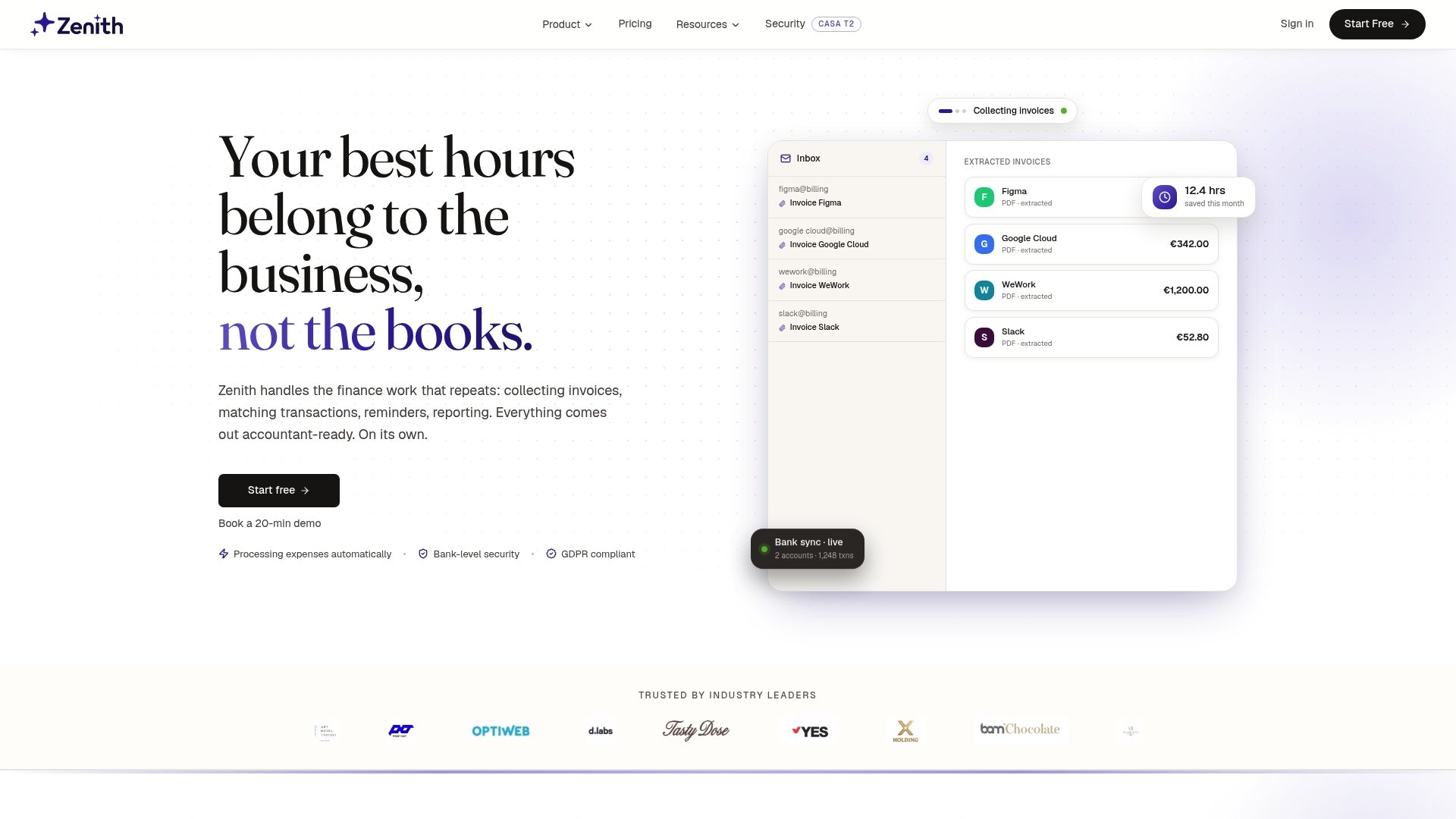
Before booking a demo with any automation vendor, bring three things: a handful of real invoices in the formats your suppliers actually send, your current month-end close time, and a rough figure for how many documents your team processes monthly. Those three numbers turn a generic product tour into a concrete answer about the accuracy and time savings you’d actually see.
Start with the invoice capture workflow if document filing is your immediate bottleneck, or look at live bank sync to Google Sheets if cash flow visibility matters more right now. Either way, the plug-and-play finance workflows overview is the right place to see how the pieces connect before you commit to anything.
Sources
- In the age of AI, why are finance teams still doing it manually?
- Sign up your business for Making Tax Digital for income tax
- How to create a business case for data-quality improvement
- Introduction to Power Query
- Even the tiniest error can cost a company millions