
Best Melio Alternatives for SMB Finance Teams in 2026

The strongest Melio alternatives for SMB finance teams are Zenith-books, Bill.com, Tipalti, Stampli, Ramp, Veem, Wise, and Plastiq — and for most teams that want fast invoice extraction, bank sync, and low migration friction, Zenith-books is the recommended starting point.
Here is the shortlist with a one-line rationale for each:
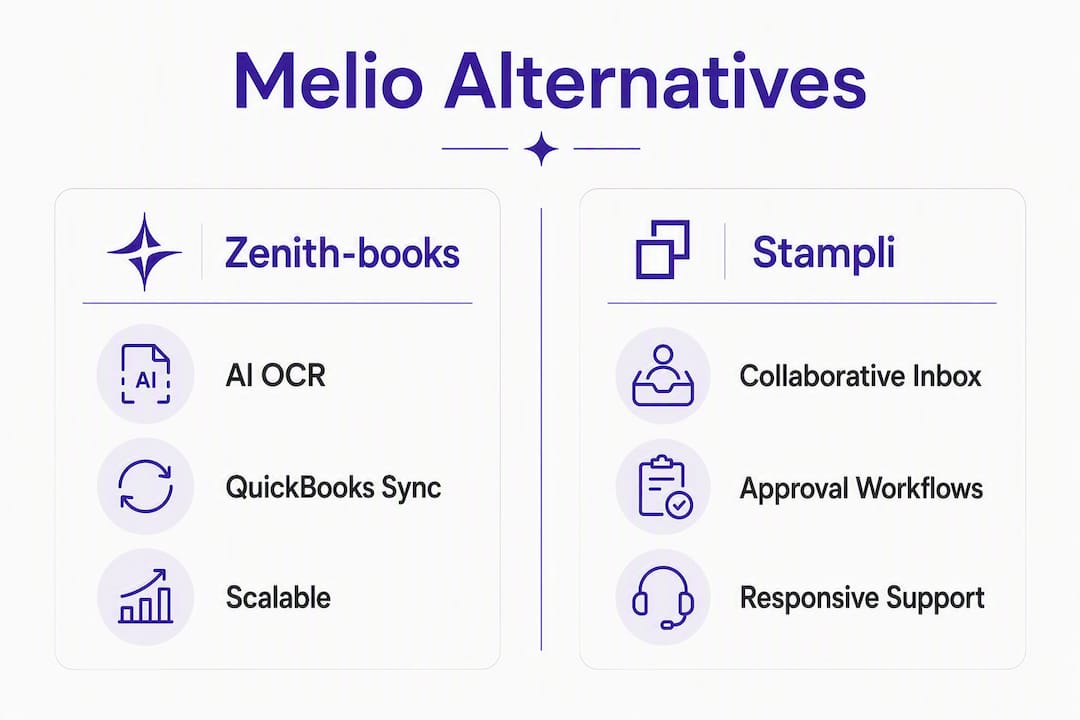
- Zenith-books — AI invoice extraction, automated Google Drive filing, and live bank-to-Sheets sync make it the fastest path from inbox to reconciled books.
- Bill.com — Deep QuickBooks and Xero integration with approval routing; best for teams already embedded in those ecosystems.
- Tipalti — Built for high-volume international payouts and automated tax form collection; overkill for purely domestic teams.
- Stampli — AP-first with strong multi-approver workflows and a collaborative invoice inbox; good for teams with complex approval hierarchies.
- Ramp — Corporate-card-first platform that bundles expense management and bill pay; ideal when card float and spend visibility matter as much as AP.
- Veem — Straightforward international wire alternative with transparent fees; works well for SMBs paying overseas vendors without a full AP suite.
- Wise — Low-cost international transfers with mid-market exchange rates; best as a supplemental payment rail, not a full AP layer.
- Plastiq — Lets you pay vendors by card even when they only accept ACH or check; useful for preserving card rewards on large invoices.
- Coupa — Enterprise spend management with deep procurement features; typically too complex and expensive for SMBs under 200 employees.
- Basware — E-invoicing and purchase-order matching at scale; designed for mid-market and enterprise, not lean finance teams.
Recommended for most SMB finance teams: Zenith-books. It covers invoice capture, reconciliation, and bank sync without requiring you to rebuild your accounting setup from scratch. Migration friction is low because it connects to your existing Google Workspace and bank feeds rather than replacing them.
Pro Tip: If your bank already offers embedded bill pay, use it for simple domestic payments. Add a standalone AP layer like Zenith-books only when you need invoice capture, multi-approver routing, or reconciliation automation that your bank’s tool cannot handle.
Table of Contents
- How do these Melio alternatives compare at a glance?
- What AP capabilities actually differ across these platforms?
- How do you choose the right Melio alternative for your business?
- Why Zenith-books belongs on every SMB shortlist
- What are the transaction limits and processing times?
- Does customer support quality vary across these platforms?
- Which AP platforms have the strongest track record?
- How well do these platforms scale as your business grows?
- Key Takeaways
- The real cost of switching AP tools is rarely the subscription fee
- Zenith-books cuts your migration risk to near zero
- Further reading and vendor pages
How do these Melio alternatives compare at a glance?
Pricing models in the AP market vary widely, from per-user monthly fees to flat-rate plans and usage-based tiers. The table below maps the shortlist across the dimensions that matter most at the selection stage.
| Platform | Best for | Pricing model & free tier | Payment methods | Key integrations | Core AP features | Security | Typical onboarding |
|---|---|---|---|---|---|---|---|
| Zenith-books | SMBs needing invoice OCR + bank sync | Subscription tiers; free trial available | ACH, bank transfer, QR pay | Google Drive, Google Sheets, bank feeds | AI invoice extraction, auto-categorization, reconciliation | SOC 2, encrypted in transit/rest | Days to first invoice |
| Bill.com | QuickBooks/Xero-native teams | Plan-based; no free tier | ACH, check, virtual card, international | QuickBooks, Xero, NetSuite, Sage | Invoice capture, approval routing, sync | SOC 2 Type II | 1–2 weeks |
| Tipalti | High-volume international payouts | Custom enterprise pricing | ACH, wire, PayPal, local rails | NetSuite, Xero, QuickBooks | Mass payouts, tax form collection, approval | SOC 2 Type II | 2–4 weeks |
| Stampli | Complex approval hierarchies | Per-user monthly | ACH, check | QuickBooks, NetSuite, Sage, Xero | Collaborative invoice inbox, multi-approver routing | SOC 2 | 1–2 weeks |
| Ramp | Card-first spend management | Free base plan; premium tiers | Corporate card, ACH, check | QuickBooks, Xero, NetSuite | Expense management, bill pay, receipt capture | SOC 2 Type II | 1 week |
| Veem | Simple international SMB payments | Per-transaction fees; free to send | Bank transfer, wire, card | QuickBooks, Xero | Basic AP, payment tracking | SOC 2 | Days |
| Wise | Low-cost FX transfers | Per-transaction FX fee | Bank transfer, debit card | QuickBooks, Xero | Basic payments, batch transfers | FCA/FinCEN regulated | Days |
| Plastiq | Card-funded vendor payments | Per-transaction fee | Credit/debit card to ACH/check | QuickBooks | Bill pay, card-to-check conversion | PCI DSS | Days |
| Coupa | Enterprise procurement | Custom enterprise | Card, ACH, wire, check | SAP, Oracle, NetSuite | Full P2P, procurement, analytics | SOC 2, ISO 27001 | 6–8 weeks |
| Basware | Mid-market e-invoicing | Custom pricing | ACH, wire, e-invoice | SAP, Oracle, NetSuite | PO matching, e-invoicing, analytics | SOC 2, ISO 27001 | 8–16 weeks |
Trade-off notes worth knowing:
- Bill.com has the deepest native sync with QuickBooks and Xero, but its per-user pricing climbs fast once your team grows past five people.
- Tipalti is genuinely powerful for international payouts and vendor tax compliance, but its implementation timeline and pricing make it a poor fit for teams under roughly 100 monthly vendor payments.
- Stampli shines on approval workflows. Its invoice-inbox collaboration model is unlike any other tool on this list, but it does not handle international payments natively.
- Ramp is free at the base tier, which sounds attractive, but the real value only materializes if your team actually shifts spend to Ramp cards. Pure AP teams without a card program get less from it.
- Coupa and Basware belong on enterprise shortlists, not SMB ones. Onboarding alone can take days to 16 weeks, depending on platform and complexity.
What AP capabilities actually differ across these platforms?
Invoice capture and OCR accuracy
The quality gap between platforms is widest here. Zenith-books uses AI extraction that pulls line-item data from emailed invoices and auto-files them to Google Drive with standardized naming. Bill.com and Stampli both offer OCR, but accuracy on non-standard invoice layouts varies. Plastiq and Veem treat invoice capture as secondary — you are mostly entering payment details manually.
What to look for: structured data extraction (not just PDF storage), confidence scores on extracted fields, and automatic routing to the right approval queue without manual intervention.
Approval routing and multi-approver workflows
Stampli is the specialist here. Its collaborative inbox lets approvers comment directly on an invoice, and it supports conditional routing based on amount, department, or vendor. Bill.com handles basic two-step approvals well. Ramp’s approval logic is tied to its card and expense system, which works cleanly if you are already using Ramp cards. Zenith-books handles approval routing as part of its automated categorization and reconciliation flow, keeping the process inside your existing Google Workspace.
Payment funding options
ACH is table stakes. The real differentiators are: same-day ACH availability, international wire support, and whether the platform lets you pay by card when a vendor only accepts check. Plastiq is the only tool on this list purpose-built for that last scenario. Veem and Wise cover international transfers at lower cost than traditional wires. Ramp covers card and ACH natively. Tipalti supports the widest range of local payment rails globally.

Reconciliation and accounting sync
This is where most teams underestimate switching cost. A tool that pushes a payment record to QuickBooks is not the same as one that matches it against an open bill, applies the correct GL code, and closes the transaction. Zenith-books syncs bank data live to Google Sheets and matches transactions automatically, which means your reconciliation happens continuously rather than at month-end. Bill.com and Stampli both offer two-way sync with QuickBooks and Xero, but the depth of that sync (bill matching vs. journal entry only) varies by plan.
International payments and tax compliance
Tipalti is the clear leader for teams paying a larger number of international vendors monthly. It handles multi-currency payouts, collects W-8/W-9 forms from vendors, and manages 1099/1042-S reporting. Wise and Veem are better fits for SMBs with occasional international payments. Neither handles tax compliance automation.
Finance teams increasingly prefer integrated spend-management ecosystems that combine cards, expense reporting, and AP — Ramp is the clearest example of that model.
Pro Tip: During any trial, send 20 invoices with different layouts (PDF, scanned, emailed) and check whether the extracted data matches your chart of accounts without manual correction. That test reveals extraction accuracy faster than any vendor demo.
Security baseline: Look for SOC 2 Type II certification, AES-256 encryption at rest, TLS in transit, and a defined SLA for payment processing. Bill.com, Tipalti, Stampli, and Ramp all carry SOC 2 Type II certifications. Zenith-books applies encryption in transit and at rest with secure bank integrations. Coupa and Basware add ISO 27001 for enterprise requirements.
How do you choose the right Melio alternative for your business?
Three non-negotiables before you evaluate anything else:
- Does it integrate with your accounting platform without requiring a manual export?
- Can it replicate your existing approval workflow without forcing a redesign?
- Does reconciliation happen automatically, or does someone still have to match transactions by hand?
If a vendor cannot confirm all three, the sticker price is irrelevant. A tool that forces teams to rework processes often reduces productivity despite lower costs — the hidden cost of switching AP tools is vendor re-enrollment, rebuilding approval workflows, and reconciliation cleanup.
Prioritized decision criteria
- Company size and payment volume: Under 50 invoices per month, most teams are fine with a lean tool like Zenith-books or Veem. Over 200 monthly vendor payments with international complexity, Tipalti becomes worth the setup cost.
- Domestic vs. international payments: Domestic-only teams can ignore Tipalti and Wise entirely. Teams paying vendors in more than three currencies need a platform with native multi-currency support.
- Number of approvers: One or two approvers? Any tool works. Three or more, with conditional routing? Stampli or a platform with configurable approval chains.
- Accounting platform: QuickBooks or Xero users have the most options. NetSuite users should prioritize Bill.com, Tipalti, or Stampli. Google Sheets-based teams fit Zenith-books naturally.
- Cards and spend management: If you want to unify card spend and AP in one dashboard, Ramp is the only tool on this list built for that from the ground up.
For a deeper look at the operational considerations behind these criteria, the AP automation guide for finance leaders covers the full decision framework.
Questions to ask vendors in demos
- Show me a sample accounting sync payload — what fields map to my chart of accounts?
- How long does vendor enrollment take, and what does the vendor experience look like?
- What is your reversal or cancellation policy for an ACH payment already in flight?
- What is your SLA for payment timing, and what happens if a payment is delayed?
- How do you handle duplicate invoice detection?
Migration checklist
- Map your current approval workflows before touching any new tool. Document every rule, threshold, and approver.
- Export your vendor list with bank details and payment terms. Plan for re-enrollment time.
- Run a parallel close cycle — process one full month in both the old and new system and compare reconciliation output.
- Clean your chart of accounts before migrating. Garbage in, garbage out.
- Communicate with vendors about any new payment methods or portal requirements at least two weeks before cutover.
- Budget at least one full close cycle to validate that the new system’s reconciliation matches your accountant’s expectations.
Red flags that should pause a switch: no SOC 2 certification, fees that are not disclosed until checkout, no ability to cancel or reverse a payment, and an accounting sync that only writes journal entries rather than matching open bills.
Pro Tip: Ask every vendor for a list of customers in your industry with similar payment volume. A reference call with a peer company reveals integration quirks that no demo will show you.
Why Zenith-books belongs on every SMB shortlist
Zenith-books is the recommended option for SMB finance teams that need fast invoice extraction, live bank-to-Sheets sync, and low migration friction. The core reason is that it connects to infrastructure you already use (email, Google Drive, your bank) rather than requiring you to adopt a new ecosystem.
What Zenith-books does that most AP tools do not:
- Extracts invoice data from email automatically, categorizes it, and files it to Google Drive with standardized naming — no manual upload, no renaming.
- Syncs live bank data to Google Sheets, so your cash position is always current without a manual export.
- Matches transactions automatically, reducing month-end reconciliation from hours to minutes.
- Generates payment QR codes and issues invoices natively, covering both payables and receivables in one workflow.
- Exports to standardized eSlog accounting format for clean handoffs to your accountant.
Clients like Združenje YES and BAM Chocolate report reduced month-end close times and zero manual entry across transactions after switching to Zenith-books. That outcome is the benchmark: if a tool cannot get you to zero manual entry, it is solving only part of the problem.
For teams evaluating international-payments-heavy alternatives, the Tipalti alternatives comparison covers that segment in more depth.
Security and onboarding: Zenith-books applies encryption in transit and at rest, uses secure bank integrations, and offers a trial/pilot option so teams can validate reconciliation outcomes before full cutover. Onboarding typically takes days, not weeks, because the connectors are plug-and-play against your existing Google Workspace and bank feeds.
What are the transaction limits and processing times?
Processing times and transaction limits vary more than most vendors advertise upfront. Standard ACH transfers typically settle in 1–3 business days; same-day ACH is available on some platforms (Bill.com, Ramp) for an additional fee. International wires through Tipalti or Veem generally settle in 1–3 business days depending on the destination country and currency corridor.
Transaction limits are rarely published on pricing pages. Many platforms impose transaction and daily limits that depend on account verification, credit line, or card network, which may require additional verification for higher volumes.
The practical implication: if you regularly pay vendors over $50,000 per transaction, verify the platform’s limit structure before committing. A limit that blocks a large vendor payment at month-end is a serious operational problem, not a minor inconvenience.
Does customer support quality vary across these platforms?
Yes, and the gap is wider than review scores suggest. G2 reviews for Stampli consistently highlight responsive support as a differentiator — users cite fast response times and dedicated onboarding help. Bill.com reviews on G2 show a more mixed picture: strong product satisfaction but slower support response at higher ticket volumes.

Tipalti reviews on Capterra note that enterprise-tier customers receive dedicated account management, while smaller accounts rely on self-serve documentation. Ramp’s Capterra reviews frequently mention chat support quality as a strength.
For SMB teams without a dedicated finance ops person, support responsiveness during the first 90 days matters more than any feature. Ask vendors specifically: what is the average first-response time for billing and payment issues, and is there a phone number for urgent payment failures?
Which AP platforms have the strongest track record?
Bill.com has been in the AP automation space for many years and processes very large payment volumes annually, giving it a deep integration network and well-tested reconciliation logic. Tipalti, founded in 2010, has built a strong reputation specifically in global payables and tax compliance. Gartner peer reviews for Melio alternatives show Bill.com and Tipalti consistently rated highly by finance professionals evaluating enterprise-grade AP tools.
Stampli, founded in 2015, has carved out a clear niche in AP collaboration and approval workflows. Ramp, founded in 2019, has grown fast in the spend-management category and carries strong G2 ratings from SMB users.
Newer entrants carry more platform risk. If your AP process is mission-critical and you cannot afford downtime, weight vendor longevity and financial stability alongside feature fit.
How well do these platforms scale as your business grows?
Most SMB-focused tools hit a usage ceiling beyond a certain monthly invoice volume. Below that threshold, Zenith-books, Veem, and Wise handle volume without complexity. Above it, the question shifts from “does it work?” to “does it scale without requiring a full reimplementation?”
Bill.com scales reasonably well into the mid-market but starts to show limits on custom approval logic and ERP depth beyond QuickBooks and Xero. Stampli scales approval complexity well but is not a spend-management platform. Tipalti and Coupa are built for scale from the start — but their implementation overhead means a small team will spend more time configuring than processing invoices.
Zenith-books’s subscription tiers scale by usage (invoice OCR pages, number of bank accounts), so cost grows with actual volume rather than with headcount. That model suits lean finance teams that process variable invoice volumes month to month. For teams comparing finance automation options across the SaaS space, this external comparison of finance automation alternatives covers scalability trade-offs in more detail.
Customization is a separate question from scale. Ramp offers the most customizable spend policy enforcement. Tipalti offers the most customizable payout workflows. Zenith-books offers the most flexibility for teams that want to own their data in Google Sheets and Drive rather than inside a vendor’s proprietary dashboard.
Key Takeaways
The right Melio alternative depends on three factors above all: accounting integration fit, approval workflow parity, and whether reconciliation is automated or manual.
| Point | Details |
|---|---|
| Shortlist by integration first | Match the platform to your accounting system (QuickBooks, Xero, NetSuite, or Google Sheets) before evaluating any other feature. |
| Test OCR with real invoices | Send 20 varied invoices during any trial to verify extraction accuracy against your chart of accounts. |
| Budget for migration overhead | Plan at least one full close cycle to validate reconciliation before cutting over completely. |
| Scale model matters | Choose usage-based pricing (like Zenith-books) if your invoice volume fluctuates; per-user pricing penalizes team growth. |
| Zenith-books for lean SMB teams | Zenith-books covers invoice extraction, bank sync to Sheets, and reconciliation automation with onboarding typically taking days and a free trial. |
The real cost of switching AP tools is rarely the subscription fee
The conventional wisdom when evaluating AP tools is to compare pricing pages and feature checklists. That framing misses the actual cost of a switch.
The teams I have seen struggle most after a migration are not the ones who picked the wrong feature set. They are the ones who underestimated how much of their workflow lived in undocumented approval logic, informal vendor communication habits, and month-end reconciliation routines that nobody had written down. When those break, the new tool gets blamed — even when the tool is fine.
The smarter approach is to treat the migration itself as a project with a defined scope: map your approvals before you touch anything, run a parallel close, and pilot with a small vendor subset first. A tool that lets you do that without a six-week implementation is worth more than a tool with a longer feature list that requires a consultant to configure.
That is why I keep coming back to platforms that reduce switching overhead as a first-class design goal rather than an afterthought. The best AP tool for your team is the one you can actually validate before you commit.
Zenith-books cuts your migration risk to near zero
Most AP tools ask you to trust their reconciliation before you have seen it work with your own data. Zenith-books flips that: you can pilot the full workflow with your actual invoices and bank feeds before you pay for a full subscription.
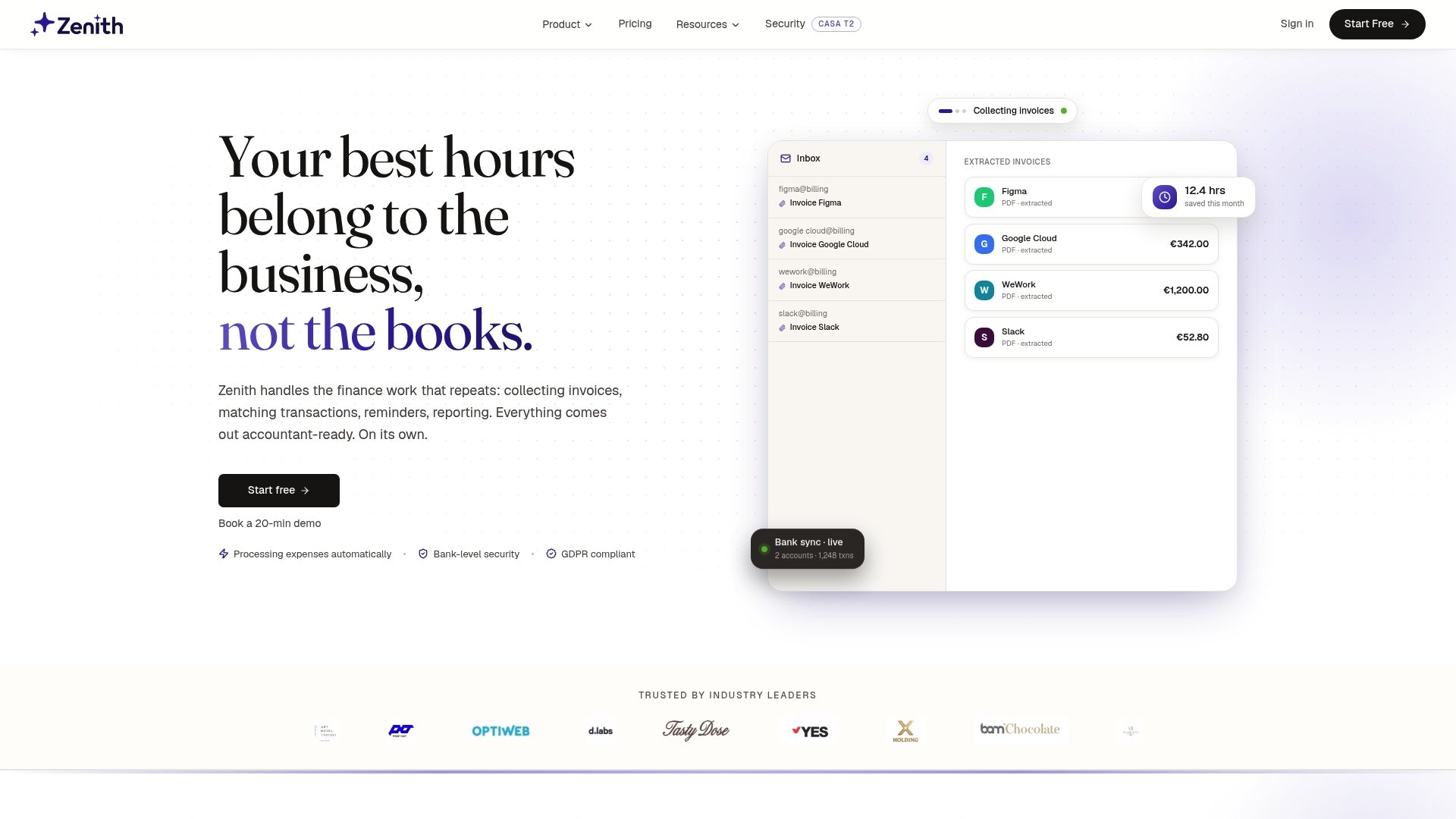
The concrete difference from the alternatives above: Zenith-books connects to your existing Google Workspace and bank feeds in days, not weeks. Invoice extraction starts from your email inbox automatically. Bank data syncs live to Google Sheets. Reconciliation runs continuously. Clients like BAM Chocolate and Združenje YES moved from manual entry to zero-touch bookkeeping without rebuilding their accounting setup.
Start a free trial or explore the full solutions page to see which workflows you can automate this week.
Further reading and vendor pages
- Gartner peer reviews: top Melio alternatives — finance professional ratings and comparisons
- G2 reviews: Tipalti — user ratings for international payables
- Capterra reviews: Tipalti — verified buyer reviews
- G2 reviews: Bill.com — SMB and mid-market AP ratings
- Capterra reviews: Bill.com — verified buyer reviews
- G2 reviews: Stampli — approval workflow and collaboration ratings
- Capterra reviews: Stampli — verified buyer reviews
- G2 reviews: Ramp — spend management and AP ratings
- Capterra reviews: Ramp — verified buyer reviews
- G2 reviews: Wise Business — international transfer ratings
- Zenith-books solutions page — plug-and-play finance workflow overview and trial starting point
- AP automation guide for finance leaders — decision criteria and integration-readiness checklist