


AI invoice categorization uses OCR and machine learning to read incoming invoices, assign them to the right general ledger code, and route them for approval, cutting manual coding time down to a review step instead of a data-entry job. Start small: pick your top 10 to 20 suppliers or PO-backed invoices, run them through a pilot with a human checking every low-confidence result, and expand once accuracy holds steady. This is not experimental technology. Microsoft’s prebuilt invoice model already returns standard invoice fields with confidence scores out of the box, and published research on SBERT-based classification shows small, company-specific models reaching strong accuracy with only about 100 labeled invoices.
Before you pilot anything, get three things in place:
- A defined scope (which suppliers, which invoice types, what volume)
- A human-in-the-loop process for anything below your confidence threshold
- A baseline measurement of your current time-per-invoice and error rate
Key Takeaways
AI invoice categorization works best as a layered system: rules handle the obvious cases, a fine-tuned model handles the rest, and a human reviews anything below your confidence threshold.
| Point | Details |
|---|---|
| Start with intake, not modeling | Fix document splitting and OCR quality before tuning any classification model. |
| Pilot on real volume | Test with your top 10 to 20 suppliers or PO-backed invoices over a defined window. |
| Confidence scores drive workflow | Route low-confidence predictions to a human review queue with a clear SLA. |
| Small datasets can work | Fine-tuned models can reach strong accuracy with modest labeled datasets per client. |
| Zenith-books automates the full pipeline | Zenith’s platform handles email capture, extraction, categorization, and matching with zero manual entry reported by clients like BAM Chocolate. |
Table of Contents
- What Is AI Invoice Categorization?
- How Does Machine Learning Invoice Processing Actually Work?
- How Do You Implement AI Invoice Categorization Step by Step?
- What Operational Practices Prevent AI Invoice Categorization From Breaking Down?
- What KPIs Prove AI Invoice Categorization Is Working?
- How Zenith-books Puts This Into Practice
- What Most AP Teams Get Wrong About This Technology
- Get Started With Zenith-books
- Frequently Asked Questions
- Sources
What Is AI Invoice Categorization?
AI invoice categorization is the process of automatically reading an invoice, pulling out its key data, and assigning it to the correct expense or GL account without a person retyping anything. It sits inside a longer pipeline, and each stage does a distinct job.
Capture (OCR) turns a scanned PDF or image into machine-readable text. This is the foundation. If your OCR misreads a vendor name or garbles a line item, everything downstream inherits that error.
Document splitting separates a batch scan or a multi-page email attachment into individual invoices before anything else happens. Skip this step and a five-invoice PDF gets treated as one giant document, producing extraction failures or merged, meaningless records, a failure mode document routing platforms flag as one of the most common intake breakdowns.
Extraction identifies specific fields: invoice number, date, vendor name, subtotal, tax, total, and line items.
Classification takes that extracted data and decides which GL code, cost center, or expense category the invoice belongs to.
Routing sends the classified invoice to the right approver, workflow, or accounting system.
A typical model output for a single invoice looks like this:
- Invoice ID and date
- Vendor name and matched vendor record
- Subtotal, tax, and total amount
- Line-item detail (description, quantity, unit price)
- A confidence score attached to each field
That last item matters more than most finance teams realize. Confidence scores tell you which fields the model is sure about and which ones need a human glance, and building your workflow around that signal, rather than treating every invoice the same, is the difference between a pilot that scales and one that quietly accumulates errors.
How Does Machine Learning Invoice Processing Actually Work?
Machine learning invoice processing works by combining structured signals (vendor ID, PO number, historical GL codes) with unstructured signals (line-item descriptions, free-text notes) to predict a category, then attaching a confidence score to that prediction. The strongest systems don’t rely on one model type. They blend approaches.

A rules-first layer handles the easy cases: if vendor X always maps to GL code 6100, a simple rule catches it instantly with no model needed. Oracle’s classification documentation describes exactly this pattern: evaluate rules first, and only fall back to ML or generative AI when rules don’t resolve the case.
For everything rules can’t catch, transformer-based models, including SBERT-style embeddings and BERT variants, read the invoice’s text and match it against patterns learned from historical data. Research on invoice classification shows that breaking the task into subproblems, predicting the account code separately from the VAT code, for example, produces measurably better accuracy than trying to predict everything in one pass, according to research on automated invoice classification.
Key technical building blocks:
- Vendor-history matching (often the single strongest signal)
- Line-item text embeddings for semantic similarity
- PO-to-invoice matching where purchase orders exist
- Ensemble scoring that combines multiple model outputs into one confidence figure
Small language models fine-tuned on client-specific data can reach strong classification accuracy with datasets as small as roughly 100 invoices per client, according to the arXiv study on SBERT-based invoice categorization, which also found vendor identity clusters tightly with embedding geometry, a strong argument for weighting vendor history heavily in any model you deploy.
Confidence handling should follow a clear fallback path: a fine-tuned custom model attempts classification first, and if confidence falls below your threshold, the system either checks a prebuilt model for a second opinion or routes straight to a human. Microsoft’s documentation recommends exactly this pattern, using prebuilt models as a fallback layer rather than the primary engine once you have custom coverage in place.
How Do You Implement AI Invoice Categorization Step by Step?
Implementation succeeds or fails based on sequencing. Teams that jump straight to model selection without scoping the pilot end up with a system nobody trusts. Here’s the order that works.
-
Scope the pilot. Pick a defined slice: your top 10 to 20 suppliers, or every PO-backed invoice for one department, over a fixed window like 60 or 90 days. Define success criteria up front: target accuracy (say, 90%), maximum exception rate, and a hard number for minutes saved per invoice.
-
Choose your approach. A prebuilt model with custom overlays gets you running in days and costs less upfront, but you inherit its field definitions and limited customization. A fine-tuned in-house small model, as the arXiv research on SBERT fine-tuning shows, takes longer to stand up but gives you full control over data, better interpretability for auditors, and no per-call dependency on an external vendor. Most finance teams start prebuilt and migrate specific supplier categories to a custom model as volume justifies it.
-
Prepare your data. Confirm OCR quality on a sample batch before you trust any output. Label 100 to 200 real invoices by hand as training and test examples. Map your GL hierarchy explicitly, don’t let the model guess your chart of accounts. Handle multi-currency and VAT rate variations as separate fields, not folded into the total. Build a splitting step for multi-invoice PDFs before extraction runs.
-
Test rigorously. Hold out a test set the model never saw during training. Measure accuracy, F1 score, and coverage (the percentage of invoices the model handles without human intervention). Set your confidence threshold based on where errors start climbing, not an arbitrary round number, and define rollback criteria in advance: if accuracy drops below your floor for two consecutive weeks, pause and retrain.
-
Integrate and operationalize. Route low-confidence invoices into a dedicated exception queue with a named owner and a service-level agreement, ideally same-day review. Log every manual correction. Feed those corrections back into scheduled retraining rather than letting them sit as isolated notes.
Pro Tip: Run your pilot on invoices you’d process anyway, not a synthetic test batch. Real vendor variation, messy line items, and the occasional handwritten note are exactly what your model needs to learn from.
What Operational Practices Prevent AI Invoice Categorization From Breaking Down?
Most AI invoice categorization failures trace back to intake, not the model. Get document splitting and routing right before you spend another dollar tuning classification accuracy. A model can’t categorize what it never correctly received as a discrete document.
Build these governance habits into the system from day one:
- Route every invoice below your confidence threshold into an exception queue with a named reviewer and a same-day or next-day SLA.
- Use vendor-mapping rules for repeat suppliers with consistent GL codes; save the machine learning model for genuinely ambiguous cases.
- Keep a plain-language audit trail for every automated decision, since your auditors will ask why an invoice landed in a specific account.
- Set a fixed retraining cadence (monthly or quarterly) rather than retraining reactively only after something breaks.
- Track model drift by comparing this month’s confidence-score distribution against last quarter’s; a shift signals your supplier mix or invoice format has changed.
The single most overlooked failure mode is assuming one file always equals one invoice. Batch scans, forwarded email chains, and multi-page PDFs routinely bundle several invoices together, and if your splitting logic doesn’t catch that upstream, extraction produces garbled, unusable records no matter how good your classification model is.
Pro Tip: Every manual correction a reviewer makes is free training data. Build your workflow so those corrections flow automatically into your retraining pipeline instead of getting fixed once and forgotten.

What KPIs Prove AI Invoice Categorization Is Working?
Track a small set of numbers consistently rather than a dashboard full of vanity metrics. The core five: accuracy (percentage of invoices correctly categorized), coverage (percentage handled without human touch), exception rate, average minutes per invoice, and cost per invoice processed.
For a pilot with a modest dataset, expect accuracy to improve steadily over the first few retraining cycles rather than hitting a ceiling immediately, small labeled sets take a few rounds of correction feedback to mature.
| Metric | What It Tells You |
|---|---|
| Accuracy / coverage | Share of invoices the model categorizes correctly without human correction |
| Exception rate | Percentage routed to manual review, ideally trending down over time |
| Time-to-post | Minutes from invoice receipt to posted GL entry |
| Cost per invoice | Staff time cost plus system cost divided by invoice volume |
A simple ROI estimate multiplies hours saved per week by average staff hourly cost, then adds the value of errors avoided (late payment penalties, duplicate payments, miscoded expenses that complicate month-end close). Even a modest pilot, a few hundred invoices a month, usually produces a clear enough signal within one quarter to justify scaling or to reveal that your data needs more prep first.
How Zenith-books Puts This Into Practice
Zenith-books built its invoice automation around the exact pipeline this article describes: automatic capture from email and bank feeds, AI-driven extraction and categorization, and transaction matching that eliminates retyping. Clients see it work at real operational scale.
- Združenje YES and BAM Chocolate both report reduced month-end close times and zero manual data entry across their transaction volume after adopting Zenith’s invoice-to-Drive automation.
- Invoices arrive by email, get automatically filed and named, and flow into categorization without a staff member opening a single PDF.
- For teams building their own pilot before committing to a platform, Zenith’s blog resources walk through automating invoice intake step by step.
The pattern holds across company sizes: intake automation removes the bottleneck, and categorization accuracy improves once volume gives the model enough real examples to learn from.
What Most AP Teams Get Wrong About This Technology
The conventional advice treats AI invoice categorization as a model-selection problem: pick the best transformer, tune the hyperparameters, ship it. That’s backwards. The research on splitting classification into subproblems and the practitioner data on document-splitting failures both point the same direction: the wins are in the plumbing, not the algorithm.
Most finance teams I’d push back on are the ones spending months evaluating models while their intake process still can’t reliably tell a three-page invoice from three separate invoices. Fix that first. It’s unglamorous work, and it won’t show up in a vendor demo, but it’s the difference between a pilot that degrades quietly over six months and one that keeps improving as it sees more real invoices.
The other overrated idea is that bigger, more general models automatically win. The SBERT research is compelling precisely because it shows a small, client-specific model beating generic approaches on the tasks that actually matter to one company’s chart of accounts. If you’re choosing between a massive prebuilt system and a modest fine-tuned model built on your own 100 invoices, don’t assume bigger is safer. Test both.
Get Started With Zenith-books
If you’ve made it this far, you already know the manual alternative: someone on your team retyping invoice data, guessing at GL codes, and reconciling by hand at month-end. Zenith-books replaces that entire chain with automated capture, extraction, and categorization, so your finance team reviews exceptions instead of processing every invoice by hand.
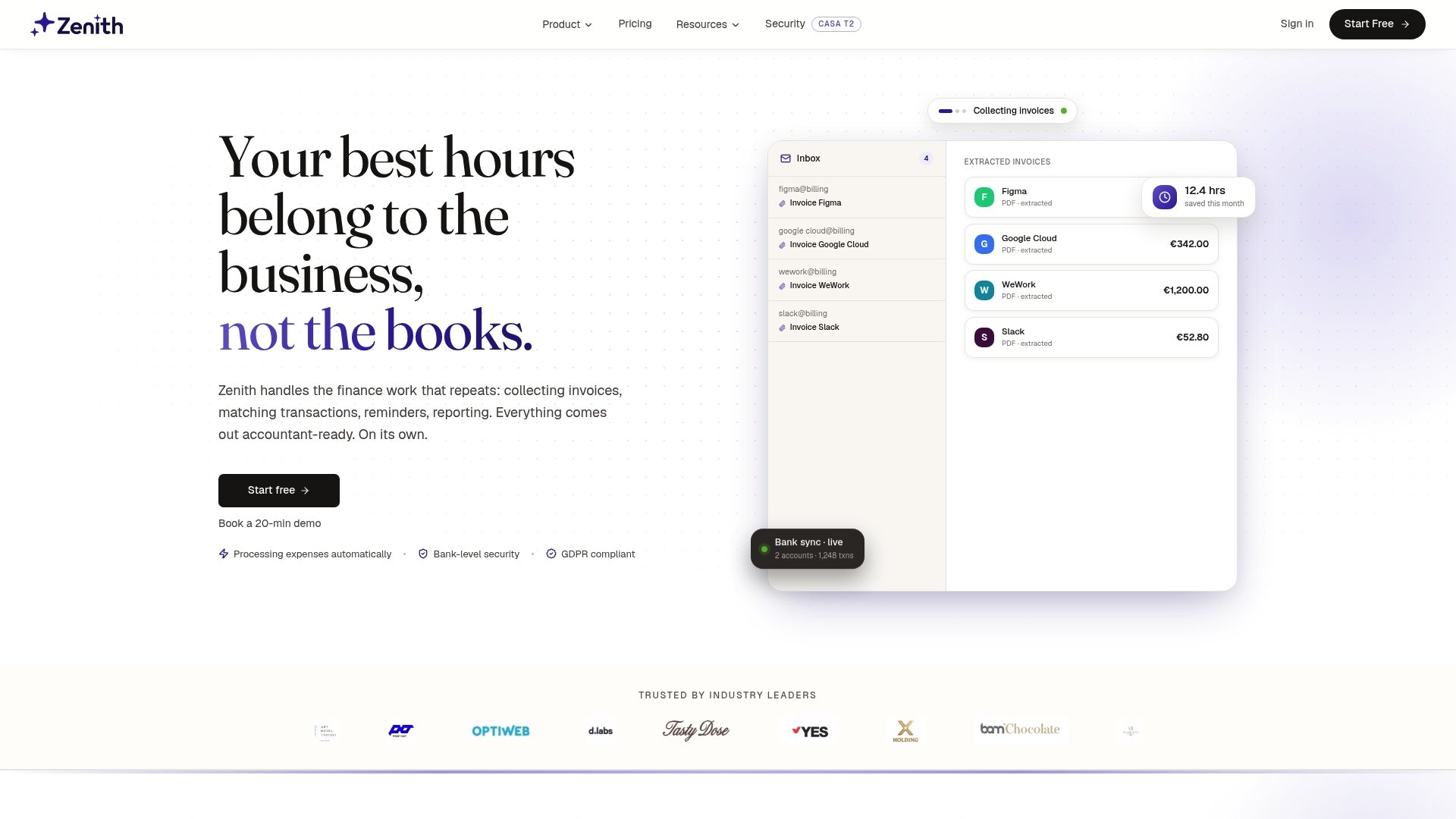
Zenith-books connects directly to your email and bank feeds, extracts and categorizes invoices automatically, and matches transactions without anyone opening a PDF. Clients like Združenje YES report zero manual entry across their transaction volume and materially shorter month-end close times. The full solutions overview covers invoice automation, bank syncing, and reconciliation in one platform built for finance teams that want to stop retyping data. If you’re ready to see what a pilot looks like on your own invoices, start with Zenith’s email-to-Drive automation and get your first batch of invoices auto-filed and categorized this week.
Frequently Asked Questions
What is AI invoice categorization? AI invoice categorization is the automated process of reading an invoice, extracting its key fields, and assigning it to the correct general ledger code or expense category using machine learning models instead of manual data entry.
How accurate is AI invoice categorization? Accuracy depends heavily on data quality and training volume. Fine-tuned models built on client-specific data can reach strong accuracy with datasets as small as around 100 labeled invoices, though results improve further as the model sees more real-world examples and corrections.
Do I need a data science team to implement this? Not necessarily. Prebuilt models like the ones Microsoft documents handle standard fields out of the box with no custom training required. A data science team becomes more valuable if you move toward a fine-tuned in-house model for better control and interpretability.
What happens when the AI isn’t confident about a category? Well-designed systems flag low-confidence predictions and route them to a human reviewer rather than guessing. This human-in-the-loop step is what keeps error rates low while the model continues learning from corrections.
Can AI invoice categorization integrate with my existing accounting software? Yes, most modern platforms are built to route categorized invoice data directly into existing accounting or ERP systems, minimizing double entry and keeping your GL hierarchy consistent across tools.
This article is general information, not a substitute for advice from a qualified financial advisor. Consult a qualified financial professional about your own circumstances before acting on anything here.
Sources
- Invoice processing prebuilt AI model — Microsoft Learn
- Automatic Electronic Invoice Classification Using Machine Learning Models — MDPI
- Generate sustainability activities from payables invoices — Oracle docs