


Continuous accounting embeds routine close tasks, like bank reconciliations, accruals, and invoice matching, into daily workflows instead of batching them into a frantic period-end sprint. The verdict: if your team reconciles high transaction volumes or dreads the same five-day scramble every month, this is worth building towards.
TL;DR:
- Automating bank reconciliations and invoice matching reduces manual data entry and allows most transactions to be processed daily, cutting down month-end backlog.
- Continuous accounting relies on a culture of ownership and consistent workflows, with clear leadership on exception resolution within 48 hours.
- Implementing starts with mapping existing tasks, automating high-volume routines, and gradually building trust through measurement before full automation.
- Legacy systems and cross-team dependencies can hinder progress, so phased automation and reliable data sources are crucial for success.
- Tools like Zenith support a seamless workflow with live bank feeds, AI invoice capture, and automatic exception handling, easing the transition to a continuous close.
What is continuous accounting, and how does it differ from a traditional close?
Traditional accounting is calendar-driven. Transactions pile up all month, then finance teams spend the first week of the next month untangling them, chasing missing invoices, and reconciling bank statements that should have been checked weeks earlier. Continuous accounting flips that model. It’s event-driven: when a transaction hits the bank feed or an invoice lands in an inbox, the relevant accounting action fires immediately rather than waiting for a scheduled batch run.
The terminology gets used loosely, so it’s worth separating three related ideas:
- Continuous accounting is the umbrella concept: spreading period-end tasks across the whole period through automation and daily routines.
- Continuous close refers specifically to the technical and procedural changes that let the month-end close itself shrink, ideally to near-instant, because most reconciliation work already happened.
- Rolling close describes a close cadence that runs every day or every week rather than once a month, so financials stay current without a distinct “closing” event at all.
A simple example makes the contrast concrete. Under a traditional model, a finance team might reconcile 400 bank transactions on day three of the new month, discover 12 unmatched items, and spend two days chasing down what they are. Under a continuous accounting model, those 400 transactions get matched automatically as they land, daily, so by month-end there might be four unmatched items left, not 12. That’s the entire point: distribute the work so nothing accumulates into a backlog.
What are the core principles of continuous accounting?
Every continuous accounting programme rests on the same three pillars, regardless of company size or industry. Skip one, and the whole system tends to collapse back into a period-end scramble.
- Automation of repetitive tasks. Bank matching, recurring accruals, and invoice categorisation should run without a human initiating them each time.
- Even distribution of workload. Tasks get scheduled daily or weekly rather than piling up for a once-a-month push, which is what actually shortens the close.
- A continuous accounting culture. Staff need clear daily ownership and the habit of fixing exceptions as they appear, not filing them away for later.
These map to concrete operational components. Subledgers need to feed a reconciliation engine automatically, not via manual export and re-import. Exception workflows need an owner and a service-level agreement, so an unmatched transaction gets resolved within, say, 48 hours rather than sitting for three weeks. Monitoring dashboards should flag anomalies (a duplicate invoice, an unusual variance) the day they occur.
Corporate Finance Institute frames this as three foundational elements: repeatable processes, automated workflows, and auditable systems with traceable actions. Miss the auditability piece and you’ve just built faster chaos.
Pro Tip: Assign one named owner per reconciliation type (bank, intercompany, accruals) rather than leaving exceptions in a shared queue. Ownership diffused across a team is the single most common reason daily cadences quietly slip back into monthly ones.
What benefits does continuous accounting actually deliver?
The headline benefit is time. Top-performing finance teams already close in four to five days, and continuous accounting pushes the target further: getting 60 to 80% of close tasks finished before month end even arrives, so what’s left on day one is genuinely minor.
That’s not the only payoff, though it’s the one most teams measure first.
- Fewer errors, because mismatches get caught and corrected within a day or two rather than discovered in a frantic month-end review.
- Less reliance on temporary staff during peak close periods, since the workload no longer spikes.
- Faster FP&A lead time, because forecasting teams work from figures that are days old, not weeks old.
- More capacity for actual analysis. Staff who aren’t buried in data entry can spend time explaining variances instead of just finding them.
The staff wellbeing angle is easy to dismiss as soft, but it shows up in retention. Accounting Today’s coverage of the shift notes that distributing close tasks across the period reduces the “manic rush” that defines month-end in most finance teams, along with the errors and burnout that come with it.
A useful way to track progress: measure the percentage of reconciliation line items closed before the last business day of the month, not just total close duration.
How do you implement continuous accounting, step by step?
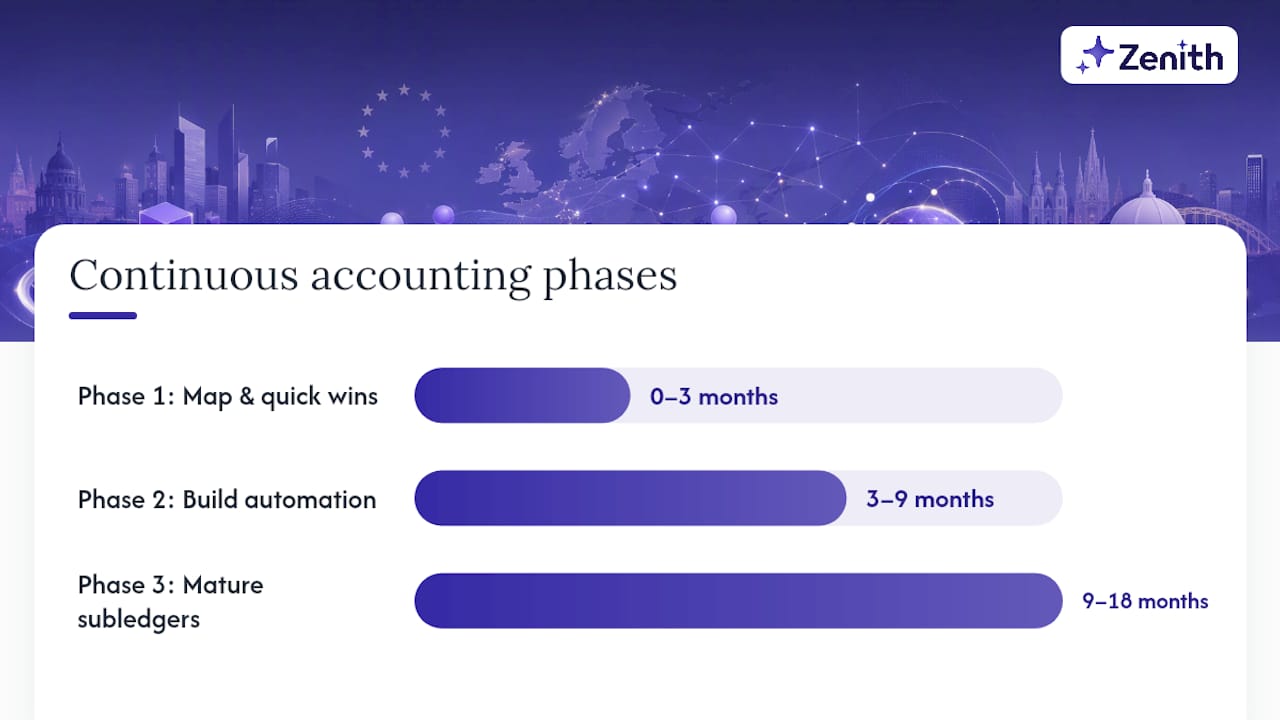
Nobody moves from a five-day scramble to a continuous close in one sprint. Treat it as three phases, each building on the last.
Phase 1 (months 0 to 3): map and pick quick wins.
- Document the current close calendar task by task, noting which tasks are manual, which are automated, and how long each takes.
- Automate bank reconciliation first. It’s usually the highest-volume, most repetitive task, and it’s the one where automating your bookkeeping pays off fastest.
- Set up recurring accruals as templated, scheduled entries rather than manual journal lines re-entered each month.
- Assign named owners to each task category, with a clear escalation path for anything unresolved after 48 hours.
Phase 2 (months 3 to 9): build the automation layer.
- Introduce invoice OCR so line-item data extracts automatically instead of being keyed in by hand.
- Set up continuous transaction matching rules so the system flags exceptions daily rather than at month-end.
- Build monitoring dashboards that surface anomalies (unusual variances, duplicate charges) as they happen.
- Formalise exception-handling SLAs, so nothing sits unresolved for more than a few working days.
Phase 3 (months 9 to 18): mature the subledgers and lock in the culture.
- Push subledger data quality to the point where reconciliation exceptions become rare rather than routine.
- Set formal continuous close targets, for example 70% of tasks complete five business days before month end.
- Review the whole process quarterly, because integrations drift and new transaction types appear as the business grows.
Common early quick wins worth prioritising, based on what practitioner guides consistently flag: bank reconciliations, invoice capture and matching, recurring accruals, and anomaly monitoring. Start with whichever of those carries your highest transaction volume, because that’s where daily automation saves the most hours per month.
What technology and data do you need for continuous accounting?
Continuous accounting lives or dies on data quality and integration reliability, not on how sophisticated your reconciliation software looks in a demo. A Fynapse analysis of the modern month-end close makes this point plainly: predictable, well-governed data flows matter more than chasing perfect accuracy on day one.
The practical requirements break down into four areas:
- Direct bank integrations. A read-only open banking or PSD2 connection gives you a live, predictable transaction feed instead of manually downloaded CSVs that arrive whenever someone remembers to export them.
- A reconciliation engine with rule automation. Matching logic needs to run daily against incoming transactions, not weekly against a batch.
- Invoice capture with OCR and duplicate detection. Manually keying in invoice data is exactly the kind of repetitive task continuous accounting is meant to eliminate.
- Multi-currency reconciliation and governance controls. If you operate across borders, your matching engine needs to handle FX variance without creating false exceptions.
Pro Tip: Before buying anything, audit how many of your current bank feeds are manual exports versus live API or open banking connections. That single number predicts more about your continuous accounting readiness than any feature list.
Zenith’s bank sync product is one example of this kind of connection: a read-only PSD2 link covering 2,400+ banks across 30 European countries, with data delivered to Google Sheets, Claude via MCP, a REST API, or CSV. Details on how the connections work are documented at Zenith’s developer docs.
What challenges and trade-offs come with continuous accounting?
Legacy ERP systems are the most common blocker. Many weren’t built for daily automated feeds, so teams end up building fragile middleware or relying on manual exports that undermine the whole point of the exercise.
Cross-team dependencies bite hard too. Continuous accounting assumes sales, operations, and banking data arrive cleanly and on schedule, but a delayed invoice from procurement or a mis-coded sale from the CRM breaks the daily matching cycle just as effectively as it breaks a monthly one.
- Integration gaps between legacy systems and modern reconciliation tools often need custom connectors or phased data migration.
- Cross-functional dependencies (sales, ops, banking) require agreed data standards, not just better software.
- Speed and accuracy pull against each other early on: pushing for daily automation before data quality is solid just creates daily exceptions instead of monthly ones.
The sensible mitigation is phasing. Automate the highest-confidence, highest-volume tasks first (bank reconciliation is usually safest), and hold off on riskier automation until the data feeding it is genuinely reliable.
How does Zenith support a continuous accounting workflow?
Zenith’s feature set maps directly onto the operational components a continuous close needs: AI and OCR-based invoice capture with line-item detail, automatic duplicate invoice detection, open banking bank sync, bank reconciliation and transaction matching, and automated exports to your accounting software.
The bank sync facts, specifically: a service covering banks in many European countries, priced per account with a quick setup, with detailed documentation available.
- Invoice capture from email inboxes and Google Drive removes manual data entry at the source.
- Duplicate detection catches double payments before they leave the account, not after.
- Bank reconciliation runs against live feeds rather than monthly exports.
- Exports feed straight into your accounting software, closing the loop without a manual re-key.
Full technical detail sits at Zenith’s documentation.
How does continuous accounting affect compliance and audits?
Continuous accounting changes the audit conversation from a retrospective investigation into an ongoing verification exercise. When reconciliations happen daily and exceptions get logged as they occur, auditors get a running trail of evidence rather than a pile of month-end adjustments to unpick after the fact.

This matters most for what auditors actually spend time on: sampling and testing controls. A traditional close often forces auditors to test a handful of transactions and extrapolate, because the underlying trail is thin. A continuous close with automated, timestamped matching gives them a far larger, more granular sample to work from, which can shorten fieldwork and reduce the back-and-forth over unsupported adjustments.
It also changes where compliance risk sits. Errors caught and corrected within 48 hours rarely become material misstatements. Errors that sit undiscovered for five weeks, which is the traditional close’s default state, are far more likely to compound into something an auditor flags formally. Continuous audit practices, where auditors sample transactions throughout the year rather than only at year-end, become genuinely practical once the underlying data is already structured for daily review.
None of this removes the need for proper segregation of duties or approval controls. If anything, automation raises the stakes on governance: a matching rule with a logic error can propagate incorrect postings daily instead of once a month, so the exception-handling SLA discussed earlier isn’t optional if you care about audit readiness.
What have I learned from watching continuous accounting adoption succeed and fail?
Three lessons stand out. First, the teams that succeed automate bank reconciliation before anything else, because it’s the highest-volume, lowest-risk starting point. Second, culture beats software: a brilliant matching engine sitting on top of a team still working to a monthly rhythm changes nothing. Third, measure early. Track pre-month-end completion percentage from week one, even before you’ve automated much, so you can see whether changes are actually working.
A one-month starting checklist: map your close calendar, automate bank reconciliation, assign task owners, and set a 48-hour exception SLA. Measure your baseline before you touch anything else.
— Gašper Anderle
Ready to move your close from monthly to daily?
If you’ve read this far, you already know the bottleneck isn’t ambition, it’s manual bank data and invoice entry eating the first week of every month. Zenith is built to close that specific gap: a read-only PSD2 connection across 2,400+ banks in 30 European countries, set up in about five minutes, delivering live transaction data to Google Sheets, Claude, a REST API, or CSV for €5 per account per month.
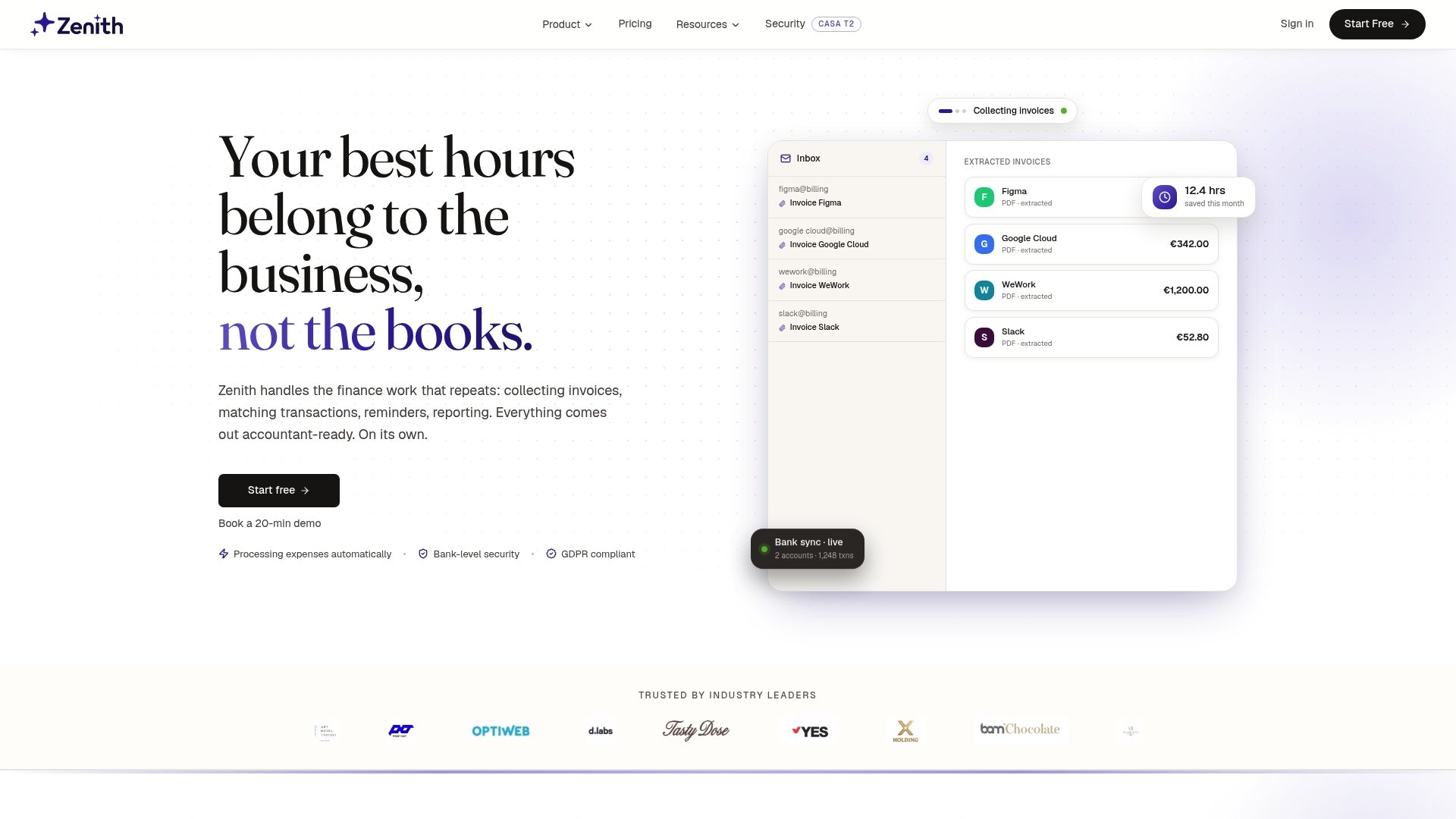
Pair that with AI-powered invoice capture from email and Google Drive, automatic duplicate detection, and bank reconciliation that runs against live feeds rather than monthly exports, and most of the Phase 1 and Phase 2 work described above is available out of the box. You can see live account balances consolidated in one place through Zenith’s cash balances tool, sync bank data straight into a spreadsheet with bank to Google Sheets, and route invoices automatically with invoices to Drive. For teams still weighing up invoice tooling more broadly, it’s worth comparing notes with resources like QuoteLock’s invoicing software guide for the AP side of the equation.
Every plan carries a 30-day money-back guarantee, so start the bank sync setup today and measure your own pre-month-end completion rate a month from now.