


Transaction matching automation compares transactions across two or more data sources, automatically clears the ones that agree, and hands you only the exceptions that need a human eye. The immediate payoff is time: reconciliation staff stop checking rows that already match and start working the handful that genuinely don’t. The best systems now blend fixed rules with AI so they catch not just exact matches, but the messy, close-enough ones too.
TL;DR:
- Automated transaction matching effectively handles high-volume, variable transactions such as intercompany, card settlements, and e-commerce, especially when data originates from multiple sources.
- A combination of deterministic rules and AI-based fuzzy matching improves accuracy for messy cases, but data cleanliness and real-time connectivity are critical to success.
- The best deployment pilots high-volume, structurally consistent accounts, with clear tolerance settings and ownership of exceptions for faster ROI.
- The actual measure of success is the volume and nature of exceptions remaining after auto-matching, not the overall auto-match rate.
- Integration quality, configurable rules, AI learning, and audit trails are more important to long-term effectiveness than AI features alone.
Table of Contents
- Where finance teams actually use transaction matching automation
- How does automated transaction matching actually work?
- What features actually matter when choosing matching transactions software
- How to implement transaction matching automation without a mess
- What match rate should you actually expect?
- Real deployments: what Zenith-books clients see in practice
- When automation pays off fast, and when it doesn’t
- Start a transaction matching pilot with Zenith-books
- Sources
Where finance teams actually use transaction matching automation
Most teams don’t buy this technology in the abstract. They buy it because one specific reconciliation is eating a disproportionate amount of month-end time, and it’s usually one of these:
- GL-to-bank reconciliation, run continuously rather than as a monthly scramble
- AP invoice to payment matching, including cash application against partial or split payments
- Intercompany reconciliation and treasury matching, where the same transaction appears differently in two ledgers
- Card processor and PSP settlement, where a single batch payout represents dozens or hundreds of underlying sales
- High-volume e-commerce and marketplace settlements, where fees, refunds and currency conversion all sit inside one net figure
The common thread is volume combined with variation. A business with 50 clean, predictable transactions a month doesn’t need this; a business with thousands of transactions arriving through five different channels, each with its own reference format, does. Transaction matching automates reconciliation and cuts close cycle time, but only once the underlying data is clean enough to compare. Card and PSP settlements tend to be the hardest of the group, because one bank line can map to a hundred sales records, and that’s precisely where rules-only tools start to struggle.
How does automated transaction matching actually work?
Underneath the interface, every matching engine follows roughly the same sequence, whether it’s reconciling bank feeds or intercompany ledgers.
- Ingest and normalise. Data arrives from ERPs, banks and payment processors either through live API feeds or batch file imports, then gets standardised into a common format for comparison.
- Run deterministic matching first. Exact matches on amount, date and reference clear automatically. This handles the majority of straightforward transactions with no ambiguity involved.
- Apply probabilistic or AI-based matching to what’s left. AI reconciliation pairs deterministic rules with probabilistic matching and exception-routing agents to catch transactions that are close but not identical, a rounding difference, a truncated reference, a split payment.
- Handle many-to-many relationships. One invoice paid across three instalments, or one bank deposit covering ten separate sales, needs group matching logic rather than simple one-to-one comparison. Fuzzy matching and pattern parsing via regex are what make many-to-many settlement matching workable at volume.
- Score confidence and route exceptions. Anything below a set confidence threshold gets flagged with a suggested fix and pushed into a review workflow, rather than silently misfiled.
Pro Tip: Before trusting a vendor’s match-rate claims, ask how their engine anchors and sorts incoming data. Oracle’s own documentation on matching engine behaviour shows that processing order genuinely changes which candidates get considered for a match. Get the anchor system wrong and you’ll see false negatives that have nothing to do with the transactions themselves.
What features actually matter when choosing matching transactions software
Vendor demos tend to show the happy path. The features below are the ones that determine whether the tool still works on your messiest account six months in.
- ERP and bank connectivity, and how fresh the data really is. Real-time API feeds behave very differently to overnight batch files, especially for card settlement timing.
- A rules engine you can edit yourself. If changing a matching rule means filing an IT ticket, the tool will lag behind your business within a quarter.
- AI confidence scoring with a visible learning loop. You want to see why the model flagged something, and evidence that it improves as your team corrects it.
- Exception management with SLAs and assignment. Exceptions need an owner and a deadline, not just a queue.
- A genuine audit trail. Every automatic match and every manual override should be logged, timestamped and reviewable.
- Scalability and compliance controls that hold up as transaction volume climbs, not just at pilot scale.
Clean integration with your existing bookkeeping stack tends to matter more than any single AI feature, because a brilliant matching engine fed bad data still produces bad matches.
How to implement transaction matching automation without a mess
- Pick your pilot account carefully. Choose a high-volume, structurally consistent account, like a single bank feed or one major customer’s AP flow, so you can prove value in weeks, not quarters.
- Fix your data hygiene first. Standardise reference formats, map fields consistently across systems, and settle how you’ll handle currency conversion and timestamp mismatches before go-live.
- Set tolerances and business calendars explicitly. Decide upfront how much variance is acceptable on amount and date, and account for weekends, bank holidays and settlement lag.
- Feed the AI labelled exceptions. Every time a human resolves a flagged item, that resolution should train the model. Review for drift periodically rather than assuming it stays accurate forever.
- Assign ownership and logging from day one. Someone needs to own exception SLAs and escalation paths, and every override needs an audit entry.
Multi-currency accounts are usually where pilots stumble, so it’s worth reading a dedicated playbook on multi-currency reconciliation before you set tolerances on anything crossing borders.
What match rate should you actually expect?
Rules-only systems typically clear a solid majority of straightforward, well-structured transactions automatically. Adding AI-based probabilistic matching lifts that further by catching the near-matches that pure rules reject outright. Gartner found notable adoption of AI-based anomaly detection in finance in 2025, and that share is climbing as agentic tools that propose fixes rather than just flag problems become standard.
The number that actually matters isn’t the auto-match rate. It’s what’s inside the exceptions left over. In most well-configured deployments, the large majority of flagged items turn out to be timing or formatting differences rather than genuine accounting errors. Track auto-match rate alongside exception ageing, mean time to resolve, and month-end close reduction, and you’ll get a far more honest picture than the headline percentage alone.
Real deployments: what Zenith-books clients see in practice
Zenith-books builds its matching engine around the same principle: automate what’s certain, route what isn’t, and log everything. The platform captures invoices from email, matches transactions against bank feeds automatically, and files everything with zero manual entry.
Client outcomes back this up directly:
- Združenje YES reports substantial time savings on month-end tasks that previously required manual line-by-line checking.
- BAM Chocolate achieved zero manual data entry across its transaction workflow after automation.
- Both cases point to shorter month-end close times as the practical, measurable result of automated matching.
If you’re running a pilot yourself, build your acceptance criteria around the same metrics: auto-match rate, exception volume, and time to close, not just whether the software “works.”
When automation pays off fast, and when it doesn’t
Quick ROI is realistic when your accounts are already structurally consistent, a single bank feed, a predictable AP flow, where a plug-in connector clears most transactions within weeks. Messy, multi-entity operations with inconsistent references need a longer runway and real investment in the AI layer before it earns its keep. Either way, governance shouldn’t be an afterthought bolted on once volume grows. Build the audit trail and exception ownership into the pilot from day one, because retrofitting compliance controls onto an automation system that’s already processing thousands of transactions monthly is far harder than designing them in from the start.
— Gašper
Start a transaction matching pilot with Zenith-books
Zenith-books gives finance teams the practical advantage this article has been building towards: automatic extraction, matching and categorisation with zero manual entry, not a rules engine you have to babysit. It maps directly onto the checklist above, ERP and bank connectivity, configurable rules, AI confidence scoring, and a full audit trail, without needing a specialist implementation team to configure it.
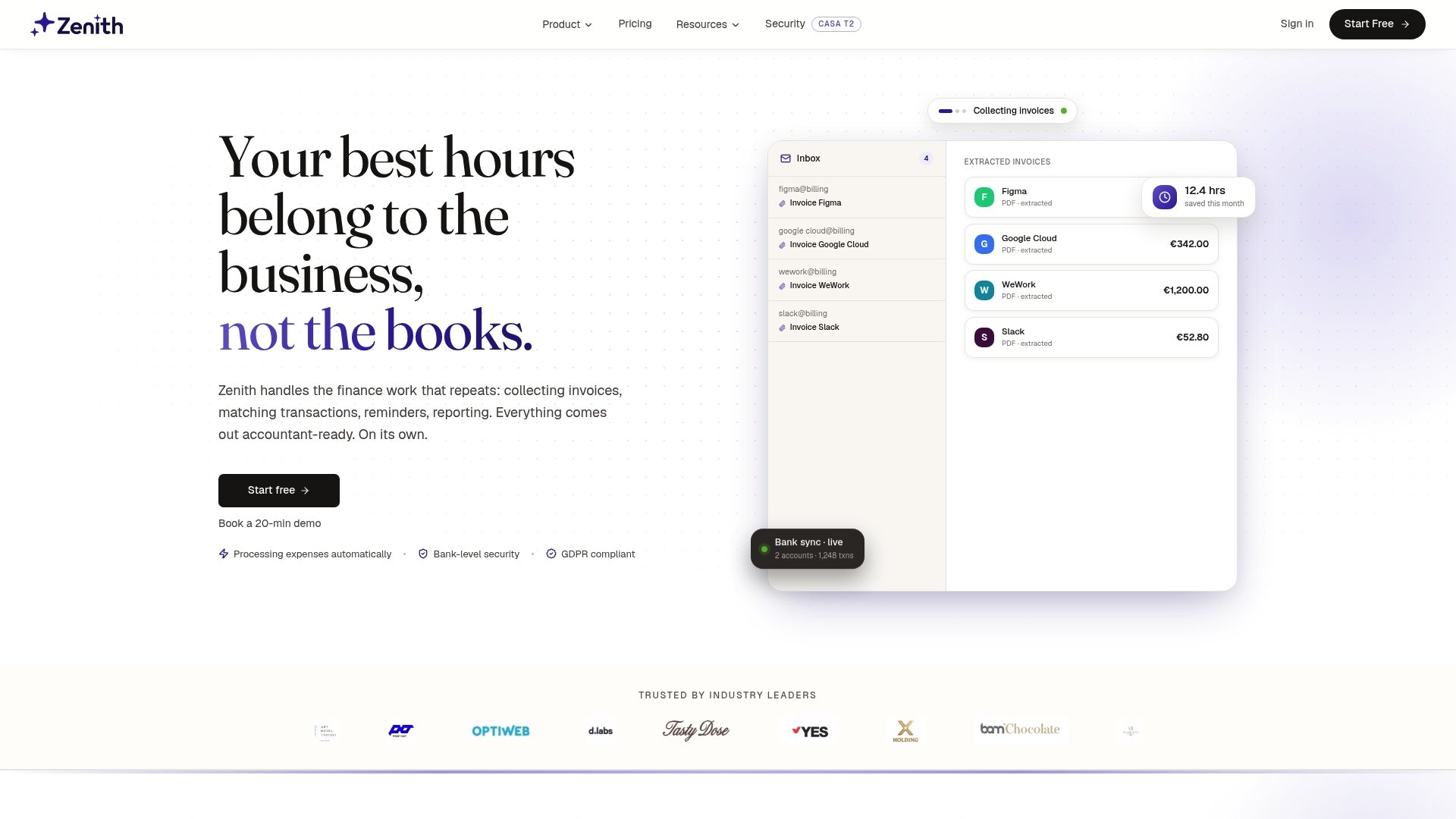
Invoices arriving by email get captured and filed automatically to Google Drive, while bank data syncs in real time so matching happens continuously rather than in a month-end rush. Pricing runs on tiered subscriptions with a pay-as-you-go option based on usage, invoice volume, number of bank accounts, so you can start small and scale as your reconciliation volume grows. If you’re weighing up whether automation is worth the switch, the practical next step is to see it against your own bank feed. Visit the Zenith-books solutions page to start a pilot on one account and measure the exception rate yourself.
Sources
- Gartner survey shows finance AI adoption remains steady in 2025
- AI‑Powered Financial Reconciliation: Complete Guide | NAYA